Magnitude 5.9 earthquake jolts northern Pakistan with no reports of casualties

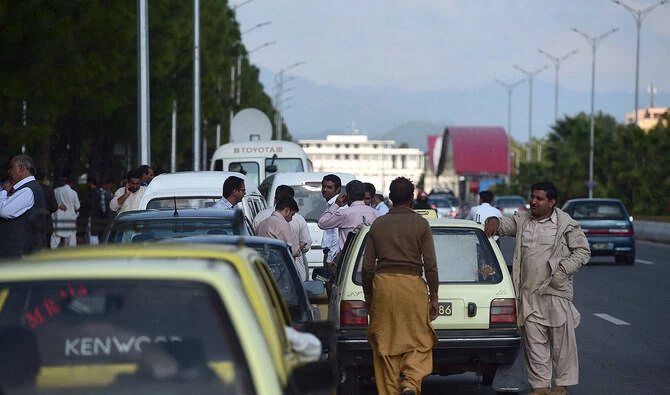
In this file photo taken on October 26, 2015, people gather outside the buildings after earthquake tremors felt in Islamabad. (AFP/File)
Short Url
Updated 19 April 2025
Follow

Magnitude 5.9 earthquake jolts northern Pakistan with no reports of casualties

  • Pakistan’s seismic monitoring center says quake’s epicenter was Afghanistan-Tajikistan border region
  • Tremors felt in Islamabad, Rawalpindi, Lahore, Abbottabad and Khyber Pakhtunkhwa’s various cities

ISLAMABAD: A magnitude 5.9 earthquake jolted several cities in northern Pakistan on Saturday morning, state-run media reported, with no reported casualties or damages. 
As per the National Seismic Monitoring Center, the earthquake’s epicenter was the border region between Afghanistan and Tajikistan and was measured at a depth of 94 kilometers. 
“The National Seismic Monitoring Center reported that the earthquake’s tremors were felt in numerous cities at 11:48 a.m. including Islamabad, Rawalpindi, Lahore, Sheikhupura, Abbottabad, Attock, Haripur, Mansehra, Peshawar, Nowshera, Mardan, Haripur, Swat, Chitral, Shangla, Malakand, Muzaffarabad and several other cities,” state-run Associated Press of Pakistan (APP) said. 
As per the APP, alarmed citizens ran out of their homes and started reciting verses from the Qur’an after feeling the tremors. 
“No loss of life and property was reported from any part of the country so far,” it added. 
Pakistan sits on the boundary of the Indian and Eurasian tectonic plates and is prone to seismic activity.
The country’s northern and western regions are home to mountain ranges such as the Himalayas, Hindu Kush and Karakoram.
Among the most devastating earthquakes in Pakistan’s history was the 2005 Kashmir quake, which measured 7.6 in magnitude and killed more than 86,000 people.
In 2013, a 7.7-magnitude earthquake struck southwestern Balochistan, killing over 800 people and flattening entire villages.

Pakistan’s OGDC ramps up unconventional gas plans

Updated 05 December 2025
Follow

Pakistan’s OGDC ramps up unconventional gas plans

  • Pakistan has long been viewed as having potential in tight and shale gas but commercial output has yet to be proved
  • OGDC says has tripled tight-gas study area to 4,500 square km after new seismic, reservoir analysis indicates potential

ISLAMABAD: Pakistan’s state-run Oil & Gas Development Company is planning a major expansion of unconventional gas developments from early next year, aiming to boost production and reduce reliance on imported liquefied natural gas.

Pakistan has long been viewed as having potential in both tight and shale gas, which are trapped in rock and can only be released with specialized drilling, but commercial output has yet to be proved.

Managing Director Ahmed Lak told Reuters that OGDC had tripled its tight-gas study area to 4,500 square kilometers (1,737 square miles) after new seismic and reservoir analysis indicated larger potential. Phase two of a technical evaluation will finish by end-January, followed by full development plans.

The renewed push comes after US President Donald Trump said Pakistan held “massive” oil reserves in July, a statement analysts said lacked credible geological evidence, but which prompted Islamabad to underscore that it is pursuing its own efforts to unlock unconventional resources.

“We started with 85 wells, but the footprint has expanded massively,” Lak said, adding that OGDC’s next five-year plan would look “drastically different.”

Early results point to a “significant” resource across parts of Sindh and Balochistan, where multiple reservoirs show tight-gas characteristics, he said.

SHALE PILOT RAMPS UP

OGDC is also fast-tracking its shale program, shifting from a single test well to a five- to six-well plan in 2026–27, with expected flows of 3–4 million standard cubic feet per day (mmcfd) per well.

If successful, the development could scale to hundreds or even more than 1,000 wells, Lak said.

He said shale alone could eventually add 600 mmcfd to 1 billion standard cubic feet per day of incremental supply, though partners would be needed if the pilot proves viable.

The company is open to partners “on a reciprocal basis,” potentially exchanging acreage abroad for participation in Pakistan, he said.

A 2015 US Energy Information Administration study estimated Pakistan had 9.1 billion barrels of technically recoverable shale oil, the largest such resource outside China and the United States.

A 2022 assessment found parts of the Indus Basin geologically comparable to North American shale plays, though analysts say commercial viability still hinges on better geomechanical data, expanded fracking capacity and water availability.

OGDC plans to begin drilling a deep-water offshore well in the Indus Basin, known as the Deepal prospect, in the fourth quarter of 2026, Lak said. In October, Turkiye’s TPAO with PPL and its consortium partners, including OGDC, were awarded a block for offshore exploration.

A combination of weak gas demand, rising solar uptake and a rigid LNG import schedule has created a surplus of gas that forced OGDC to curb output and pushed Pakistan to divert cargoes from Italy’s ENI and seek revised terms with Qatar.