Colombo: A gunman fired at a church in Sri Lanka, police said Saturday, with the country on high alert six years since Easter Sunday bombings killed hundreds.
The gunman opened fire Friday at a church in Manampitiya, 160 kilometers (100 miles) northeast of the capital Colombo, a police statement said.
The shooting damaged windows and no one was hurt, while a suspect has been arrested, police said.
“Initial investigations suggest that the suspect had targeted the church due to a personal enmity with the pastor,” the statement said.
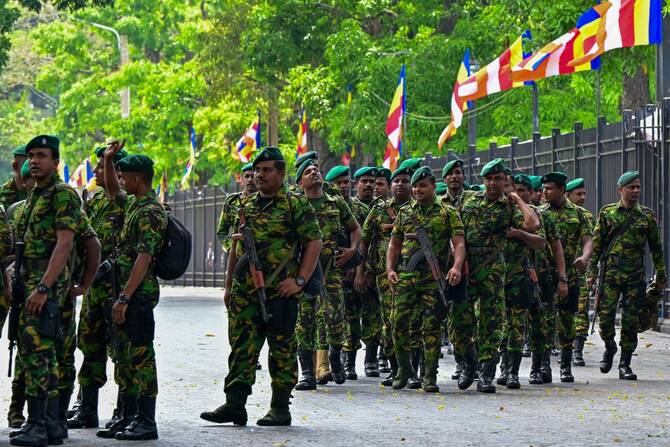
Armed police and troops have been deployed to nearly all churches nationwide during Easter celebrations, with security heightened following the 2019 attack.
Suicide bombers in 2019 killed 279 people, including 45 foreigners, at three churches and three hotels.
More than 500 people were wounded in the attack, which officials blamed on a home-grown Islamist group.
The Catholic Church will commemorate the victims on Monday, by declaring them “Heroes of the Faith.”
Sri Lanka’s Catholic minority has maintained a campaign for justice since the bombings, saying that prior investigations failed to answer outstanding questions.
The Church has accused successive governments of protecting those behind the attack and several high-level investigations have identified links between military intelligence units and the bombers.

Gunman fires at Sri Lanka church ahead of Easter bombings anniversary
Short Url
https://arab.news/zuhtq
Gunman fires at Sri Lanka church ahead of Easter bombings anniversary
- The shooting damaged windows and no one was hurt and a suspect has been arrested
Japan restarts world’s biggest nuclear plant again
TOKYO: Japan switched on the world’s biggest nuclear power plant again on Monday, its operator said, after an earlier attempt was quickly suspended due to a minor glitch.
The Kashiwazaki-Kariwa plant in the Niigata region restarted at 2:00 p.m. (0500 GMT), the Tokyo Electric Power Company (TEPCO) said in a statement.
A glitch with an alarm in January forced the suspension of its first restart since the 2011 Fukushima disaster.
The facility had been offline since Japan pulled the plug on nuclear power after a colossal earthquake and tsunami sent three reactors at the Fukushima atomic plant into meltdown.
But now Japan is turning to atomic energy to reduce its reliance on fossil fuels, achieve carbon neutrality by 2050 and meet growing energy needs from artificial intelligence.
Conservative Prime Minister Sanae Takaichi, who pulled off a thumping election victory on Sunday, has promoted nuclear power to energise the Asian economic giant.
TEPCO initially moved to start one of seven reactors at the Kashiwazaki-Kariwa plant on January 21 but shut it off the following day after an alarm from the monitoring system sounded.
The alarm had picked up slight changes to the electrical current in one cable even though these were still within a range considered safe, TEPCO officials told a press conference last week.
The firm has changed the alarm’s settings as the reactor is safe to operate.
The commercial operation will commence on or after March 18 after another comprehensive inspection, according to TEPCO officials.
The Kashiwazaki-Kariwa plant in the Niigata region restarted at 2:00 p.m. (0500 GMT), the Tokyo Electric Power Company (TEPCO) said in a statement.
A glitch with an alarm in January forced the suspension of its first restart since the 2011 Fukushima disaster.
The facility had been offline since Japan pulled the plug on nuclear power after a colossal earthquake and tsunami sent three reactors at the Fukushima atomic plant into meltdown.
But now Japan is turning to atomic energy to reduce its reliance on fossil fuels, achieve carbon neutrality by 2050 and meet growing energy needs from artificial intelligence.
Conservative Prime Minister Sanae Takaichi, who pulled off a thumping election victory on Sunday, has promoted nuclear power to energise the Asian economic giant.
TEPCO initially moved to start one of seven reactors at the Kashiwazaki-Kariwa plant on January 21 but shut it off the following day after an alarm from the monitoring system sounded.
The alarm had picked up slight changes to the electrical current in one cable even though these were still within a range considered safe, TEPCO officials told a press conference last week.
The firm has changed the alarm’s settings as the reactor is safe to operate.
The commercial operation will commence on or after March 18 after another comprehensive inspection, according to TEPCO officials.
© 2026 SAUDI RESEARCH & PUBLISHING COMPANY, All Rights Reserved And subject to Terms of Use Agreement.