Lawsuit challenges Trump administration crackdown on international students

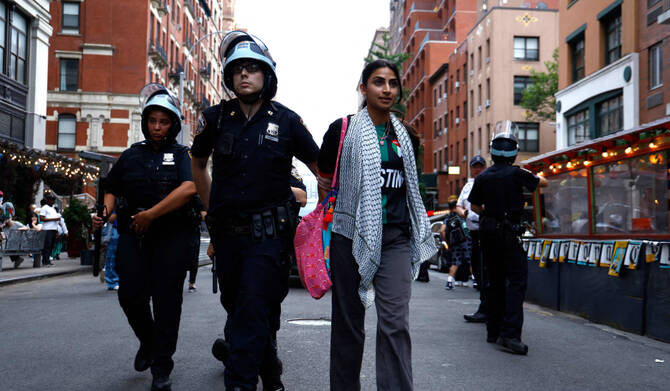
Police detain a pro-Palestine demonstrator during a protest march in New York City on July 18, 2024. (AFP)
Short Url
Updated 19 April 2025
Follow

Lawsuit challenges Trump administration crackdown on international students

  • About 1,100 students at more than 170 colleges, universities and university systems have been affected since late March, according to an Associated Press review of university statements, correspondence with school officials and court records

WASHINGTON: A class action lawsuit filed Friday asks a federal court to reinstate the legal status of international students caught up in a Trump administration crackdown that has left more than a thousand fearful of deportation.
The suit filed by several American Civil Liberties Union affiliates seeks to represent more than 100 students in New England and Puerto Rico.
“International students are a vital community in our state’s universities, and no administration should be allowed to circumvent the law to unilaterally strip students of status, disrupt their studies, and put them at risk of deportation,” said Gilles Bissonnette, legal director of the ACLU of New Hampshire.
At schools around the country, students have seen their visas revoked or their legal status terminated, typically with little notice.
About 1,100 students at more than 170 colleges, universities and university systems have been affected since late March, according to an Associated Press review of university statements, correspondence with school officials and court records. The AP is working to confirm reports of hundreds more students affected.
Students have filed other lawsuits arguing they were denied due process. Federal judges have granted temporary restraining orders in New Hampshire, Wisconsin and Montana, shielding students from efforts to remove them from the US.
Plaintiffs in the new lawsuit, filed in federal court in New Hampshire, learned without warning their F-1 student statuses had been terminated, leaving in doubt their ability to stay in the country and finish their studies, according to the complaint.
One of them, Manikanta Pasula of India, was on the brink of getting his master’s in computer science at Rivier University in New Hampshire and applying to remain in the country through a work program for international students. Hangrui Zhang of China had come to the US for a Ph.D. program in electronic and computer science at Worcester Polytechnic Institute in Massachusetts. Now, he cannot work as a research assistant, which was his only source of income, the complaint said.
The government did not give notice it is required to provide before terminating a foreign student’s legal status, the lawyers said.
The Department of Homeland Security did not immediately respond to a message seeking comment.
Last month, Secretary of State Marco Rubio said the State Department was revoking visas held by visitors who were acting counter to national interests, including some who protested Israel’s war in Gaza and those who face criminal charges.
In some high-profile cases, such as that involving Columbia University activist Mahmoud Khalil, the Trump administration has cited involvement in pro-Palestinian activism as a rationale for deportation.
But colleges say most students affected by visa revocations played no role in those protests. Many are being singled out over minor infractions such as traffic violations that occurred long ago, and in some cases the reason is unclear, colleges say.


UN experts concerned by treatment of Palestine Action-linked hunger strikers

Updated 26 December 2025
Follow

UN experts concerned by treatment of Palestine Action-linked hunger strikers

  • Eight prisoners awaiting trial for alleged offences connected to the group have taken part in the protest

LONDON: UN human rights experts have raised concerns about the treatment of prisoners linked to Palestine Action who have been on hunger strike while on remand, warning it may breach the UK’s international human rights obligations.

Eight prisoners awaiting trial for alleged offences connected to the group have taken part in the protest, reported The Guardian on Friday.

Among them are Qesser Zuhrah and Amu Gib, who were on hunger strike at HMP Bronzefield from Nov. 2 to Dec. 23, and Heba Muraisi, held at HMP New Hall. Others include Teuta Hoxha, Kamran Ahmed and Lewie Chiaramello, who has refused food on alternate days due to diabetes.

Zuhrah and Gib temporarily resumed eating this week because of deteriorating health but said they plan to resume the hunger strike next year, according to Prisoners for Palestine.

In a statement issued on Friday, UN special rapporteurs, including Gina Romero and Francesca Albanese, said the handling of the prisoners was alarming.

“Hunger strike is often a measure of last resort by people who believe that their rights to protest and effective remedy have been exhausted. The state’s duty of care toward hunger strikers is heightened, not diminished,” they said.

Three of the prisoners were in hospital at the same time on Sunday, with Ahmed admitted on three occasions since the hunger strike began.

The experts said: “Authorities must ensure timely access to emergency and hospital care when clinically indicated, refrain from actions that may amount to pressure or retaliation, and respect medical ethics.”

Prisoners for Palestine has alleged that prison staff initially denied ambulance access for Zuhrah during a medical emergency last week, with hospital treatment only provided after protesters gathered outside the prison.

“These reports raise serious questions about compliance with international human rights law and standards, including obligations to protect life and prevent cruel, inhuman or degrading treatment,” the experts said, adding: “Preventable deaths in custody are never acceptable. The state bears full responsibility for the lives and wellbeing of those it detains. Urgent action is required now.”

Families and supporters have called for a meeting with Justice Secretary David Lammy, while lawyers claim the Ministry of Justice has failed to follow its own policy on handling hunger strikes.

Government officials are understood to be concerned about the prisoners’ condition but cautious about setting a wider precedent.