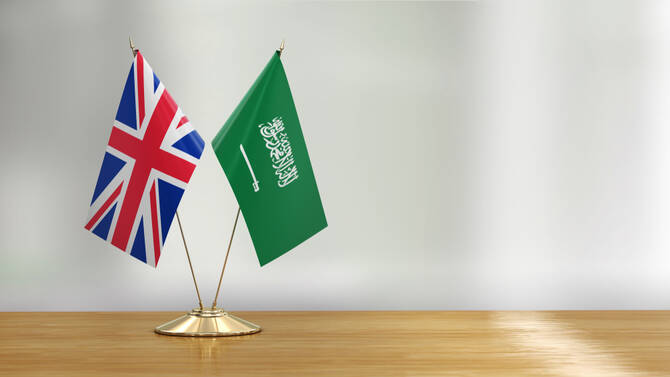

RIYADH: The strong investment growth in Saudi Arabia’s economy has led 50 British companies to set up regional headquarters, joining over 1,300 UK firms already operating in the Kingdom, said a senior UK trade official.
The UK is positioning itself as a long-term partner in the Kingdom’s economic transformation, with bilateral trade already surpassing £17 billion ($22.55 billion) and expected to grow further in line with Vision 2030.
“The UK and the Kingdom of Saudi Arabia have enjoyed a warm and deep trading relationship for a long time,” said Peter Ashby, deputy UK trade commissioner for the Middle East, in an interview with Al-Eqtisadiah.

Peter Ashby, deputy trade commissioner for the Middle East and director of trade and investment for Saudi Arabia, based in the British Embassy in Riyadh. Photo/Al-Eqtisadiah
“So, we are starting from strong foundation and a place of friendship and mutual respect,” added Ashby, who is also the director of trade and investment at the British Embassy in Riyadh.
Both governments, he said, “are working extremely hard to strengthen our trading relationships and to create quality jobs in new sectors under Vision 2030 and the UK’s upcoming Industrial Strategy.”
Ashby said the UK-Saudi Strategic Partnership Council — led by Saudi Commerce Mnister Majid bin Abdullah Al-Kassabi and UK Secretary of State for Business and Trade Jonathan Reynolds — has been central to advancing bilateral initiatives across economic and social pillars.
‘Great Futures’ initiative
A flagship effort under that framework is the ‘Great Futures’ campaign, which Ashby described as a “joint initiative to promote trade, tourism, innovation and cultural partnerships.” It has supported deals in priority sectors such as critical minerals and AI-enabled technology.
“The campaign continues, with GREAT FUTURES supporting business engagement in the UK and Saudi Arabia, including bespoke events such as the UK-Saudi Skills Forum at the upcoming HCI (Human Capability Initiative) and EDGEx Education Global Exhibition,” Ashby said.
The campaign’s impact was tangible from the outset. “The event delivered more than 50 agreements across priority sectors and was the catalyst for the partnerships worth over £7.7bn and delivering 4000 jobs in both Kingdoms, announced during the UK Prime Minister’s visit in December last year,” he said.
One of those deals involved hydrogen-focused UK firm HYCAP, which partnered with Saudi companies “to invest over £750 million in hydrogen mobility infrastructure solutions between both our countries, securing over 1000 jobs across Northern Ireland and the rest of the UK.”
Vision 2030 alignment
Ashby pointed out that the UK is “strategically aligning its expertise with Saudi Arabia's Vision 2030 priorities, particularly focusing on supporting the Kingdom's transition into non-oil sectors.”
The UK is concentrating on industries where it already leads globally — “including energy, financial services, clean technology, advanced manufacturing, digital innovation, healthcare, biotech, creative industries, and defence.”
Recent milestones include the announcement of a UK-Saudi Sustainable Infrastructure Assembly, aimed at enhancing collaboration between UK financial and professional services and Vision 2030’s sustainable infrastructure projects.
He also cited the example of UK-based Phytome Life Sciences, which launched “a UK-Saudi innovation-investment bridge with the Research, Development and Innovation Authority (RDIA), to accelerate research, development and investment in medicines, materials and agricultural solutions.”
Academic collaboration is another key focus. “Our UK universities have already been working in this space, with one notable example being the partnership in AI for precision medicines between the University of Oxford and King Abdulaziz University, and we hope to see more partnerships thrive,” he added.
“With more than 1300 UK firms operating in Saudi Arabia and more than 50 UK companies establishing regional headquarters in the Kingdom,” Ashby said, “the export of UK skills and expertise to the country puts the UK in a strong position to support the transformation that is taking place through Vision 2030.”
Supporting giga-projects
UK firms are also playing a growing role in the Kingdom’s giga-projects, including NEOM and the Red Sea Project. “UK firms are making substantial contributions to Saudi Arabia's giga-projects, bringing world-leading expertise in innovation, sustainability, and technical excellence,” he said.
He cited Graphene Innovations, a Manchester-based firm that “recently announced the world’s first commercial production plant for graphene-enriched carbon fibre with NEOM.” The facility is expected to “generate £250 million of investment into a research and innovation hub in Greater Manchester and is expected to create more than 1,000 skilled jobs in the region.”
On the Saudi side, the project is expected to “contribute over 4,500 skilled jobs to Saudi Arabia’s economy by 2030, generating revenues exceeding $1.6 billion.”
Ashby said these partnerships showcase “the UK's strengths in clean technology, advanced materials, and sustainable infrastructure — all critical components of Saudi Arabia's ambitious giga-projects as they move from strategy into delivery phase.”
Clean energy, smart Infrastructure and capital markets
Clean energy partnerships between the UK and Saudi Arabia are valued at £7.7 billion and are “set to create over 4000 UK jobs,” Ashby noted.
Among them is Carbon Clean’s work with Aramco on modular carbon capture, and Next Generation SCM’s deal with City Cement Co. to produce 2.5 million tonnes of sustainable cement and concrete materials annually.
On financial services, Ashby emphasized the UK’s global role: “All Saudi Arabian bond and sukuk issuances have been made through The London Stock Exchange (LSE), with $41.8 billion in capital raised in 2024 alone. This demonstrates the deep trust Saudi institutions place in UK financial markets.”
By leveraging this expertise, UK firms are “supporting the development of more sophisticated capital markets, and facilitating Saudi companies' access to global investment.”
UK-GCC FTA
Looking ahead, Ashby underscored the strategic significance of a UK-Gulf Cooperation Council Free Trade Agreement. “This could grow trade between the UK and the GCC by 16 percent, adding an extra £8.6 billion a year to trade. Of course, this would further help to grow the UK-Saudi trade relationship.”
He acknowledged that one of the main challenges isn’t regulation, but perception. “In fact, many UK companies are surprised by how straightforward it is to do business in Saudi Arabia — so I would say that making sure that business leaders fully understand the market is probably the biggest challenge,” he said.
“Many business leaders talk of understanding the Gulf, but the countries within the region are very different. Saudi Arabia is a unique country, with extraordinary, hard-working, and innovative leaders in business and government.”
His advice to executives: “I would encourage all leaders with a serious interest in partnering in the Kingdom to come and build relationships directly here.”
Future opportunities
Ashby said the UK’s upcoming Industrial Strategy “emphasises the importance of shaping markets to meet rapid global economic changes ensuring that the UK remains at the forefront of innovation and investment opportunities.”
He identified growth sectors aligned with Saudi Arabia’s trajectory: “Advanced manufacturing, especially involving innovative materials like graphene-enriched carbon fibre, offers substantial growth potential. The creative industries, digital technology, healthcare, and biotech sectors also present significant opportunities.”
On tourism and entertainment, he added: “Saudi Arabia's focus on developing tourism and entertainment infrastructure creates openings for UK firms with experience in these sectors.”
“As Saudi Arabia continues its impressive delivery of Vision 2030, I see great potential and opportunities for UK and Saudi businesses to contribute to the growth and prosperity of each other’s economies.”