

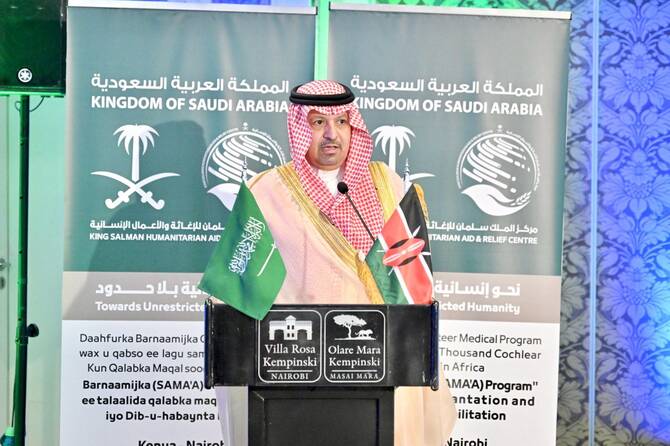
KSrelief offers vital medical support to children affected by hearing loss in Kenya

1 / 2
KSrelief launches Sama’a Volunteer Program, a Saudi-led program for Cochlear Implant and Auditory Rehabilitation in Kenya, offering vital medical support to children affected by hearing loss (Supplied)
2 / 2
KSrelief launches Sama’a Volunteer Program, a Saudi-led program for Cochlear Implant and Auditory Rehabilitation in Kenya, offering vital medical support to children affected by hearing loss (Supplied)
Short Url
Updated 18 April 2025
Follow

KSrelief offers vital medical support to children affected by hearing loss in Kenya

  • Aid agency launches Sama’a Volunteer Program supporting children with hearing loss in the African country

Riyadh: Saudi aid agency KSrelief has launched the Sama’a Volunteer Program, a Saudi-led program for cochlear implants and auditory rehabilitation in Kenya, offering vital medical support to children affected by hearing loss.

The King Salman Humanitarian Aid and Relief Center’s media department told Arab News on Friday that the program will provide 25 cochlear implant surgeries at Avenue Hospital in Nairobi and support 50 families with post-operative training in speech therapy and auditory rehabilitation.

“A team of 19 specialized medical volunteers will carry out the procedures and training over the coming days,” said KSrelief.

The launch event was attended by Saudi Ambassador to Kenya Khalid bin Abdullah Al-Salman; Mutahi Kagwe, Kenya’s minister of health; and Jibril Ibrahim Abdullahi, ambassador of Somalia to Kenya.

Children from Somalia are also among the expected beneficiaries, highlighting the program’s regional scope.

Commenting on the program, Dr. Aqeel Al-Ghamdi, assistant supervisor-general for planning and development at KSrelief, said: “Hearing loss affects each child differently. Some are born with it, others lose it later, but what they share is the potential to connect, learn and thrive when given the right care. That is what this program is here to support.”

The Sama’a Saudi Program is part of KSrelief’s broader efforts to expand access to specialized healthcare for vulnerable communities across Africa and beyond.

The Kenyan Ministry of Health posted on X: “Cabinet Secretary of Health Aden Duale launched the Volunteer Medical Porgram for Cochlear Implantation and Audio Rehabilitation for Children at a Nairobi hotel, in partnership with KSrelief. The initiative brings together advanced technology and skills transfer to support children with hearing loss.

“Aligned with Kenya’s National Ear and Hearing Care Strategic Plan (2023–2028) and UHC goals, the program is part of efforts to reverse the causes of childhood hearing loss through a comprehensive, person-centered approach.”

Duale highlighted the inclusion of hearing devices in the Kenya Essential Medical Supplies List (2023) and partial coverage for cochlear implants under the SHA benefits package.

The donation targeting 1,000 children across Africa has so far seen the implantation of the top-of-the-range hearing aids to 30 children aged between 3-5 years in Kenya (15) and Somalia (15). The implants correct severe to profound deafness.

Duale highlighted the importance of partnerships in strengthening ear and hearing care, and building a strong, inclusive health system.

He described the collaboration as a symbol of unity in restoring dignity, opportunity, and hope for children and families who need it most.


Minzal brings Saudi traditions to life in Diriyah

Updated 07 January 2026
Follow

Minzal brings Saudi traditions to life in Diriyah

  • From leather crafts and archery to Saudi coffee, Minzal offers a lesson in ‘Sloum Al-Arab’

RIYADH: This season of Minzal places social norms and traditional etiquette at its center, with tents set up to teach what is locally known as “Sloum Al-Arab” alongside gatherings for coffee, dinner and stargazing around campfires.

“Sloum Al-Arab” refers to the unwritten customers and values that have shaped Arab and Bedouin society for centuries, including generosity, coffee preparation, courage and archery. 

In Saudi Arabia, these traditions are closely ties to cultural identity and religious belief. 

Leather products and the making of leather goods is one of the crafts featured at Minzal this year and is one of the oldest crafts still practiced in the kingdom.

“The most difficult thing I faced to work on was camel leather because it is a little tough,” Nada Samman, a leather trainer and craftsman at Minzal, told Arab News. 

Minzal continues to evolve with each season, offering activities that highlight Bedouin values, traditional skills and sports. (AN photo by Haifa Alshammari)

“The work on leather is wonderful whether it is goat leather, cow leather, Sawakni sheep, and of course, camel leather. At Minzal, we are offering multiple handicraft workshops, most specifically the leather handicrafts. We want visitors to spend time at something useful and fun."

Samman explained the workshops allowed participants to preserve heritage while engaging in meaning, hands on activities. 

Faisal Al-Khaled, a visual artist and craftsman specializing in Saudi designs at Minzal, shared a similar goal: “I want people to have, by the end of this experience, a unique and traditional art piece created by them, and that I know I helped them to preserve this craft.”

Minzal, which has been organized for several years now, continues to evolve with each season, offering activities that highlight Bedouin values, traditional skills and sports. Archery is a key feature, reflecting its deep roots in Arab and Islamic history.

Mohammed Al-Sharif, a certified archery player and coach with the Saudi Archery Federation since 2028, said the sport was closely connected to Saudi culture. It was encouraged by the Prophet Muhammad, which led people to learn and teach it through generations.

“Our traditional bow is considered one of the most important and widely used bows in Arab culture,” Al-Sharif said. “We have several styles, and professional archers specializing in traditional bow shooting … There are various types of archery, such as horseback archery and standing archery, where bow sizes vary according to specific needs, such as types used for hunting and others used during warfare.”

He explained that archery was historically part of daily life, used for protection and hunting. 

Saudi coffee also plays a significant role in the Minzal experience, with live demonstrations. One of the most frequently consumed beverages in the Kingdom, it is a symbol of hospitality and generosity.

Ahmed Al-Shuaibi explained how it was prepared at the Sloum tent, first by roasting the beans and then allowing them to cool. The beans are ground with spices in a Nigr.

“Coffee is passed from our grandparents,” he added. “In significant majlis, you see them offering our local coffee and not other types of coffee. We organized this corner so that young generations can visit and learn this.”