Miami: Two men were killed in a mass shooting at a university in Florida allegedly carried out by the son of a local deputy sheriff with her old service weapon, police in the southeastern US state said Thursday.
Five people were wounded when the gunman — identified as Phoenix Ikner — rampaged through Florida State University, shooting at students, before he was shot by local law enforcement.
A sixth person was hurt trying to run away from the shooting, Chief Lawrence Revell of the Tallahassee Police Department said in a statement.
The campus was locked down as gunfire erupted, with students ordered to shelter in place as first responders swarmed the site moments after the lunchtime shootings.
Ikner, 20, has been hospitalized with “serious but non-life-threatening injuries,” Revell added.
Leon County Sheriff Walt McNeil told reporters Ikner was a student at the university and the son of a an “exceptional” 18-year member of his staff.
“Unfortunately, her son had access to one of her weapons, and that was one of the weapons that was found at the scene.
He added that the suspect was part of Sheriff’s Office training programs, meaning “it’s not a surprise to us that he had access to weapons.”
Bystander footage aired by CNN appeared to show a young man walking on a lawn and shooting at people who were trying to get away.
Witnesses spoke of chaos as people began running through the sprawling campus as shots rang out near the student union.
“Everyone just started running out of the student union,” a witness named Wayne told local news station WCTV.
“About a minute later, we heard about eight to 10 gunshots.”
The witness said he saw one man who appeared to have been shot in the midsection.
“The whole entire thing was just surreal. I just couldn’t believe what I was seeing.
“Everything was really quiet, then all chaotic.”
'Make them take time'
The two people who died were “adult males” who were not students, police said.
The university, a public institution with more than 40,000 students, canceled all classes and told students who did not live on campus to leave.
FSU President Richard McCullough said the university was working to support those affected by the attack.
“This is a tragic day for Florida State University,” he said.
“We’re absolutely heartbroken by the violence that occurred on our campus earlier today.”
Student Sam Swartz told the Tallahassee Democrat he had been in the basement of the student union when shooting started.
“Everyone started freaking out,” Swartz said, adding he had heard around 10 shots.
A group of eight people huddled in a hallway and barricaded themselves with trash cans and plywood.
“I remember learning to do the best you can to make them take time,” Swartz said, adding that mass shooters are “just trying to get as many people” as they can.
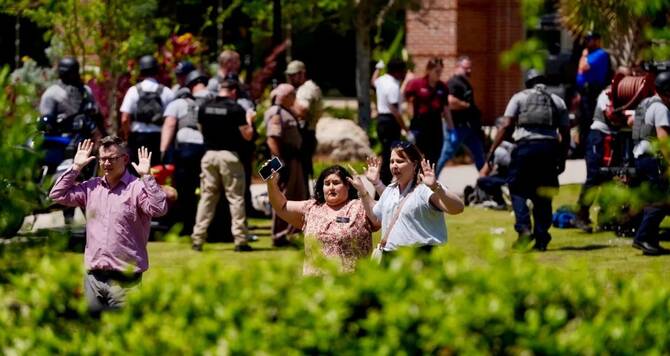
Footage on social media showed a stream of young adults walking through corridors with their hands in the air as they evacuated the building.
Mass shootings are common in the United States, where a constitutional right to bear arms trumps demands for stricter rules.
That is despite widespread public support for tighter control on firearms, including restricting the sale of high-capacity clips and limiting the availability of automatic weapons of war.
President Donald Trump called the shooting “a shame, a horrible thing,” but insisted that Americans should retain unfettered access to guns.
“I’m a big advocate of the Second Amendment. I have been from the beginning. I protected it,” he said, referring to the part of the US Constitution gun advocates say protects firearm ownership.
“These things are terrible, but the gun doesn’t do the shooting — the people do.”
A tally by the non-profit Gun Violence Archive shows there have been at least 81 mass shootings — which it defines as four or more people shot — in the United States so far this year.


![]()

Two killed as police officer’s son opens fire at US university
Short Url
https://arab.news/r7e5s
Two killed as police officer’s son opens fire at US university
- Five people were wounded when the gunman — identified as Phoenix Ikner — rampaged through Florida State University
- Footage on social media showed a stream of young adults walking through corridors with their hands in the air as they evacuated the building
Latest updates


© 2026 SAUDI RESEARCH & PUBLISHING COMPANY, All Rights Reserved And subject to Terms of Use Agreement.