CAIRO: The World Food Program has halted food shipments to Houthi-held areas of Yemen and suspended food distribution there after the militants looted one of its warehouses in the north, its deputy director said Thursday.
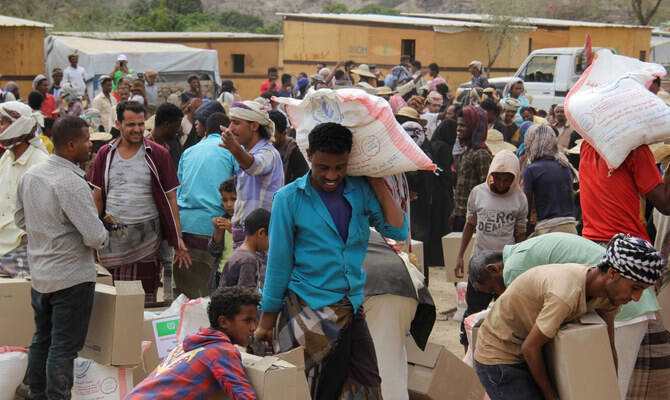
The suspension is a further blow in the war-torn country, where hunger has been growing. In February, the WFP said 62 percent of households it surveyed couldn’t get enough food, a figure that has been rising for the past nine months. It estimates that some 17 million people – early half Yemen’s population — are food insecure.
Carl Skau, WFP’s deputy executive director and chief operating officer, told The Associated Press that Houthis seized the warehouse in the northern region of Saada in mid-March and took around $1.6 million in supplies.
The seizure was the latest friction between the Houthis and the United Nations. The militants in recent months have detained dozens of UN staffers, as well as people associated with aid groups, civil society and the once-open US Embassy in Sanaa, Yemen’s capital.
UN agencies, including the WFP, had already halted operations in Saada, the Houthis’ stronghold, in February after seven WFP staffers and another UN worker were detained, and one of the WFP members died in prison. It continued low-level operations in other parts of Yemen under the Houthis’ control.
After the seizure of the warehouse, the WFP halted shipments of new supplies to Houthi-held areas, Skau said.
“The operating environment needs to be conducive for us to continue,” he said. “We cannot accept that our colleagues are being detained, and much less so that our colleagues are dying in detention. And we cannot accept our assets are being looted.”
“It’s something we don’t take lightly because the needs are massive,” he said. “The humanitarian implications of this are deep and extensive … It’s clear the food security situation is deteriorating.”
Yemen has been torn by civil war for more than a decade. Houthi militants hold the capital Sanaa and much of the north and center of the country, where the majority of its population of nearly 40 million live. The internationally recognized government controls the south and west.
Throughout the war, Yemen has been threatened by hunger, nearly falling into full-fledged famine. The impoverished nation imports most of its food.
Skau said the WFP is seeking Houthi permission to distribute food that remains in other warehouses in the north. He said that if UN workers are released, it could resume programs distributing food to some 3 million people in Houthi-held areas.
The WFP is also providing food assistance to some 1.6 million people in southern Yemen, areas controlled by the government and its allies.
But the organization has warned its programs there could be hurt after US President Donald Trump’s administration has cut off funding for WFP’s emergency programs in Yemen.
A WFP official said the organization was reducing its staff in Yemen, and that around 200 employees – 40 percent of its workforce – have been given a month’s notice. The official spoke on condition of anonymity to discuss the personnel situation.
“We have now a challenge in the south when it comes to the funding,” Skau said. “But we’re hoping that that can be resolved moving forward.”


![]()

WFP halts food shipments to Houthi-held parts of Yemen after militia seize warehouse
Short Url
https://arab.news/vsewh
WFP halts food shipments to Houthi-held parts of Yemen after militia seize warehouse
- WFP said 62 percent of households it surveyed couldn’t get enough food
- The seizure was the latest friction between the Houthis and the United Nations


Latest updates





© 2026 SAUDI RESEARCH & PUBLISHING COMPANY, All Rights Reserved And subject to Terms of Use Agreement.