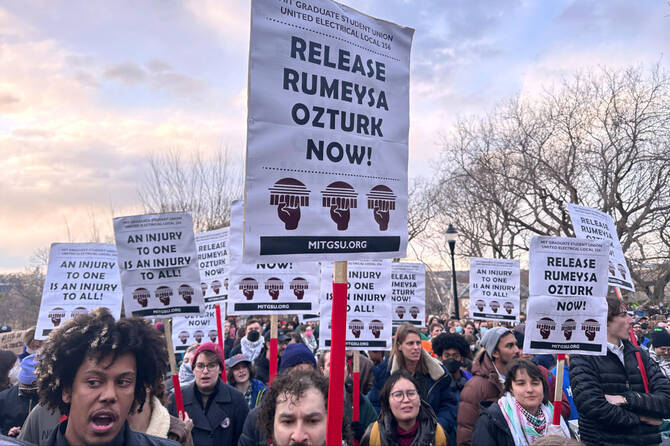
VERMONT, USA: An immigration judge denied bond for a Tufts University student from Turkiye who has been detained by authorities in Louisiana for three weeks over what her lawyers say is apparent retaliation for an op-ed piece she co-wrote in the student newspaper.
Meanwhile, Rumeysa Ozturk’s lawyers filed a new request with a federal judge in Vermont considering whether to take jurisdiction of her detention case. The lawyers asked the judge to order her to be brought to the state by Friday and hold a hearing next week. They said that would allow better communication with her legal team and a doctor to evaluate her. They say Ozturk has suffered five asthma attacks in detention.
Lawyers for Ozturk, 30, had asked an immigration judge that she be released on bond as her immigration case proceeds. That judge denied her request Wednesday, the same day Ozturk had a hearing, they said in a statement released Thursday morning.
The Department of Homeland Security presented one document to support their opposition to Ozturk’s bond request: a one-paragraph State Department memo revoking her student visa, her lawyers said in the new court filing.
The memo says that Ozturk’s visa was revoked on March 21 following an assessment that she had been involved in associations ”‘that may undermine US foreign policy by creating a hostile environment for Jewish students and indicating support for a designated terrorist organization’ including co-authoring an op-ed that found common cause with an organization that was later temporarily banned from campus.”
Ozturk’s lawyers said the immigration judge denied bond based on the “untenable conclusion that Ms. Ozturk was both a flight risk and a danger to the community.”
Messages seeking comment Thursday were emailed to the department and to ICE.
Ozturk, a doctoral student studying child development, was taken by immigration officials as she walked along a street in the Boston suburb of Somerville on March 25. After being taken to New Hampshire and then Vermont, she was put on a plane the next day and moved to an Immigration and Customs Enforcement detention center in Basile, Louisiana.
Ozturk is among several people with ties to American universities whose visas were revoked or have been stopped from entering the US after they were accused of attending demonstrations or publicly expressed support for Palestinians. A Louisiana immigration judge has ruled that the US can deport Columbia University graduate student Mahmoud Khalil based on the federal government’s argument that he poses a national security risk.
Ozturk’s lawyers are challenging the legal authority for ICE’s detention. They also have asked US District Judge William Sessions in Vermont, where her detention case was transferred after lawyers first petitioned for her release in Massachusetts, to take jurisdiction of it and release her.
Sessions, who held a hearing Monday, has not ruled yet.
“The government’s entire case against Rümeysa is based on the same one-paragraph memo from the State Department to ICE that just points back to Rümeysa’s op-ed,” Marty Rosenbluth, one of Ozturk’s attorneys, said in a statement.
Ozturk was one of four students who wrote an op-ed in the campus newspaper, The Tufts Daily, last year criticizing the university’s response to student activists demanding that Tufts “acknowledge the Palestinian genocide,” disclose its investments and divest from companies with ties to Israel.
Ozturk’s lawyers say her detention violates her constitutional rights, including free speech and due process. They said they didn’t know for hours where she was after she was taken. They said they were unable to speak to her until more than 24 hours after she was detained. Ozturk herself said she unsuccessfully made multiple requests to speak to a lawyer.
A Department of Homeland Security spokesperson said last month, without providing evidence, that investigations found that Ozturk engaged in activities in support of Hamas, a US-designated terrorist group.


Immigration judge denies bond for Tufts University student from Turkiye, her lawyers say
https://arab.news/ndba5
Immigration judge denies bond for Tufts University student from Turkiye, her lawyers say

- Rumeysa Ozturk’s lawyers filed a new request with a federal judge in Vermont considering whether to take jurisdiction of her detention case
- The lawyers asked the judge to order her to be brought to the state by Friday


Trump cuts India tariffs as Modi ‘agrees’ to stop buying Russian oil
- US will impose an 18 percent tariff on Indian goods, down from the earlier 50 percent punitive levy
- Withdrawal from Russian oil may affect India’s relations with BRICS, expert says
NEW DELHI: The US and India have announced reaching a trade agreement after months of friction, with President Donald Trump saying that Prime Minister Narendra Modi had “agreed” to halt purchases of Russian oil.
In August, Trump accused India, which imports most of its crude oil, of funding Moscow’s war in Ukraine and subjected it to a combined tariff rate of about 50 percent on most of the exports.
Following a call with Modi on Monday, Trump took to social media to say that he would cut with immediate effect US levies on Indian goods to 18 percent after Modi “agreed to stop buying Russian Oil, and to buy much more from the United States and, potentially, Venezuela.”
At the same time, India, Trump wrote, would “reduce their Tariffs and Non Tariff Barriers against the United States, to ZERO,” committing to buy “over $500 BILLION DOLLARS of US Energy, Technology, Agricultural, Coal, and many other products.”
Modi confirmed the agreement on social media, saying: “Made in India products will now have a reduced tariff of 18 percent,” without commenting on Russian oil or duty-free imports of American goods.
When the US announced its punitive tariffs last year, India quickly moved forward with free trade negotiations with other countries — signing a deal with Oman and finalizing negotiations with New Zealand and the EU.
While the agreements were expected to partially offset the loss of exports to the US, economists did not expect they would immediately mitigate it, as shifting supply chains takes time.
The newly announced agreement with the US will therefore offer short-term relief for Indian exporters — especially of textiles, gems, jewelry and marine products — who were facing the threat of a market exit.
“In that case, the trade deal with the US is a welcome step. It provides short-term relief, allowing India to continue exporting to the US without being forced to exit the US market and diversify with a huge transition cost,” said Anisree Suresh, geoeconomics researcher at the Takshashila Institution.
“However, one shouldn’t look at it as a comprehensive long-term trade deal like the one India signed with the EU. The unpredictability of the Trump administration remains a major concern, regardless of whether there is a trade deal with the US ... India cannot treat this deal the same as other FTAs, as it is limited in scope and subject to reversal.”
When the US imposed its punitive tariffs on India, about 66 percent of total Indian exports were subject to that rate. Overall, India recorded a negative margin of 19.5 percent, meaning its exports were taxed more heavily than those of its competitors.
“From that point of view, Indian goods will have a larger market over there. However, there’s a problem when we talk about a 0 percent tariff on the US,” said Prof. Arun Kumar, a development economist.
“The US will be able to export a lot more to India, and therefore it will affect our production within the economy. And that will be a setback, so while exports may rise, the internal economy may actually suffer because of this decrease in tariffs on American goods. And especially if it affects agriculture.”
The sudden withdrawal from India’s partnership with Russia may not have a serious economic impact but politically could affect New Delhi’s relations, also with other countries, especially those from BRICS — a grouping that besides India and Russia includes also Brazil and China, and is the most powerful geopolitical forum outside of the Western world.
“You can always substitute Russian oil with some other oil, but I think it’s more of a strategic question, because India and Russia have had long-standing relationships, and if we bend to US pressure and reduce purchases from Russia, then it will affect in future also our relationship with Russia, because we will not be seen as a stable ally,” Kumar said.
“BRICS nations will not trust India very much in the future ... and that’s what Trump wants. He wants to disrupt BRICS. That’s what he has been doing right since the beginning to divide nations and deal with them individually.”


