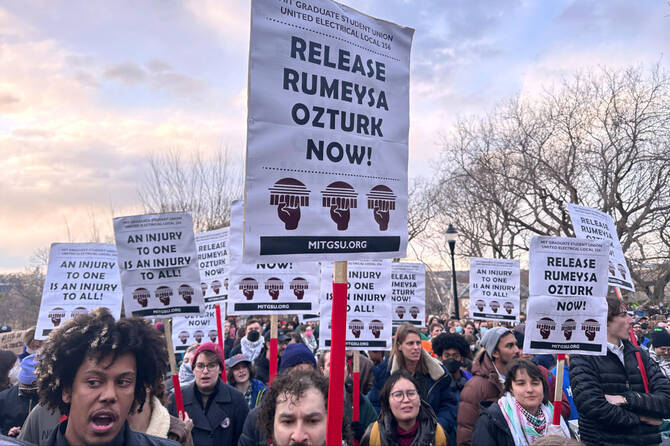
VERMONT, USA: An immigration judge denied bond for a Tufts University student from Turkiye who has been detained by authorities in Louisiana for three weeks over what her lawyers say is apparent retaliation for an op-ed piece she co-wrote in the student newspaper.
Meanwhile, Rumeysa Ozturk’s lawyers filed a new request with a federal judge in Vermont considering whether to take jurisdiction of her detention case. The lawyers asked the judge to order her to be brought to the state by Friday and hold a hearing next week. They said that would allow better communication with her legal team and a doctor to evaluate her. They say Ozturk has suffered five asthma attacks in detention.
Lawyers for Ozturk, 30, had asked an immigration judge that she be released on bond as her immigration case proceeds. That judge denied her request Wednesday, the same day Ozturk had a hearing, they said in a statement released Thursday morning.
The Department of Homeland Security presented one document to support their opposition to Ozturk’s bond request: a one-paragraph State Department memo revoking her student visa, her lawyers said in the new court filing.
The memo says that Ozturk’s visa was revoked on March 21 following an assessment that she had been involved in associations ”‘that may undermine US foreign policy by creating a hostile environment for Jewish students and indicating support for a designated terrorist organization’ including co-authoring an op-ed that found common cause with an organization that was later temporarily banned from campus.”
Ozturk’s lawyers said the immigration judge denied bond based on the “untenable conclusion that Ms. Ozturk was both a flight risk and a danger to the community.”
Messages seeking comment Thursday were emailed to the department and to ICE.
Ozturk, a doctoral student studying child development, was taken by immigration officials as she walked along a street in the Boston suburb of Somerville on March 25. After being taken to New Hampshire and then Vermont, she was put on a plane the next day and moved to an Immigration and Customs Enforcement detention center in Basile, Louisiana.
Ozturk is among several people with ties to American universities whose visas were revoked or have been stopped from entering the US after they were accused of attending demonstrations or publicly expressed support for Palestinians. A Louisiana immigration judge has ruled that the US can deport Columbia University graduate student Mahmoud Khalil based on the federal government’s argument that he poses a national security risk.
Ozturk’s lawyers are challenging the legal authority for ICE’s detention. They also have asked US District Judge William Sessions in Vermont, where her detention case was transferred after lawyers first petitioned for her release in Massachusetts, to take jurisdiction of it and release her.
Sessions, who held a hearing Monday, has not ruled yet.
“The government’s entire case against Rümeysa is based on the same one-paragraph memo from the State Department to ICE that just points back to Rümeysa’s op-ed,” Marty Rosenbluth, one of Ozturk’s attorneys, said in a statement.
Ozturk was one of four students who wrote an op-ed in the campus newspaper, The Tufts Daily, last year criticizing the university’s response to student activists demanding that Tufts “acknowledge the Palestinian genocide,” disclose its investments and divest from companies with ties to Israel.
Ozturk’s lawyers say her detention violates her constitutional rights, including free speech and due process. They said they didn’t know for hours where she was after she was taken. They said they were unable to speak to her until more than 24 hours after she was detained. Ozturk herself said she unsuccessfully made multiple requests to speak to a lawyer.
A Department of Homeland Security spokesperson said last month, without providing evidence, that investigations found that Ozturk engaged in activities in support of Hamas, a US-designated terrorist group.


![]()

Immigration judge denies bond for Tufts University student from Turkiye, her lawyers say
Short Url
https://arab.news/ndba5
Immigration judge denies bond for Tufts University student from Turkiye, her lawyers say
- Rumeysa Ozturk’s lawyers filed a new request with a federal judge in Vermont considering whether to take jurisdiction of her detention case
- The lawyers asked the judge to order her to be brought to the state by Friday


Latest updates


© 2026 SAUDI RESEARCH & PUBLISHING COMPANY, All Rights Reserved And subject to Terms of Use Agreement.