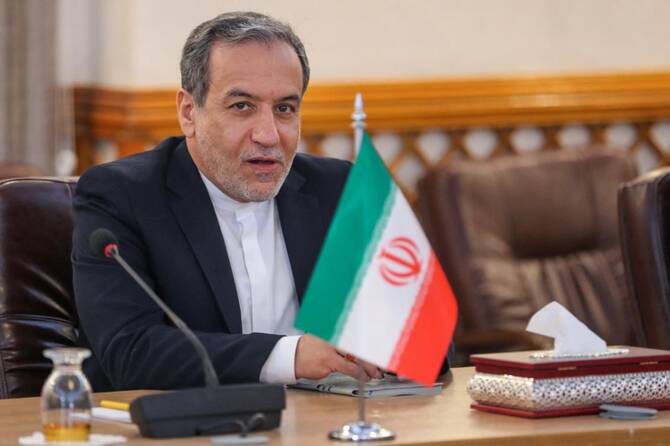
MOSCOW: Iranian Supreme Leader Ali Khamenei sent his foreign minister to Russia on Thursday with a letter for Russian President Vladimir Putin, aiming to shore up support from Moscow ahead of a second round of nuclear negotiations with the United States.
US President Donald Trump has repeatedly threatened Iran with bombing and extending tariffs to third countries that buy its oil if Tehran does not come to an agreement with Washington over its disputed nuclear program. The United States has moved additional warplanes into the region.
The US and Iran held talks in Oman last weekend that both sides described as positive and constructive. Ahead of a second round of talks set to take place in Rome this weekend, Foreign Minister Abbas Araqchi said on Wednesday that Iran’s right to enrich uranium is not negotiable.
Russia, a longstanding ally of Tehran, plays a role in Iran’s nuclear negotiations with the West as a veto-wielding UN Security Council member and a signatory to an earlier nuclear deal Trump abandoned during his first term in 2018.
“Regarding the nuclear issue, we always had close consultations with our friends China and Russia. Now it is a good opportunity to do so with Russian officials,” Araqchi told state TV. He said he was conveying a letter to Putin that discussed regional and bilateral issues.
Western powers say Iran is refining uranium to a high degree of fissile purity beyond what is justifiable for a civilian energy program and close to the level suitable for an atomic bomb. Iran denies seeking nuclear weapons and says it has a right to a civilian nuclear program.
Moscow has bought weapons from Iran for the war in Ukraine and signed a 20-year strategic partnership deal with Tehran earlier this year, although it did not include a mutual defense clause. The two countries were battlefield allies in Syria for years until their ally Bashar Assad was toppled in December.
Putin has kept on good terms with Khamenei as both Russia and Iran are cast as enemies by the West, but Moscow is keen not to trigger a nuclear arms race in the Middle East.
Russia has said that any military strike against Iran would be illegal and unacceptable. The Kremlin on Tuesday declined to comment when asked if Russia was ready to take control of Iran’s stocks of enriched uranium as part of a possible future nuclear deal between Iran and the United States.

Iranian foreign minister to discuss Iran-US nuclear talks during Moscow visit
Short Url
https://arab.news/yhjuw
Iranian foreign minister to discuss Iran-US nuclear talks during Moscow visit
- The US and Iran held talks in Oman last weekend that both sides described as positive and constructive
- Russia, a longstanding ally of Tehran, plays a role in Iran’s nuclear negotiations with the West as a veto-wielding UN Security Council member
Trump demands role in choosing next Iran leader, Khamenei's son ‘unacceptable’
- US president tells Axios US would likely return to war within five years without a favorable leader in Iran
- Draws parallel with Venezuela where interim president Delcy Rodriguez has cooperated under threat of violence
WASHINGTON: US President Donald Trump on Thursday insisted he should have a role in picking Iran’s next supreme leader after the killing of Ayatollah Ali Khamenei, whose son he said he found unacceptable.
“Khamenei’s son is a lightweight. I have to be involved in the appointment, like with Delcy,” Trump told Axios in an interview, drawing a comparison to Venezuela, where interim president Delcy Rodriguez has cooperated with him under threat of violence after the United States ousted her boss, Nicolas Maduro.
Trump told the news outlet that the United States would likely return to war within five years without a favorable leader in Iran.
“Khamenei’s son is unacceptable to me. We want someone that will bring harmony and peace to Iran,” Trump was quoted saying by the news outlet.
It was unclear in what way Trump would be able to take a role in the Islamic republic’s selection of a new supreme leader, a decision made by an assembly of senior Shiite Muslim clerics mostly staunchly opposed to the United States. Trump was raised a Presbyterian.
But his remarks imply a willingness to work with someone from within the Islamic republic rather than seek to topple the government, which has been a sworn enemy of the United States since the 1979 Islamic revolution toppled the pro-Western shah.
The late shah’s son, Reza Pahlavi, has proposed that he return as a transitional figure before Iran drafts a new constitution as a secular democracy. Pahlavi earlier Thursday said that any new supreme leader within the Islamic republic would be illegitimate.
Ali Khamenei, who ruled Iran since 1989 with hard-line policies that included repression at home and confrontation with neighboring countries, was killed Saturday in an Israeli strike as Israel and the United States opened war.
His son, Mojtaba Khamenei, is considered one of the contenders to succeed his father, who was only the second supreme leader after revolutionary leader Ayatollah Ruhollah Khomeini.
In Venezuela, Trump ordered a deadly January 3 attack in which US forces snatched Maduro, a longtime US nemesis.
Rather than backing the opposition long championed by the United States, Trump has said he has been pleased by Rodriguez, who was Maduro’s vice president but has cooperated on key US demands, notably on benefiting oil companies.
She is doing so under Trump’s threat of violence if she does not do what he wants, particularly on access to natural resources.
“Khamenei’s son is a lightweight. I have to be involved in the appointment, like with Delcy,” Trump told Axios in an interview, drawing a comparison to Venezuela, where interim president Delcy Rodriguez has cooperated with him under threat of violence after the United States ousted her boss, Nicolas Maduro.
Trump told the news outlet that the United States would likely return to war within five years without a favorable leader in Iran.
“Khamenei’s son is unacceptable to me. We want someone that will bring harmony and peace to Iran,” Trump was quoted saying by the news outlet.
It was unclear in what way Trump would be able to take a role in the Islamic republic’s selection of a new supreme leader, a decision made by an assembly of senior Shiite Muslim clerics mostly staunchly opposed to the United States. Trump was raised a Presbyterian.
But his remarks imply a willingness to work with someone from within the Islamic republic rather than seek to topple the government, which has been a sworn enemy of the United States since the 1979 Islamic revolution toppled the pro-Western shah.
The late shah’s son, Reza Pahlavi, has proposed that he return as a transitional figure before Iran drafts a new constitution as a secular democracy. Pahlavi earlier Thursday said that any new supreme leader within the Islamic republic would be illegitimate.
Ali Khamenei, who ruled Iran since 1989 with hard-line policies that included repression at home and confrontation with neighboring countries, was killed Saturday in an Israeli strike as Israel and the United States opened war.
His son, Mojtaba Khamenei, is considered one of the contenders to succeed his father, who was only the second supreme leader after revolutionary leader Ayatollah Ruhollah Khomeini.
In Venezuela, Trump ordered a deadly January 3 attack in which US forces snatched Maduro, a longtime US nemesis.
Rather than backing the opposition long championed by the United States, Trump has said he has been pleased by Rodriguez, who was Maduro’s vice president but has cooperated on key US demands, notably on benefiting oil companies.
She is doing so under Trump’s threat of violence if she does not do what he wants, particularly on access to natural resources.
© 2026 SAUDI RESEARCH & PUBLISHING COMPANY, All Rights Reserved And subject to Terms of Use Agreement.


