VATICAN CITY: The Vatican on Thursday opened the most solemn period of Holy Week with a recovering Pope Francis largely on the sidelines, as cardinals were designated to take his place presiding over the most important liturgical services leading up to Easter.
The 88-year-old Francis, who survived a life-threatening bout of double pneumonia this winter, is expected to make some appearances, however. He made a surprise cameo at the end of Palm Sunday Mass last weekend and in recent days has made some unannounced visits – including one in which he wasn’t dressed in his papal white cassock – to pray in St. Peter’s Basilica and St. Mary Major basilica across town.
By all indications he is continuing to improve after his five-week hospital stay and is slowly resuming some of his normal activities. In recent outings, he has been seen without the nasal tubes that provide supplemental oxygen and Vatican officials say he is increasingly less reliant on the therapy.
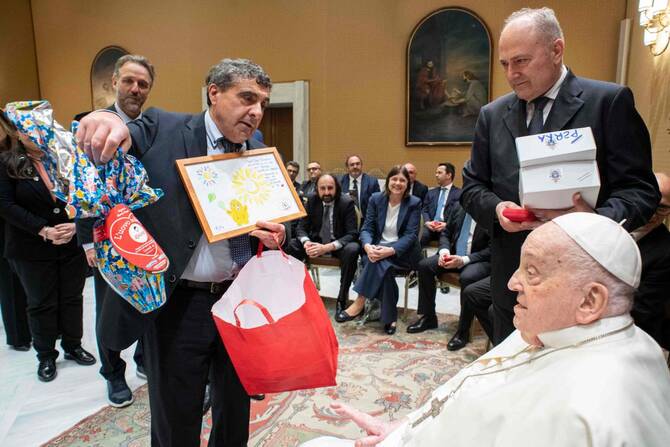
On Wednesday, Francis held his first formal group audience since returning to the Vatican on March 23, meeting with the medical staff of the Gemelli hospital who cared for him during his 38-day stay. Gathered in a Vatican audience hall, Francis thanked the 70-plus doctors, nurses and administrators and asked them for their continued prayers.
“Thank you for everything you did,” Francis said, his voice still labored but seemingly stronger as he continues respiratory and physical therapy.
He gave special thanks to the rector of Gemelli’s affiliated Catholic University of the Sacred Heart, Elena Beccalli, whom he praised for her strong leadership. “When women command, things go well,” he said in his longest public remarks since his hospitalization.
Francis has delegated the demanding Holy Week liturgical celebrations to hand-picked cardinals, but the Vatican says the pope himself composed the meditations that will be read aloud by others during the Via Crucis (Way of the Cross) procession on Friday night at Rome’s Colosseum.
The Holy Thursday Mass, for example, during which the oils used in liturgical rituals throughout the year are blessed, was being celebrated by the retired head of the Vatican’s patrimony office, Cardinal Domenico Calcagno. Friday’s solemn commemoration of the crucifixion of Christ was assigned to Cardinal Claudio Gugerotti, who heads the Vatican office in charge of eastern rite Catholics. Easter Sunday was assigned to the retired administrator of St. Peter’s, Cardinal Angelo Comastri.
It remains to be seen how Francis will handle Easter Sunday’s traditional “Urbi et Orbi” speech and blessing (Latin for “to the city and the world”). Normally the pope delivers a sometimes lengthy discourse on the state of the world from the loggia of St. Peter’s, and then imparts a special blessing to the faithful in the piazza below. In theory someone else could read the speech while Francis could impart the blessing.
Francis was admitted to Gemelli on Feb. 14 with bronchitis that quickly developed into a life-threatening case of double pneumonia. Upon his release March 23, doctors proscribed two months of convalescence at the Vatican with daily respiratory and physical therapy to improve his breathing and vocal function. With time, they have predicted he will be able to resume his normal activities.


![]()

Vatican’s solemn run-up to Easter opens with recovering Pope Francis improving but on the sidelines
Short Url
https://arab.news/rmbyp
Vatican’s solemn run-up to Easter opens with recovering Pope Francis improving but on the sidelines
- Pontiff, who survived a life-threatening bout of double pneumonia this winter, is expected to make some appearances
- By all indications he is continuing to improve after his hospital stay and is slowly resuming some of his normal activities


Latest updates


© 2026 SAUDI RESEARCH & PUBLISHING COMPANY, All Rights Reserved And subject to Terms of Use Agreement.