

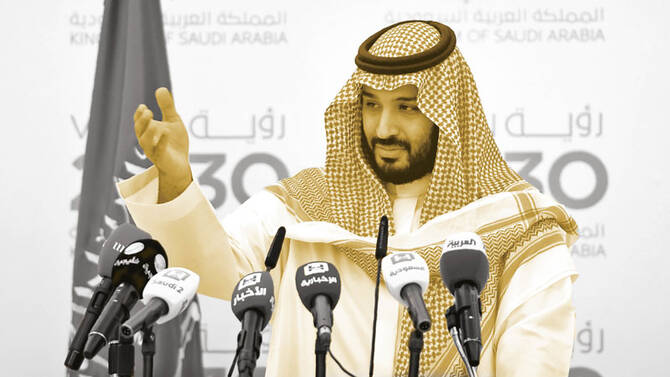

RIYADH: A seminal event occurred on April 25, 2016. On that date, Saudi Arabia’s then-Deputy Crown Prince Mohammed bin Salman, often referred to simply as MBS, announced the details of what we have come to know as the path-breaking, paradigm-shifting Saudi Vision 2030.
That day, he gave Al Arabiya News Channel an exclusive interview, his first-ever on television. At the time, I was based in Dubai editing the channel’s English-language digital arm, and it was obvious to me that if ever there was an eagerly awaited moment of change that would positively impact the region, this was it.
Here was a man who was charting a new course that represented an almost total about-face for Saudi Arabia. It was the kind of thing nobody had tried before. The young prince was giving hope to a nation in which about 60 percent of the population was under the age of 35.
He talked about the government having targets, key performance indicators and project management offices, and of ridding the Kingdom of its dependence on oil — all things that were unheard of in the past.
How we wrote it

Arab News celebrated the launch of Vision 2030 with a special front page and an editorial headlined, “KSA’s leap into future.”
Five months later, on Sept. 26, 2016, to be precise, I was in Jeddah after being appointed editor-in-chief of Arab News. Having lived there during my formative years, I felt I had a genuine feeling for, and understanding of, the city.
What I failed to consider, however, was that in the five months since the announcement of Vision 2030, change had become the new norm. And not a slow, glacial process of change but a fast and urgent one.
I was nonetheless pleasantly surprised, and on my first day at Arab News I wrote about my sense of optimism. In that column, I mentioned how I was assisted upon my arrival at the Rosewood hotel in Jeddah by a female Saudi receptionist.
“While the thought of having a woman do such a job was unheard of 20 years ago, I must confess that I honestly have never dealt with a more professional, meticulous and ‘happy to serve’ receptionist in my travels around the world,” I wrote in the piece, which was aptly titled, “The Return of the Prodigal Son.”
It was a coincidence that I returned to the Kingdom only five months after the announcement of Vision 2030. But from the perspective of a journalist it was an exciting time, even though I had no idea what to expect. Nor did I know whether the announced changes, genuine as they and the intentions underlying them were, would ever materialize into reality.
Day after day, however, it became evident that Saudi Arabia was on a new track and nothing could stand in the way. For example, curbing the powers of the religious police was a giant step away from what had been the norm. In one fell swoop, the fears that had for so long stopped Saudis from thinking outside the box were done away with. Before the curbs, members of the religious police had been a virtual law unto themselves and, in a few tragic cases, they were responsible for the deaths of young Saudis.
Key Dates
-
1
Deputy Crown Prince Mohammed bin Salman launches his Vision 2030 plan for national development and diversification.

-
2
King Salman appoints him crown prince.

-
3
At the Future Investment Initiative conference in Riyadh, the crown prince pledges a return to moderate Islam and launches NEOM, a $500-billion project to develop a new Saudi megacity.

-
4
First commercial movie theater opens in Riyadh, with a screening of the Marvel movie “Black Panther,” ending a 35-year ban on cinemas in the Kingdom

-
5
Ban on Saudi women driving is lifted.

-
6
Crown prince launches a tourism megaproject in AlUla, including a resort designed by architect Jean Nouvel and a nature reserve.
-
7
Saudi authorities establish three new ministries, for sports, tourism and investment, as part of commitment to Vision 2030.

-
8
Kingdom bids successfully to host Expo 2030 in Riyadh, beating competition from Rome and Busan.

-
9
Saudi Arabia awarded hosting rights for 2034 FIFA World Cup, which will be the first time the expanded, 48-team tournament is held in a single country.

It is disappointing that the Saudi leadership gets very little credit for their remarkable achievement, which represented a complete reversal of the status quo in the Kingdom.
That decision followed the introduction of concerts and musical performances in front of live audiences, the very kind of events that had been unheard of in the past. Some of the old-timers in the newsroom flinched when we decided to run large photos showing ordinary Saudi men and women sitting next to each other, eating popcorn as they enjoyed themselves and hummed along to live music during a show.
The first concert with a mixed audience of men and women that I personally attended in the Kingdom was by “iLuminate,” the spectacular hit music and light show from New York. In the run-up to the performance, in October 2016, there was a conflict between the security forces, who said the mixed-audience event could not take place, and officials from the Kingdom’s General Entertainment Authority, who insisted it had to be mixed.
Ultimately, the GEA won the argument and it was a fabulously memorable performance that mesmerized thousands of people in the massive Al-Jowhara Stadium. Men, women and children sat together and enjoyed a dazzling show, full of music, energetic dance moves and special effects.
This was a symbolic moment, in my opinion, because shortly afterward the inevitable occurred; in mid 2017, the Kingdom awoke to the news that MBS had been named crown prince by his father, King Salman. He replaced his predecessor, Mohammed bin Nayef who, as per royal protocol, stepped down and gave his blessing to the appointment of his younger cousin.

To launch the Sharaan Nature Reserve in AlUla, the Crown Prince symbolically released an idmi gazelle, a species threatened in the wild and experiencing a rapid population decline. SPA
MBS now had full control to push ahead with his plans, and if the world was stunned at the pace of change before, they had seen nothing compared with what was to come.
Next, the ban on women driving was lifted and draconian guardianship laws were abolished. People of my generation never thought we would see women driving in the Kingdom but we were proved wrong. I invited our senior editor, Mo Gannon, a Canadian working in our Dubai office who had an international driving license, to visit Jeddah and asked her to be part of the history that was unfolding in Saudi Arabia.
On the day the driving ban was lifted, we got her into the driver’s seat. I sat next to her to record her reactions and those of our Saudi female members of staff who were also in the car. It was an incredible moment and feeling of liberation for the women of Saudi Arabia. The happy faces that appeared on our front pages were those of proud and traditionally, but fashionably, dressed Saudi women of all shades, from all regions. What had been the forbidden exception became the accepted norm.
Then there were the high-decibel concerts that began to take place at Diriyah. The setting is straight out of the “Arabian Nights,” and it was enthralling to see the nation’s history encounter the modern world in the ancient deserts of Arabia.
As a result of these cultural and social changes, the crown prince received huge support and the admiration of the people. He earned popularity and respect, especially among the youth of the country and women, by making longed-for changes and getting rid of suffocating restrictions.

At the same time, the crown prince did not forget about Saudi Arabia’s history and heritage. Yes, we have futuristic projects such as the NEOM megacity on one hand, but when it came to preserving history, heritage and even wildlife, MBS was adamant about the importance of that as well. Places such as Diriyah, AlUla and the old town of Jeddah are living examples of this commitment.
He also set about rehabilitating the image of the country and transforming it into a center of moderation. To do this, he hosted leaders of other religions in Saudi Arabia and focused on the virtues and advantages of interfaith cooperation. He invited Jewish rabbis and Christian preachers to the Kingdom and encouraged them to engage in dialogue with one another and with the Saudi ulema.
The most significant announcement by MBS, however, was the one in which he stated that he wanted to restore Saudi Arabia to a more moderate form of Islam or, in his words, return things to the way they were before 1979.
Why 1979? Because, as he said during an interview with Norah O’Donnell on CBS in September 2018: “We were living a very normal life, like the rest of the Gulf countries. Women were driving cars. There were movie theaters in Saudi Arabia. Women worked everywhere. We were just normal people, developing like any other country in the world until the events of 1979.”
Having said all of this, I must now ask a question: Has the crown prince’s Vision 2030 succeeded in all that it set out to achieve? No. Will it? Probably not. But this is no secret, and Arab News publishes an annual report in which we keep track of the progress and the shortcomings.

The master plan for Riyadh Expo 2030 revealed. Royal Commission for Riyadh City
Were there mistakes along the way? Yes; painful ones, too, some of which have had harmful consequences on progress and the reputation of the Kingdom. While nothing can be said in their defense, there are two overarching arguments that can be made here.
The first is to imagine, despite the mistakes, if all these reforms had not happened. What would have become of Saudi Arabia then?
The second is to consider whether the Kingdom is better off, and its people happier, now than they were nine years ago? Just ask the youths who form about 60 percent of the Saudi population what they think, and there you will find the answer. Or if not, check out the report published by market research and consulting firm Ipsos in 2024 that ranked Saudi Arabia as the world’s second-happiest country.
- Faisal J. Abbas is the editor-in-chief of Arab News.


