CAIRO: A notorious paramilitary group fighting against the Sudanese military announced that it was forming a rival government, which will rule parts of the country controlled by the group including the western Darfur region where the United Nations says recent attacks by the group have killed over 400 people.
Gen. Mohammed Hamdan Dagalo, commander of the Rapid Support Forces, announced the move in a speech on Tuesday as the northeastern African nation marked two years of civil war.
“On this anniversary, we proudly declare the establishment of the Government of Peace and Unity,” Dagalo said in a recorded speech, adding that other groups have joined the RSF-led administration, including a faction of the Sudan’s Liberation Movement, which controls parts of Kordofan region.
Dagalo, who is sanctioned by the US over accusations that his forces committed genocide in Darfur, said that he and his allies were also establishing “a 15-member Presidential Council” representing all of Sudan’s regions.
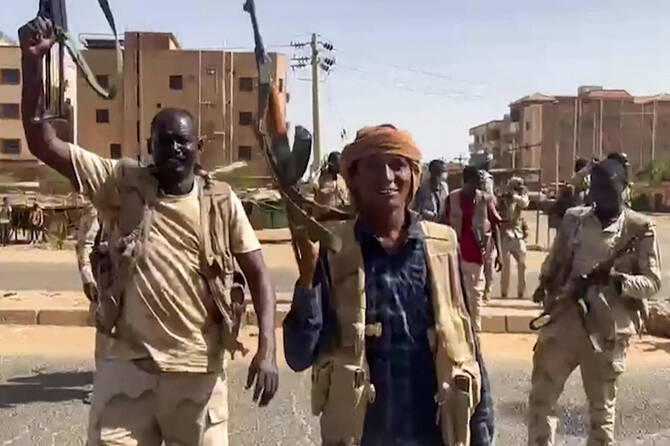
The move came as the RSF suffered multiple battlefield setbacks, losing the capital, Khartoum and other urban cities in recent months. The paramilitary group has since regrouped in its stronghold in the sprawling region of Darfur.
It raises concerns that Sudan is heading toward partition, or a prolonged conflict like that one in neighboring Libya where two rival administrations have been fighting for power for over a decade. The nation of South Sudan won independence from Sudan in a 2011 referendum that followed a war in which Janjaweed militias, a predecessor to the RSF, fought on behalf of the government.
The Janjaweed were accused of mass killings, rapes and other atrocities.
Many countries, including the US, have rejected the RSF efforts to establish an administration in areas they control.
“Attempts to establish a parallel government are unhelpful for peace & security for the country, and risk further instability & de facto partition of the country,” the State Department’s Bureau of African Affairs posted on X in March when the RSF and its allies signed what they called “transitional constitution” in a Kenya-hosted conference.
Sudan was plunged into chaos on April 15, 2023 when simmering tensions between the military and the RSF exploded into open warfare across the country.
Since then, at least 24,000 people have been killed, though the number is likely far higher. The war has driven about 13 million people from their homes, including 4 million who have crossed into neighboring countries, and pushed parts of the country into famine.
The fighting has been marked by atrocities including mass rape and ethnically motivated killings that amount to war crimes and crimes against humanity, especially in Darfur, according to the UN and international rights groups.
Dagalo’s announcement has come a few days after his forces and allied militias rampaged through two famine-hit camps, which shelter some 700,000 Sudanese who fled their homes, in North Darfur province.
The multi-day attack on the Zamzam and Abu Shouk camps killed more than 400 people, including 12 aid workers and dozens of children, the UN humanitarian office said, citing local sources.
UN spokesman Stephane Dujarric said Tuesday the attack forced up to 400,000 people to flee the Zamzam camp in recent days.
He said the camp has become inaccessible after the RSF and its allied militias took control of it, “restricting the movement of those remaining, especially young people.”


![]()

Sudanese paramilitary group says its forming a rival government
Short Url
https://arab.news/jsy2x
Sudanese paramilitary group says its forming a rival government
- The move came as the RSF suffered multiple battlefield setbacks, losing the capital, Khartoum and other urban cities in recent months
- It raises concerns that Sudan is heading toward partition, or a prolonged conflict like that one in neighboring Libya where two rival administrations have been fighting for power for over a decade


Latest updates


© 2026 SAUDI RESEARCH & PUBLISHING COMPANY, All Rights Reserved And subject to Terms of Use Agreement.