
RIYADH: New research from football media company Footballco has revealed a growing interest in opportunities for women’s football in Saudi Arabia.
The report, released recently, also provides a profile of fandom in the region and how supporters want to consume both editorial and branded content.
Footballco’s study shows that among fans of women’s sport in Saudi Arabia, 61 percent follow football, compared to 47 percent globally.
This strong interest is relatively new, with 27 percent having followed women’s football for three to five years, 40 percent for up to two years, and one third stating that they have watched more games in the past 12 months.
The growth also highlights how, despite female fans being allowed into stadiums since 2018, some still felt excluded by the sport.
Seventy-two percent said that women’s football attracts fans who previously felt excluded from the sport, while 68 percent agree that inclusion can help tackle issues in broader society.
While females have played football in Saudi Arabia for decades, the Saudi Women’s Premier League only launched in 2022, making the surge in interest even more remarkable.
This is mirrored by the relatively high proportion of fans considering themselves Super Fans (21 percent). Only the US has a bigger proportion of Super Fans, and it is larger than in both Brazil and leading European markets.
Andy Jackson, Footballco’s senior vice president for the Middle East, said that globally an “increasing interest in women’s football follows an increasing interest in female empowerment.”
This was being replicated in Saudi Arabia with also a surge in interest in football more broadly, “creating a perfect storm that’s driving growth in both men’s and women’s football.”
The research shows that fans in the Kingdom see female players as great role models, more so than in other markets.
Saudi Arabia fans believe female footballers are the second-most inspirational group of women, beaten only by entrepreneurs. Globally, female footballers appear fourth behind entrepreneurs, actors and singers.
This should encourage brands to align themselves not only with women’s football as a sport but also with the women on the pitch. This point is emphasized by 56 percent of female fans saying they would think more positively about a brand that sponsors the women’s game.
For brands already involved in women’s football or those curious about opportunities, these numbers highlight that while socially conscious activations can be popular, they also need to align with broader lifestyle and cultural themes.
Sixty-one percent of women’s football fans say that they like it when content is a mixture of lifestyle and culture, rather than focusing on only the game.
By far, the most popular medium for this content is video, with 89 percent of fans naming it as their preferred format, which includes long- and short-form, live streams and documentaries.
Yasmin El-Bizri, Middle East and North Africa strategy director for Footballco, said: “Too often women’s football content and creative can be too focused on the struggle.
“While that’s important, it’s not everything and the output still needs to entertain and engage — this especially true in Saudi, where 54 percent of fans see women’s football as fun and entertaining.”
The research goes on to show that brands cannot rely on copying what they do for the men’s game. Sixty-six percent of fans say that the women’s game should be celebrated as different and that should be reflected by the media and the brands.
The research suggests brands should look at ways to increase participation for women and girls in all areas of football. Of those surveyed, 49 percent thought growth would be best achieved through more opportunities to play, while 30 percent wanted to see women in more off-pitch roles, in both men’s and women’s football.
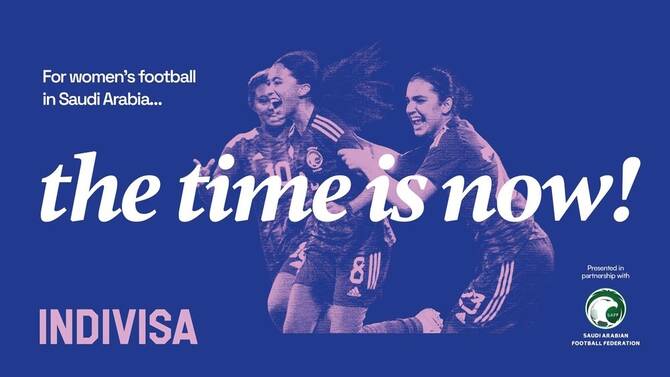
“What’s clear is that Saudi women’s football isn’t an opportunity for brands in the future, it’s now,” Jackson added.
“As we’ve seen in more established markets, the brands that see the greatest benefits are those that are involved early on and get recognized for their contribution to supporting the game.”
Footballco’s research is based on data collected from more than 8,000 women’s sports fans across the world, including more than 1,000 from Saudi Arabia.
Footballco is home to a global football media brand, GOAL, and the biggest Arabic-language sports website, Kooora.
Footballco also operates two dedicated Arabic women’s football brands, INDIVISA, which covers the game and culture from the grassroots, and the Gen-Z YouTube show Yalla Girl.

keywords