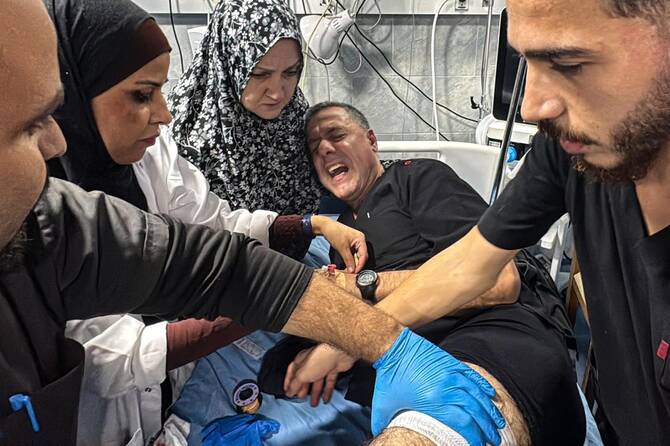
NAZARETH: The director of Gaza’s Kamal Adwan hospital who was detained by Israeli forces in December is being held in “inhumane” conditions by Israel and subjected to “physical and psychological intimidation,” his lawyer told AFP.
Hussam Abu Safiya, a 52-year-old paediatrician, rose to prominence last year by posting about the dire conditions in his besieged hospital in Beit Lahia during a major Israeli offensive.
On December 27, Israeli forces began an assault on the facility which they labelled a Hamas “terrorist center,” and arrested dozens of medical staff including Abu Safiya.
The military accused him of being a “Hamas operative.”
Abu Safiya’s lawyer, Gheed Qassem, was able to visit the doctor on March 19 in Ofer prison in the occupied West Bank.
“He is suffering greatly, he is exhausted from the torture, the pressure and the humiliation he has endured to force him to confess to acts he did not commit,” said Qassem who met an AFP correspondent in Nazareth.
The Israeli military did not respond to a request for comment from AFP about the conditions in which Abu Safiya is being held.
After initially spending two weeks in the Sde Teiman military base in southern Israel’s Negev desert, Abu Safiya was transferred to Ofer, where Israel keeps hundreds of Palestinian prisoners.
In Sde Teiman, Abu Safiya was subjected to interrogations “involving beatings, mistreatment and torture,” Qassem said, before he was transferred to a cramped cell in Ofer for 25 days, where he was also subjected to questioning.
The Israeli authorities have designated the medic an “illegal combatant” for an “unlimited period of time,” Qassem said, and his case has been designated confidential by the military, meaning Abu Safiya’s defense cannot access the files.
She denounced what she said were restrictions imposed on legal visits, which have prevented lawyers from informing detainees about “the war, the date, the time or their geographic location.”
Her meeting with Abu Safiya, which took place under tight surveillance, lasted for only 17 minutes, she said.
Adopted in 2002, Israel’s law concerning “illegal combatants” permits the detention of suspected members of “hostile forces” outside of normal legal frameworks.
In January, rights group Amnesty International demanded Abu Safiya’s release, citing witness testimonies describing “the horrifying reality” in Israeli prisons, where Palestinian detainees are subjected to “systematic acts of torture and other mistreatment.”
A social media campaign using the hashtag #FreeDrHussamAbuSafiya has brought together health care organizations, celebrities and UN leaders.
That includes the director of the World Health Organization, Tedros Adhanom Ghebreyesus, who demanded Abu Safiya’s release in a post on X.
Qassem warned that her client’s health was “very worrying.”
“He is suffering from arterial tension, cardiac arrhythmia and vision problems,” she said, adding “he has lost 20 kilos in two months and fractured four ribs during interrogations, without receiving proper medical care.”
The doctor remains calm, she said, but “wonders what crime he has committed” to be subjected to “such inhumane conditions.”
According to the lawyer, Abu Safiya’s jailers are demanding that he confess to having operated on members of Hamas or Israeli hostages held in Gaza, but he has refused to do so and denies the accusations.
The doctor insists that he is just a paediatrician, “and everything he did was out of a moral, professional and human duty toward the patients and the wounded,” Qassem said.
Since October 7, 2023, around 5,000 Gazans have been arrested by Israel, and some were subsequently released in exchange for hostages held in Gaza.
In general, they are accused of “belonging to a terrorist organization” or of posing “a threat to Israel’s security,” the lawyer said.
Qassem said that a number of detainees are being held without charge or trial and that their lawyers often did not know where their clients were during the first months of the war.


![]()

Gaza hospital chief held in ‘inhumane’ conditions by Israel: lawyer
Short Url
https://arab.news/8ezqp
Gaza hospital chief held in ‘inhumane’ conditions by Israel: lawyer
- Abu Safiya was subjected to interrogations involving beatings, mistreatment and torture.
- In January, rights group Amnesty International demanded Abu Safiya’s release, citing witness testimonies describing “the horrifying reality” in Israeli prisons.


Latest updates


© 2026 SAUDI RESEARCH & PUBLISHING COMPANY, All Rights Reserved And subject to Terms of Use Agreement.