Lebanon assures Jordan of solidarity after foiled threats to national security

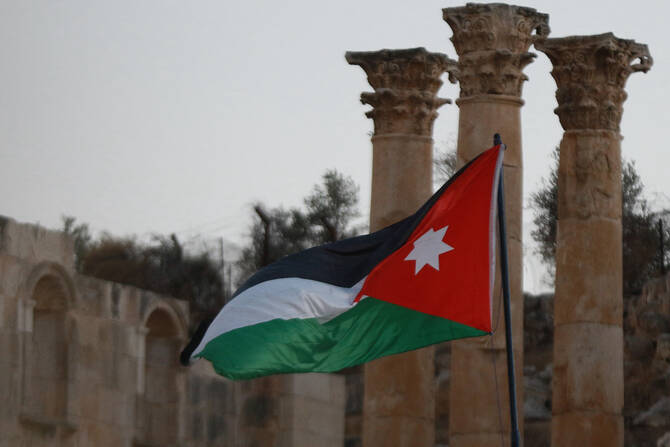
Jordan's flag flutters in the ancient Roman city of Jarash, north of Amman. (AFP)
Short Url
Updated 16 April 2025
Follow

Lebanon assures Jordan of solidarity after foiled threats to national security

  • After arrest of 16 suspects ‘planning acts of chaos and sabotage,’ Beirut is ‘fully prepared’ to cooperate by sharing info about 2 who reportedly trained in Lebanon, says PM Nawaf Salam
  • Palestinian Authority condemns the ‘terrorist plots’ and says ‘attempts to target and weaken Jordan are targeting and weakening Palestine’

LONDON: Lebanon’s prime minister expressed solidarity with Jordan following the arrest on Tuesday of several suspects accused of involvement in plots to compromise Jordanian national security.

During a telephone conversation with his counterpart, Jafar Hassan, Nawaf Salam pledged Lebanon's full cooperation in efforts to tackle threats to Jordan’s security and stability.

Earlier, the Jordanian General Intelligence Department arrested 16 people suspected of “planning acts of chaos and sabotage,” the Jordan News Agency reported. Two of the suspects, Abdullah Hisham and Muath Al-Ghanem, were believed to have visited Lebanon to coordinate with a senior leader in the Muslim Brotherhood and receive training, the agency added.

Salam said Lebanese authorities were “fully prepared” to cooperate with their Jordanian counterparts by providing information about individuals suspected of involvement in the plots who received training in Lebanon, the country’s National News Agency reported.

“Lebanon refuses to be a base or a launching pad for any action that would threaten the security of any brotherly or friendly country,” the prime minister added.

In a message posted on social media platform X, Lebanese MP Fouad Makhzoum said the case affects Lebanon’s relations with Arab and other foreign countries, and urged the government to clarify the circumstances surrounding the suspects’ training.

“All solidarity with Jordan in the face of malicious attempts to undermine its stability,” he added.

During a telephone call with Jordan’s foreign minister, Ayman Safadi, Lebanon’s former prime minister, Najib Mikati, similarly expressed his solidarity with Amman.

The Palestinian Authority condemned the “terrorist plots” and said they represented an attempt to undermine national security. The president’s office said “attempts to target and weaken Jordan are targeting and weakening Palestine,” the Palestinian News Agency reported.


Syria Kurds chief says ‘all efforts’ being made to salvage deal with Damascus

Updated 25 December 2025
Follow

Syria Kurds chief says ‘all efforts’ being made to salvage deal with Damascus

  • Abdi said the Syrian Democratic Forces (SDF), the Kurds’ de facto army, remained committed to the deal
  • The two sides were working toward “mutual understanding” on military integration and counter-terrorism

DAMASCUS: Syrian Kurdish leader Mazloum Abdi said Thursday that “all efforts” were being made to prevent the collapse of talks on an agreement with Damascus to integrate his forces into the central government.
The remarks came days after Aleppo saw deadly clashes between the two sides before their respective leaders ordered a ceasefire.
In March, Abdi signed a deal with Syrian President Ahmed Al-Sharaa to merge the Kurds’ semi-autonomous administration into the government by year’s end, but differences have held up its implementation.
Abdi said the Syrian Democratic Forces (SDF), the Kurds’ de facto army, remained committed to the deal, adding in a statement that the two sides were working toward “mutual understanding” on military integration and counter-terrorism, and pledging further meetings with Damascus.
Downplaying the year-end deadline, he said the deal “did not specify a time limit for its ending or for the return to military solutions.”
He added that “all efforts are being made to prevent the collapse of this process” and that he considered failure unlikely.
Abdi also repeated the SDF’s demand for decentralization, which has been rejected by Syria’s Islamist authorities, who took power after ousting longtime ruler Bashar Assad last year.
Turkiye, an important ally of Syria’s new leaders, sees the presence of Kurdish forces on its border as a security threat.
In Damascus this week, Turkish Foreign Minister Hakan Fidan stressed the importance of the Kurds’ integration, having warned the week before that patience with the SDF “is running out.”
The SDF control large swathes of the country’s oil-rich north and northeast, and with the support of a US-led international coalition, were integral to the territorial defeat of the Daesh group in Syria in 2019.
Syria last month joined the anti-IS coalition and has announced operations against the jihadist group in recent days.