

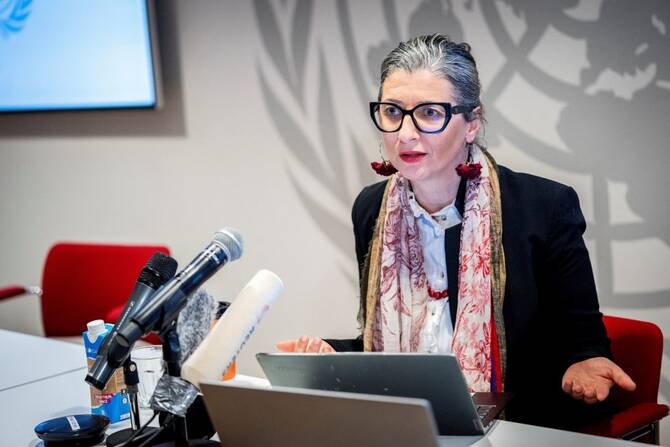

NEW YORK CITY: The US has strongly denounced the continued tenure of Francesca Albanese as the UN special rapporteur on the situation of human rights in the Palestinian territories, citing what it describes as antisemitic rhetoric and bias against Israel.
In a statement issued by the US Mission to the UN, Washington reiterated its longstanding opposition to Albanese’s role, saying her actions “make clear the United Nations tolerates antisemitic hatred, bias against Israel, and the legitimization of terrorism.”
Albanese’s outspokenness against Israeli policies and what the International Court of Justice has ruled as potential genocidal actions in Gaza has marked what many called “an extraordinary period in UN history and even for human rights struggle in world history.”
But the US described Albanese’s record as emblematic of the broader failings of the UN Human Rights Council, whose support for Albanese “offers yet another example of why President Trump ordered the United States to cease all participation in the HRC.”
Albanese, an Italian academic appointed to the mandate in 2022, will remain in the role until April 2028, completing the six-year maximum term for special rapporteurs. The position is unpaid.
The UNHRC said that no formal reappointment was made during its recent 58th session earlier this month, adding that her tenure is proceeding as originally scheduled.
Albanese’s continued role has drawn sharp criticism from pro-Israel organizations and the Israeli government.
Israel’s Ambassador to the UN, Danny Danon, condemned what he described as the council’s de facto renewal of her mandate, calling it “a disgrace and a moral stain on the United Nations.”
He accused Albanese of promoting antisemitic views and excusing Hamas’ actions during the Oct. 7 attacks.
Pro-Israel advocacy groups had petitioned the council to remove Albanese, citing her statements and reports as evidence of partiality.
Critics point to her March 2025 report, in which Albanese accused Israel of pursuing a “long-term strategy” of ethnic cleansing in Gaza and the West Bank.
However, pro-Palestinian figures, including prominent Jewish historians, lawyers, and human rights advocates, have rallied in support of Albanese, with many praising her continued role as “a small, but defiant, victory for Gaza, truth, and human rights.”
Albanese, who is also affiliated with Georgetown University and a former UNRWA staffer, has faced mounting scrutiny since the outbreak of Israel’s military campaign in Gaza in October 2023.
Similar attacks, although less ferocious, have been directed at each of the three special rapporteurs that preceded Albanese. One of the three, Richard Falk, described the claims against Albanese as “a totally defamatory smear that has been repeated by Israeli media and lobbying organizations around the world.”
Falk described Albanese as “a person of the highest moral character, a true champion of human rights, and someone who is entirely free from prejudice against any ethnicity, including, of course, the Jewish people.”
He added that at the same time, Albanese is “an unsparing critic of Israel as a state guilty of settler colonial policies and practices that have made the Palestinian people suffer extreme harm and hardships since 1948.”
Her defenders believe the backlash is part of a political campaign to silence criticism of Israeli actions in Gaza and the West Bank.
The UNHRC has not signaled any move to alter Albanese’s mandate before its scheduled end in 2028.


