

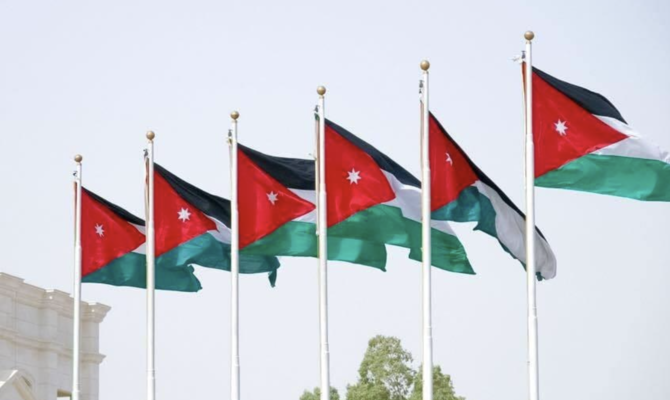
Jordanian intelligence thwarts plots threatening national security

Officials at Jordan's General Intelligence Department said on Tuesday they had foiled a series of plots targeting the kingdom’s national security. (Jordan News Agency)
Short Url
Updated 16 April 2025
Follow

Jordanian intelligence thwarts plots threatening national security

  • Department arrests 16, says Jordan News Agency 
  • TV report on arrests identified Ibrahim Mohammad as key instigator affiliated with unlicensed Muslim Brotherhood group

AMMAN: Officials at Jordan’s General Intelligence Department said on Tuesday they had foiled a series of plots targeting the country’s national security, the Jordan News Agency reported.

The GID arrested 16 individuals suspected of “planning acts of chaos and sabotage,” according to the agency.

Authorities said the department had been monitoring the group’s activities since 2021.

The foiled plans reportedly involved the manufacture of missiles using both locally sourced materials and imported components. Explosives and firearms were also found.

Investigators additionally uncovered a missile that had been concealed and prepared for deployment.

In addition to the weapons cache, the suspects were allegedly engaged in efforts to develop drones, recruit and train individuals within the country, and send others abroad for further training.

All the individuals arrested have been referred to the State Security Court for legal proceedings, the GID confirmed.

A televised report aired on Jordanian television on Tuesday revealed further details about the cell, identifying three main operatives behind the plot, which was allegedly spearheaded by Ibrahim Mohammad — a key instigator affiliated with the unlicensed Muslim Brotherhood group, the JNA reported.

Ibrahim, who is already on trial in a separate case involving the transport and storage of nearly 30 kilograms of high-grade explosives including TNT, C4, and SEMTEX-H, reportedly urged others to manufacture rockets inside Jordan.

According to confessions from the suspects, two members of the cell — Abdullah Hisham and Muath Al-Ghanem — were sent to Lebanon to coordinate with a senior figure in the organization and receive training.

A third operative, Muhsen Al-Ghanem, was tasked with transferring funds from abroad to finance the operation, JNA added.

The group established operational hubs in the governorates of Zarqa and Amman, setting up a manufacturing site and a warehouse in the Nuqaira area of the capital.

The warehouse, concealed behind a camouflaged cement door, was used to store raw materials, prototype rocket parts, and completed assemblies.

Security forces uncovered metal components in the suspects’ homes, including tubular and conical shapes consistent with improvised rocket designs. When assembled, the parts formed short-range rockets modelled on the GRAD system, ready to be fitted with explosives, turbines, and detonators.

Technical analysis suggested the seized materials were sufficient to produce up to 300 such rockets, each with a range of 3–5 kilometers.

Echos Of Civil War
50 years on, Lebanon remains hostage to sectarian rivalries

Enter


keywords

IMF approves reviews, unlocks $240m in funding for Jordan

Updated 11 sec ago
Follow

IMF approves reviews, unlocks $240m in funding for Jordan

  • The decision allows Jordan to draw about $130 million under the EFF and about $110 million under the RSF

AMMAN: The International Monetary Fund’s executive board has completed the fourth review of Jordan’s Extended Fund Facility and the first review under the Resilience and Sustainability Facility, unlocking immediate access to about $240 million to support the Kingdom’s economic program.

The decision allows Jordan to draw about $130 million under the EFF and about $110 million under the RSF, bringing total disbursements under the IMF arrangement to about $733 million.

In a statement issued on Saturday, the IMF said Jordan’s economy “remains resilient,” supported by sound macroeconomic policies and strong international backing.

Growth accelerated to 2.7 percent in the first half of 2025 and is expected to reach about 3 percent in the coming years, driven by major investment projects, deeper regional integration and continued structural reforms.

Inflation remains anchored at about 2 percent, while the current account deficit is projected to narrow to below 5 percent of GDP over the medium term. The IMF also noted that Jordan’s banking sector is stable and international reserves remain strong.

Fiscal performance continues to align with program targets, underpinned by robust revenue collection and disciplined current spending. The authorities remain committed to reducing public debt to 80 percent of GDP by 2028 through gradual fiscal consolidation, while protecting social and development spending and reducing losses at public utilities.

The IMF said progress under the RSF is ongoing, with reforms addressing vulnerabilities in the water and electricity sectors and strengthening health emergency preparedness. All reform measures scheduled for the current review have been completed.

Commenting after the board discussion, IMF Deputy Managing Director Kenji Okamura said Jordan’s continued macroeconomic stability amid persistent external headwinds reflects the authorities’ commitment to sound policies, supported by strong international assistance.

He said growth continues to recover, inflation remains low and reserve buffers are strong, stressing the importance of maintaining prudent fiscal and monetary policies amid regional tensions and global uncertainty.

Okamura added that accelerated structural reforms are essential to foster job-rich growth, improve the business environment, enhance labour market flexibility, tackle youth unemployment and low female labour force participation, and attract private investment.

He also underlined the importance of sustained donor support to help Jordan manage external challenges and the economic cost of hosting large numbers of refugees, while noting that progress under the RSF would help address long-term vulnerabilities and strengthen balance-of-payments stability.