

Syria leader in Qatar for first time since Assad’s fall

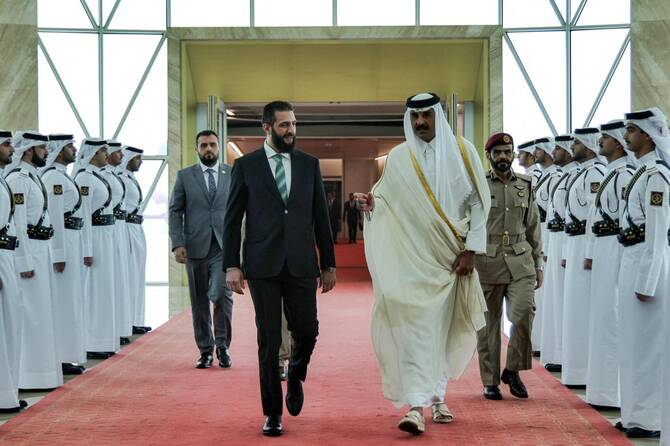
Interim President Ahmed Al-Sharaa, left, is received by Qatar’s Emir Sheikh Tamim bin Hamad Al-Thani at Hamad International Airport in Doha on April 15, 2025. (Syrian Presidency/AFP)
Short Url
Updated 16 April 2025
Follow

Syria leader in Qatar for first time since Assad’s fall

  • Emir Sheikh Tamim bin Hamad Al-Thani met Syria’s interim President Ahmed Al-Sharaa on his arrival
  • Qatar was one of the first Arab countries to back the armed rebellion led by Al-Sharaa

DOHA: Syria’s new president arrived in Qatar on Tuesday, state media said, for his first official visit to the Gulf state, a key backer of the new administration after longtime ruler Bashar Assad’s ouster.
The official Qatar News Agency reported Emir Sheikh Tamim bin Hamad Al-Thani met Syria’s interim President Ahmed Al-Sharaa on his arrival at Doha’s Hamad International Airport.
Earlier, Syria’s foreign minister posted on X that he was accompanying Sharaa on his “first presidential visit to the country that has stood by Syrians from day one and has never abandoned them.”
Sharaa and Shaibani’s Qatar trip comes on the heels of a Sunday visit to the United Arab Emirates, where they met Emirati President Sheikh Mohamed bin Zayed Al-Nahyan, who expressed his country’s support for Syria’s reconstruction.
Sharaa’s Islamist group Hayat Tahrir Al-Sham led the alliance that ousted Assad from power on December 8.
His new administration has received support from several countries including key backers Turkiye and Qatar, as well as multiple Arab states.
Qatar was one of the first Arab countries to back the armed rebellion that erupted after Assad’s government crushed a peaceful uprising in 2011. Unlike other Arab nations, Doha did not restore diplomatic ties with Syria under Assad.
The new authorities have engaged in a flurry of diplomatic activity since taking power, and Sharaa has visited several Arab countries as well as Turkiye.
Meanwhile, Lebanese President Joseph Aoun departed Beirut on Tuesday for Doha, his office said, on his first visit to the Gulf country since his January election.
“The visit will continue until tomorrow afternoon, Wednesday, and will include a bilateral meeting between President Aoun and the Emir of Qatar, as well as expanded talks involving both the Qatari and Lebanese delegations,” Aoun’s presidential office said.
A day earlier, Lebanese Prime Minister Nawaf Salam met with Sharaa in Damascus in an effort to reboot ties between the two neighbors.
Beirut and Damascus have been seeking to improve relations since the overthrow of Assad, whose family dynasty exercised control over Lebanese affairs for decades and has been accused of assassinating numerous officials in Lebanon who expressed opposition to its rule.
Middle East analyst Andreas Krieg said since the fall of the Assad government, Qatar had emerged as “the most important interlocutor with the Al-Sharaa government in the Arab world, at least after Turkiye.”
He said the gas-rich Gulf emirate was a “diplomatic force multiplier to the Al-Sharaa government in Syria” and would be able to connect Syrians back to Lebanon “which is, for both countries, extremely important.”
Sheikh Tamim visited Damascus in January, becoming the first head of state to visit since Assad’s ouster.
Doha has pledged to support the rehabilitation of Syria’s infrastructure, and in January announced an agreement to provide Syria with 200 megawatts of power, gradually increasing production.
Syrian authorities are seeking assistance including from wealthy Gulf states for reconstruction after nearly 14 years of war.
Qatar is one of the providers of financial and in-kind support to the Lebanese army and pledged support for reconstruction in February after the recent confrontation between Hezbollah and Israel.

Echos Of Civil War
50 years on, Lebanon remains hostage to sectarian rivalries

Enter


keywords

West Bank Bedouin community driven out by Israeli settler violence

Updated 4 sec ago
Follow

West Bank Bedouin community driven out by Israeli settler violence

  • With heavy hearts, Bedouins in a West Bank village dismantle their sheep pens and load belongings onto trucks, forced from their homes in the Israeli-occupied territory by rising settler violence
Ras ‘Ein al ‘Auja, Palestinian Territories: With heavy hearts, Bedouins in a West Bank village dismantle their sheep pens and load belongings onto trucks, forced from their homes in the Israeli-occupied territory by rising settler violence.
While attacks by Israeli settlers affect communities across the West Bank, the semi-nomadic Bedouins are among the territory’s most vulnerable, saying they suffer from forced displacement due in large part to a lack of law enforcement.
“What is happening today is the complete collapse of the community as a result of the settlers’ continuous and repeated attacks, day and night, for the past two years,” Farhan Jahaleen, a Bedouin in the village of Ras Ein Al-Auja, told AFP.
Since Israel took control of the West Bank in 1967, Israeli outposts have steadily expanded, with more than 500,000 settlers now living in the territory, which is also home to three million Palestinians.
A minority of settlers engage in violence toward the locals aimed at coercing them to leave, with the UN recording an unprecedented 260 attacks in October last year.
The threat of displacement has long hung over Jahaleen’s community, but the pressure has multiplied in recent months as about half of the hamlet’s 130 families decided to flee.
Among them, 20 families from the local Ka’abneh clan left last week, he said, while around another 50 families have been dismantling their homes.
’We can’t do anything’
The trailers of settlers dot the landscape around the village but are gradually being replaced by houses with permanent foundations, some built just 100 meters (300 feet) from Bedouin homes.
In May last year, settlers diverted water from the village’s most precious resource — the spring after which it is named.
Nestled between rocky hills to the west and the flat Jordan Valley that climbs up the Jordanian plateau to the east, the spring had allowed the community to remain self-sufficient.
But Bedouin families have been driven away by the constant need to stand guard to avoid settlers cutting the power supply and irrigation pipes, or bringing their herds to graze near Bedouin houses.
“If you defend your home, the (Israeli) police or army will come and arrest you. We can’t do anything,” lamented Naif Zayed, another local.
“There is no specific place for people to go; people are acting on their own, to each their own.”
Most Palestinian Bedouins are herders, which leaves them particularly exposed to violence when Israeli settlers bring their own herds that compete for grazing land in isolated rural areas.
It is a strategy that settlement watchdog organizations have called “pastoral colonialism.”
Israel’s military chief Lt. Gen. Eyal Zamir said in November that he wanted to put a stop to the violence. This month the army announced new monitoring technology to enforce movement restrictions on both Israelis and Palestinians, with Israeli media reporting the move was largely aimed at reining in settler attacks.
Asked for comment, the Israeli military said: “Incidents in the Ras Al-Ain are well known. (Israeli military) forces enter the area in accordance with calls and operational needs, aiming to prevent friction between populations and to maintain order and security in the area.”
It said it had increased its presence in the area “due to the many recent friction incidents.”
’Bedouin way of life’
Naaman Ehrizat, another herder from Ras Ein Al-Auja, told AFP he had already moved his sheep to the southern West Bank city of Hebron ahead of his relocation.
But Jahaleen said moving to other rural parts of the territory risks exposing the herders to yet more displacement in the future.
He pointed to other families pushed out of the nearby village of Jiftlik, who were again displaced after moving to a village in the Jordan Valley.
Slogans spray-painted in Arabic have appeared along major roads in the West Bank in recent months that read: “No future in Palestine.”
For Jahaleen, whose family has lived in Ras Ein Al-Auja since 1991, the message sums up his feelings.
“The settlers completely destroyed the Bedouin way of life, obliterated the culture and identity, and used every method to change the Bedouin way of life in general, with the complete destruction of life,” he said.