

Nigeria embraces AI in education to equip youth for global economy

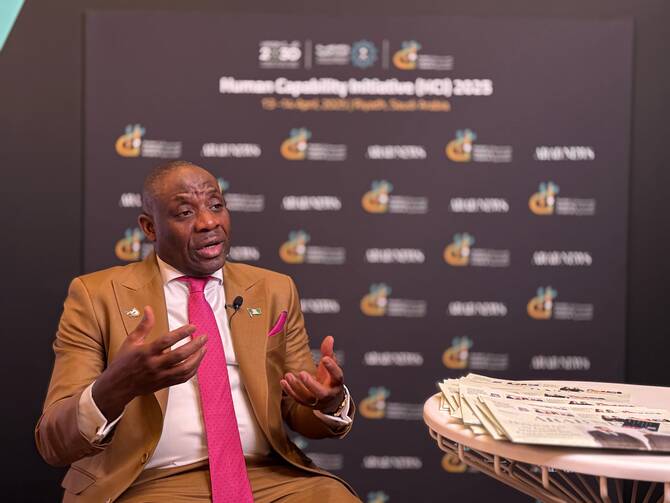
Nigeria’s Minister of State for Education Maruf Tunji Alausa during an interview with Arab News. AN photo by Huda Bashatah
Short Url
Updated 14 April 2025
Follow

Nigeria embraces AI in education to equip youth for global economy

RIYADH: Nigeria is integrating artificial intelligence into its education system as part of a broader strategy to train its vast youth population for the global tech economy, according to Minister of State for Education Maruf Tunji Alausa.  

Speaking to Arab News on the sidelines of the Human Capability Initiative in Riyadh, Alausa said African nations must embrace AI in education while ensuring that students retain critical social skills. 

“The basic outcome was that we don’t have a choice now, AI has come to stay. We need to now use AI as part of our learning,” Alausa said. “Countries need to infuse AI to help augment and improve education delivery.” 

However, he cautioned against over-reliance on technology, warning that it must not erode children’s social skills. “We have to be sure that it doesn’t leave deficiencies in the skill set, in the social skills of our children,” he added.   

With over 60 percent of Africa’s 1.2 billion people under 30 — and Nigeria’s 220 million population being 70 percent youth — Alausa argued that the continent is uniquely positioned to supply skilled labor to aging economies like Europe, Japan, and the US. 

“Today, Nigeria has 65 million people between 15 and 29, with 5 million entering the workforce yearly,” he said. “We need to train this youthful population in tech skills — software development, cybersecurity, AI, cloud computing — so they can service companies worldwide while staying in Nigeria.”  

Nigeria has launched a digital training academy to upskill university graduates in high-demand tech fields, enabling them to earn online certifications and work remotely for international firms. Alausa urged other African nations to adopt similar models.   

During his visit to Saudi Arabia, Alausa toured several academic institutions alongside Education Minister Yousef Al-Benyan and praised the Kingdom’s dual-track approach to higher education. 

“Saudi Arabia has gotten it right,” he said. 

He also announced forthcoming collaborations between Nigeria and Saudi Arabia in education and skills development. 

“As we learn from Saudi Arabia, Saudi Arabia can also learn from us,” Alausa added.  

Held under the patronage of Crown Prince Mohammed bin Salman, the Human Capability Initiative convened more than 12,000 experts from over 100 countries to address the intersection of education, workforce transformation, and emerging technologies. 

This year’s theme, “Beyond Readiness,” focused on AI, inclusive development, and global equity in skills training.   

With Nigeria positioning itself as a hub for global tech talent, Alausa’s vision aligns with HCI’s goal of fostering cross-border partnerships to future-proof economies.


Saudi minister at Davos urges collaboration on minerals

Global collaboration on minerals essential to ease geopolitical tensions and secure supply, WEF hears. (Supplied)
Updated 20 January 2026
Follow

Saudi minister at Davos urges collaboration on minerals

  • The reason of the tension of geopolitics is actually the criticality of the minerals

LONDON: Countries need to collaborate on mining and resources to help avoid geopolitical tensions, Saudi Arabia’s minister of industry and mineral resources told the World Economic Forum on Tuesday.

“The reason of the tension of geopolitics is actually the criticality of the minerals, the concentration in different areas of the world,” Bandar Alkhorayef told a panel discussion on the geopolitics of materials.

“The rational thing to do is to collaborate, and that’s what we are doing,” he added. “We are creating a platform of collaboration in Saudi Arabia.”

Bandar Alkhorayef, Saudi Minister of Industry and Mineral Resources 

The Kingdom last week hosted the Future Minerals Forum in Riyadh. Alkhorayef said the platform was launched by the government in 2022 as a contribution to the global community. “It’s very important to have a global movement, and that’s why we launched the Future Minerals Forum,” he said. “It is the most important platform of global mining leaders.”

The Kingdom has made mining one of the key pillars of its economy, rapidly expanding the sector under the Vision 2030 reform program with an eye on diversification. Saudi Arabia has an estimated $2.5 trillion in mineral wealth and the ramping up of extraction comes at a time of intense global competition for resources to drive technological development in areas like AI and renewables.

“We realized that unlocking the value that we have in our natural resources, of the different minerals that we have, will definitely help our economy to grow to diversify,” Alkhorayef said. The Kingdom has worked to reduce the timelines required to set up mines while also protecting local communities, he added. Obtaining mining permits in Saudi Arabia has been reduced to just 30 to 90 days compared to the many years required in other countries, Alkhorayef said.

“We learned very, very early that permitting is a bottleneck in the system,” he added. “We all know, and we have to be very, very frank about this, that mining doesn’t have a good reputation globally.

“We are trying to change this and cutting down the licensing process doesn’t only solve it. You need also to show the communities the impact of the mining on their lives.”

Saudi Arabia’s new mining investment laws have placed great emphasis on the development of society and local communities, along with protecting the environment and incorporating new technologies, Alkhorayef said. “We want to build the future mines; we don’t want to build old mines.”