

Gabon junta chief Oligui Nguema wins presidential election deemed to be fair

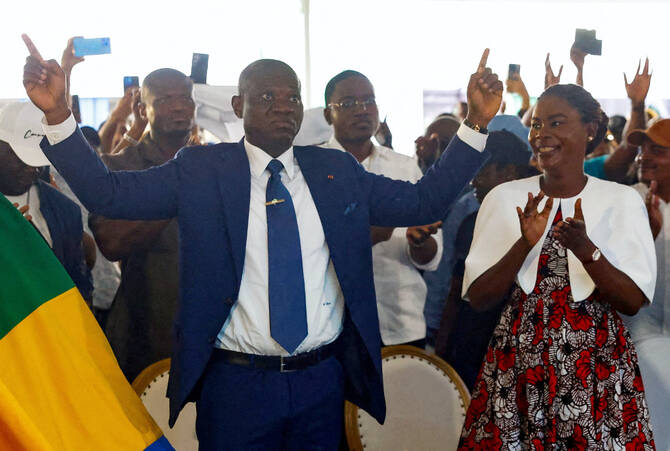
Gabon junta leader Brice Clotaire Oligui Nguema celebrates in Libreville, Gabon, after he was proclaimed winner in the country's presidential election on April 13, 2025. (Reuters)
Short Url
Updated 14 April 2025
Follow

Gabon junta chief Oligui Nguema wins presidential election deemed to be fair

  • Seeking to shed his military strongman image, Oligui allowed foreign and independent media to film the ballot count
  • The new president faces a litany of problems in the oil-rich country, from crumbling infrastructure to widespread poverty

LIBREVILLE: Junta chief Brice Oligui Nguema celebrated a huge victory in Gabon’s presidential election Sunday after provisional results gave him 90.35 percent of the vote.
Oligui, who ended more than five decades of corruption-plagued rule by the Bongo family in August 2023, assuming the role of transitional president, had promised to return the country to democratic rule.
“God does not abandon his people,” Oligui told hundreds of delighted supporters at his campaign headquarters, paying tribute to what he called “the maturity of the Gabonese people.”
Interior Minister Hermann Immongault said earlier that Oligui had won a seven-year mandate with more than 575,200 votes, or 90.3 percent, of the votes counted so far.
His main rival, Alain-Claude Bilie By Nze, took three percent of the vote and six other candidates failed to win more than 1 percent in Saturday’s election.
Even before the count was completed, the official Gabonese media had that announced Mr. Oligui was “far ahead.”
Voters in the nation of 2.3 million people flocked to the ballot boxes on Saturday to take part in an election officially marking the end of military rule. The interior ministry put the participation rate at 70.4 percent.
French President Emmanuel Macron congratulated Oligui on his win and the conduct of the election in a telephone call, his office said.

The day after voting, the streets of the capital Libreville were calm — in contrast with elections in 2016 and 2023 marked by tensions and unrest.
“I hadn’t voted in a long time, but this time, I saw a ray or something that made me go out and vote,” 58-year-old Olivina Migombe told AFP while en route to church on Sunday.
“I believe in change this time,” the professed Oligui voter added.
The new president faces a litany of problems in the oil-rich country, from crumbling infrastructure to widespread poverty, all while laboring under a crushing mountain of debt.
Oligui had sought to shed his military strongman image and even ditched his general’s uniform to run for a seven-year term.
The junta leader dominated the campaign, with his seven challengers, led by ousted leader Ali Bongo’s last prime minister, Alain-Claude Bilie By Nze, largely invisible by comparison.
Critics accuse Oligui of having failed to move on from the years of plunder of the country’s vast mineral wealth under the Bongos, whom he served for years.
For the first time, foreign and independent media were allowed to film the ballot count.
International observers at polling stations across the country did not see major incidents, according to first reports.
In total, some 920,000 voters were eligible to cast ballots at 3,037 polling stations, of which 96 were abroad.
Already, in the first results released by state media on Sunday morning, Oligui was the overwhelming favorite to win in around 30 polling stations, some of them returning results of 100 percent of the vote in his favor.


US moves to counter China in Bangladesh, plans to pitch defense alternatives

Updated 3 sec ago
Follow

US moves to counter China in Bangladesh, plans to pitch defense alternatives

DHAKA: The United States is concerned about China’s ​expanding presence in South Asia and is planning to offer Bangladesh’s next government US and allied defense systems as alternatives to Chinese hardware, Washington’s ambassador to Dhaka told Reuters. Bangladesh votes in a general election on Thursday after a Gen Z-led uprising toppled India-allied premier Sheikh Hasina in August 2024. She has since taken refuge in New Delhi, allowing China to deepen its influence in Bangladesh as India’s presence wanes. China recently signed a defense agreement with Bangladesh to build a drone factory near the India border, worrying foreign diplomats. Bangladesh is also in talks with Pakistan to buy JF-17 Thunder fighter jets, a multi-role combat ‌aircraft jointly developed with ‌China.
“The United States is concerned about growing Chinese influence in South ​Asia ‌and ⁠is committed ​to ⁠working closely with the Bangladeshi government to clearly communicate the risks of certain types of engagement with China,” US Ambassador Brent T. Christensen said in an interview on Tuesday.
“The US offers a range of options to help Bangladesh meet its military capability needs, including US systems and those from allied partners, to provide alternatives to Chinese systems,” he said without offering further details.
The Chinese foreign ministry did not immediately respond to a request for comment.
Christensen also said that President Donald Trump’s administration would “like to see a good relationship between Bangladesh and India ⁠to support stability in the region.” New Delhi-Dhaka relations have nosedived since ‌Hasina fled, badly affecting visa services and cricket ties between the ‌two neighbors.

COMMERCIAL DIPLOMACY IS PRIORITY
Christensen said many US businesses were looking ​at potentially investing in Bangladesh but would want ‌the next government to show early and clear signs that it is “open for business.”
“Commercial diplomacy is one ‌of our top priorities, and we look forward to working with the new government to build on progress made with the interim government, particularly in strengthening commercial, economic, and security ties,” he said.
Energy producer Chevron has been in Bangladesh for decades but not many other US companies are visible in the densely populated country of 175 million people, ‌as high taxes and difficulties repatriating profits have created some hurdles.
There are no Starbucks or McDonald’s outlets in Bangladesh.
The envoy said Washington would ⁠work with “whichever government is elected ⁠by the Bangladeshi people.” The race is between two coalitions led by former allies, the Bangladesh Nationalist Party (BNP) and the Islamist Jamaat-e-Islami, with opinion polls suggesting the BNP holds an advantage.

AID FOR ROHINGYA REFUGEES
Regarding the 1.2 million Rohingya refugees sheltered in Bangladesh, the ambassador said the United States remained the largest contributor to humanitarian operations.
“The US remains the largest contributor to the Rohingya refugee response and continues robust health programming in Bangladesh,” he said, noting a recent $2 billion worldwide funding framework signed with the United Nations to improve the effectiveness of such assistance, including in Bangladesh.
He urged other international donors to take on a greater share of the burden.
“The US cannot sustain the bulk of the effort alone. International partners need to increase their support for the Rohingya response,” he said. In recent years, the UN refugee agency has ​been struggling to raise sufficient funds to support ​the Rohingya community, leading to cuts in their rations and the closure of some schools for them.