JERUSALEM: Israeli Prime Minister Benjamin Netanyahu on Sunday lashed out at French President Emmanuel Macron over his plans to recognize a Palestinian state.
“President Macron is gravely mistaken in continuing to promote the idea of a Palestinian state in the heart of our land — a state whose sole aspiration is the destruction of Israel,” Netanyahu said in a statement.
He was addressing Macron’s remarks earlier this week in which he said that France could recognize a Palestinian state within months.
“To this day, not a single figure in Hamas or the Palestinian Authority has condemned the horrors of the worst massacre of Jews since the Holocaust,” Netanyahu said, referring to the October 7, 2023 attack led by Hamas on Israel.
He described this as “a silence that reveals their true attitude toward the Jewish state.
“We will not endanger our existence over illusions detached from reality, and we will not accept moral lectures about establishing a Palestinian state that would threaten Israel’s survival — especially not from those who oppose granting independence to Corsica, New Caledonia, French Guiana, and other territories, whose independence would pose no threat to France whatsoever.”
His remarks echoed those of his son Yair, who struck out at Macron in an earlier post on X.
“Screw you!” Yair Netanyahu wrote in English late on Saturday.
“Yes to independence of New Caledonia! Yes to independence to French Polynesia! Yes to independence of Corsica! Yes to independence of the Basque Country! Yes to independence of French Guinea!” he added, apparently confusing it with French Guiana.
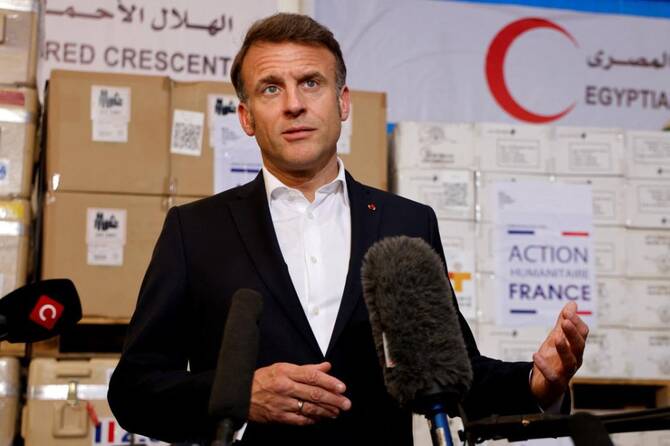
Macron, in an interview to France 5 broadcast on Wednesday, stated that France could take the step during a UN conference in New York in June, saying he hoped this would trigger a reciprocal recognition of Israel by Arab countries.
“We must move toward recognition, and we will do so in the coming months,” Macron said.
“I will do it because I believe that at some point it will be right and because I also want to participate in a collective dynamic, which must also allow all those who defend Palestine to recognize Israel in turn, which many of them do not do.”
His remarks sparked a wave of criticism from right-wing groups in France, after which Macron appeared to clarify his initial remarks on Friday.
“I support the legitimate right of Palestinians to a state and to peace, just as I support the right of Israelis to live in peace and security, both recognized by their neighbors,” he said on X.
“I am doing everything I can with our partners to reach this goal of peace. We truly need it,” he said.
Relations between Israel and France have deteriorated in recent months.
France has long championed a two-state solution to the Israeli-Palestinian conflict, including after the October 7, 2023 attack by Palestinian militant group Hamas on Israel.
But formal recognition by Paris of a Palestinian state would mark a major policy switch and risk antagonizing Israel, which insists such moves by foreign states are premature.
France would be the most significant European power to recognize a Palestinian state, a move the United States has also long resisted. Hamas welcomed Macron’s statement.
Nearly 150 countries recognize a Palestinian state.
Last May, Ireland, Norway and Spain announced recognition, followed by Slovenia in June, moves partly fueled by condemnation of Israel’s bombing of Gaza that followed the October 7, 2023 Hamas attacks on Israel.


![]()

Israel PM says Macron ‘gravely mistaken’ in promoting Palestinian state
Short Url
https://arab.news/5t2fz
Israel PM says Macron ‘gravely mistaken’ in promoting Palestinian state
- “President Macron is gravely mistaken in continuing to promote the idea of a Palestinian state in the heart of our land,” Netanyahu said


Latest updates


© 2026 SAUDI RESEARCH & PUBLISHING COMPANY, All Rights Reserved And subject to Terms of Use Agreement.