

Saudi Arabia launches bold initiatives to empower youth, drive innovation

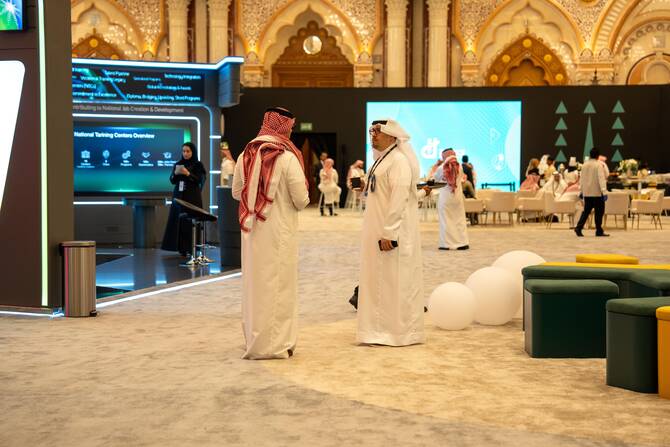
Held under the patronage of Crown Prince Mohammed bin Salman, the Human Capability Initiative 2025 runs from April 13-14 at the King Abdulaziz International Conference Center in Riyadh. AN photo by Huda Bashatah
Short Url
Updated 13 April 2025
Follow

Saudi Arabia launches bold initiatives to empower youth, drive innovation

RIYADH: The opening day of the Human Capability Initiative 2025 in Riyadh marked a significant milestone in the Kingdom’s journey toward empowering youth and fostering innovation with the signing of several agreements and the launch of impactful programs.

In a move underscoring global collaboration, the Kingdom signed an agreement with the Saudi Arabian Scouts Association, the World Organization of the Scout Movement, and the World Scout Foundation.

Under this partnership, Saudi Arabia will invest $50 million over the next decade to support the Messengers of Peace initiative—a global youth-led program focused on peace-building and sustainable development projects.

On the national front, the Kingdom reaffirmed its commitment to transforming education through the National Curriculum Center. This research-driven institution, working with key government entities such as the Ministries of Sports, Education, Economy and Planning, and Culture, aims to empower teachers and better prepare students for global competitiveness.

King Saud University and CEER, the Kingdom’s national automotive company, also signed a memorandum of understanding to promote collaboration in scientific research, training, and knowledge sharing.

Their partnership will emphasize innovation, technical consulting, and talent development—critical elements in building a knowledge-based economy.

In an effort to professionalize the sports sector, the Ministry of Sports, in partnership with the Leaders Development Institute, introduced the Professional License and Program Accreditation Regulation.

This initiative sets a new benchmark for qualifications, training, and the development of athletic professionals in line with Vision 2030.

Further advancing digital capabilities, the Ministry of Communications and Information Technology, in collaboration with Noon, launched the second edition of the Digital Future Readiness Program.

This initiative will equip 7,000 Saudi students with generative AI skills, combining hands-on training with cutting-edge digital tools to cultivate future-ready leaders.

The Ministry of Tourism also backed a strategic agreement between Umm Al-Qura University and Ecole Hoteliere de Lausanne to strengthen collaboration in tourism education and training.

KSU launched a new open online training platform, offering certified programs recognized by both the university and the National e-Learning Center.

This platform expands professional development opportunities while enabling developers to contribute and gain academic accreditation for their content.

Additionally, KSU signed agreements with IBM Middle East and the Saudi Authority for Data and Artificial Intelligence to accelerate AI innovation through specialized training and certifications.

The Ministry of Human Resources and Social Development also awarded KSU the prestigious Gold Certificate for Accreditation, recognizing its compliance with Universal Accessibility Standards. This milestone underscores KSU’s ongoing commitment to creating an inclusive environment for both students and staff, aligning with Saudi Arabia’s Vision 2030 goals for equitable and accessible education.

In related developments, the King Salman Global Academy for Arabic Language launched several initiatives aimed at strengthening Arabic language education and research on a global scale. One key initiative, the “Language Policies Around the World” project, will compile and analyze language policies in non-Arab countries, comparing them with Saudi Arabia’s own approach. The findings will be presented in a comprehensive report, followed by an international symposium to discuss the future directions of language policy.

KSGAAL is also expanding the scope of its Arabic Language Months initiative. In its second phase, the program will continue offering high-quality Arabic teaching programs, focusing on educator training, improving learning methodologies, and enhancing Arabic’s presence worldwide.

Alongside this, KSGAAL is introducing the “Kalamuna” video series, which features over 50 Arabic language experts who will produce 1,000 short video clips—each under two minutes—aimed at simplifying complex linguistic concepts and elevating the cultural status of Arabic. These videos will be shared across a variety of digital platforms.

Additionally, KSGAAL has launched the “Children of Arabic” book series, a collection of 30 interactive books designed for young learners. The series includes literary stories, language games, and coloring/activity books, with the goal of engaging children with both the Arabic language and Saudi culture in an educational and fun way.

Meanwhile, the Heritage Commission has introduced the Heritage Pioneers Program, an annual training initiative aimed at 500 participants in fields such as archaeology, site management, and craft preservation. The program offers participants hands-on experience, mentorship from experts, and collaboration with universities and cultural organizations to develop critical skills in heritage conservation.

Targeting both recent graduates and experienced practitioners, the program plays an important role in supporting Saudi Arabia’s cultural leadership and its broader sustainable development goals.

The Ministry of Industry and Mineral Resources signed an MoU with FESTO, a German company, to develop vocational training programs in industrial facilities across the Kingdom.

Minister of Industry and Mineral Resources Bandar Al-Khorayef also witnessed the launch of NAVA Academy—the first digital glossary for electric vehicle manufacturing and maintenance terminology.

This initiative was launched in partnership with theministry and the King Salman Global Academy for Arabic Language.

The UN Educational, Scientific and Cultural Organization, through its Regional Center for Quality and Excellence in Education, established a strategic partnership with the World Bank to advance educational development initiatives.

The first day of the event concluded with the signing of a MoU between the Statistical, Economic and Social Research and Training Centre for Islamic Countries and the Technical and Vocational Training Corp., reinforcing efforts to enhance vocational education and workforce development across the region.

Held under the patronage of Crown Prince Mohammed bin Salman, the Human Capability Initiative 2025 runs from April 13-14 at the King Abdulaziz International Conference Center in Riyadh. Themed “Beyond Readiness,” the summit brings together more than 12,000 attendees and 300+ speakers from over 100 countries.

Discussions focus on preparing the global workforce for future challenges, with key themes including AI-driven transformations, upskiling strategies, and inclusive development. The event also features the Education Global Exhibition, spotlighting innovations in learning and workforce evolution.


Saudi Arabia sets global benchmark in AI modernization

Updated 15 January 2026
Follow

Saudi Arabia sets global benchmark in AI modernization

  • Executives hail the Kingdom’s robust infrastructure and strategic workforce programs

RIYADH: Saudi Arabia is emerging as a global leader in artificial intelligence, according to executives from OpenText, one of the world’s largest enterprise information management companies. 

With 22 years of international AI experience, Harald Adams, OpenText’s senior vice president of sales for international markets, said the Kingdom’s modernization efforts are now setting a global standard.

“From my perspective, Saudi Arabia is not only leading the modernization towards artificial intelligence in the Middle East, I think it is even not leading it only in the MENA region. I think it is leading it globally,” Adams told Arab News.

In an interview, Adams and George Schembri, vice president and general manager for the Middle East at OpenText, discussed the Kingdom’s significant investments in AI during the inauguration of OpenText’s new regional headquarters in Riyadh.

“So for us (OpenText), from our perspective, it was a strategic decision to move our MENA headquarters to Saudi Arabia because we believe that we will see here a lot of innovation coming out of the country, we can replicate not only to the MENA region, maybe even further to the global level,” Adams said.

The new headquarters, located in the King Abdullah Financial District, will serve as a central hub for OpenText customers and partners across the Middle East. Its opening reflects a broader trend of tech giants relocating to Riyadh, signaling the Kingdom’s rise as a hub for global AI innovation.

Adams attributed Saudi Arabia’s lead in AI modernization to a combination of substantial financial backing, a unified national strategy, and a remarkable pace of execution.

“I mean, a couple of things, because the ingredients in Saudi Arabia are of course, quite interesting. On the one hand side, Saudi Arabia has deep pockets and great ambitions. And they are, I mean, and they are executing fast, yeah,” he said.
“So from that perspective, at the moment, what we see is that there are, especially on the government side, I can’t see any other government organizations globally moving faster into that direction than it is happening in Saudi Arabia. Not in the region, not even on a global level, they are leading the game,” he underlined.

Schembri added, “Saudi’s AI vision is one of the most ambitious in the world, and AI on a national scale is not good without trusted, secured, and governed, and this is where OpenText helps to enable the Saudi organizations to be able to deliver on the 2030 Vision.”

“The Kingdom’s focus on AI and digital transformation creates a powerful opportunity for organizations to unlock value from their information,” Schembri stated.
“With OpenText on the ground in Riyadh, our customers gain direct access to trusted global expertise combined with local insight — enabling them to manage information securely, scale AI with confidence, and compete on a global stage,” he added.

DID YOU KNOW?

• Saudi Arabia ranks 5th globally and 1st in the region for AI growth under the 2025 Global AI Index.

• The Kingdom is also 3rd globally in advanced AI model development, trailing only the US and China.

• AI is projected to contribute $235.2 billion — or 12.4 percent — to Saudi Arabia’s GDP by 2030.

The inauguration of OpenText’s new regional headquarters was attended by Canada’s Minister of International Trade and Economic Development, Maninder Sidhu, and Jean-Philippe Linteau, Canada’s ambassador to Saudi Arabia. 

Sidhu emphasized the alignment of Saudi Vision 2030 with Canada’s economic and innovation goals.

“His Highness (Crown Prince Mohammed bin Salman) and Vision 2030, there is a lot of alignment with Canada, as you know, with the economic collaboration, with his vision around mining, around education, tourism, healthcare, you look at AI and tech, there’s a lot of alignment here at OpenText Grand opening their regional headquarters,” Sidhu told Arab News.

Saudi Arabia’s AI ambitions are projected to contribute $235.2 billion — or 12.4 percent — to its GDP by 2030, according to PwC. The Saudi Data and AI Authority, established by a royal decree in 2019, drives the Kingdom’s national data and AI strategy.

One flagship initiative, Humain, chaired by Crown Prince Mohammed bin Salman, was launched in May 2025 under the Public Investment Fund. It aims to build a full AI stack — from data centers and cloud infrastructure to models and applications — positioning Saudi Arabia as a globally competitive AI hub. The project plans to establish a data center capacity of 1.8 GW by 2030 and 100 GW of AI compute capacity by 2026.

Saudi Arabia is also expanding international partnerships. In May 2025, Humain signed a $5 billion agreement with Amazon Web Services to accelerate AI adoption domestically and globally, focusing on infrastructure, services, and talent development.

The Kingdom ranked fifth globally and first in the Arab region for AI sector growth under the 2025 Global AI Index, and third worldwide in advanced AI model development, behind only the US and China, according to the Stanford University AI Index 2025.

Education is another pillar of Saudi AI strategy. Starting in the 2025-26 academic year, AI will be taught as a core subject across all public school grades, reaching roughly 6.7 million students. The curriculum will cover algorithmic thinking, data literacy, and AI ethics.

OpenText executives emphasized their commitment to supporting Vision 2030 and the national AI strategy through workforce development.

“OpenText has put a lot of investment in the Kingdom, right. We brought cloud to the Kingdom, we’ve opened our headquarters in the Kingdom, we’ve basically hiring Saudis in the Kingdom, We basically building, if you like, an ecosystem to support the Kingdom. And on top of that, what we’re doing is we’re putting a plan together, if you like, a program to look at how we can educate, if you like, the students at universities,” Schembri said.
“So this is something that we are looking into, we are basically investigating and to see how we can support the Saudi nationals when they come into the workplace. And I’m really excited. I have Harry who is, our leadership who’s supporting this program.”
“It’s something that we are putting together. It’ll take some effort. So it’s still in play because we want to make sure what we put it basically delivers on what we're trying to achieve based on the vision of Saudi,” he added.

“The younger generation is sooner or later either working for us or maybe for a partner or for maybe for a customer. So that’s why we are to 100 percent committed to enable all of that,” Adams said.