South Korea’s ex-president Yoon to face insurrection trial

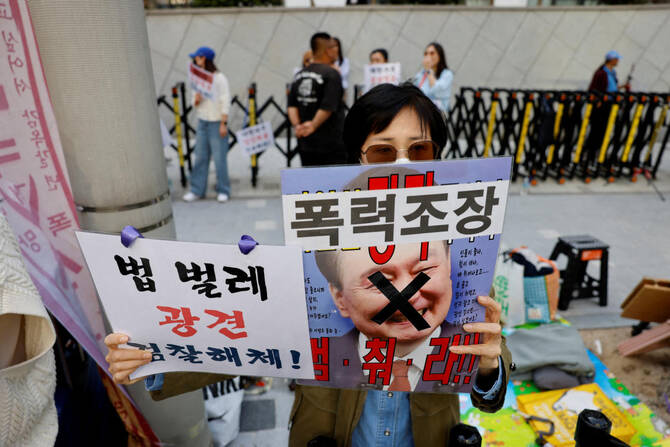
An anti-Yoon protester holds signs, one which reads, "Promoting violence", near the private residence of ousted former South Korean President Yoon Suk Yeol, on the day he returns there, in Seoul, South Korea, April 11, 2025. (Reuters)
Short Url
Updated 13 April 2025
Follow

South Korea’s ex-president Yoon to face insurrection trial

SEOUL: Former South Korean president Yoon Suk Yeol will face his first criminal trial on Monday for insurrection after his short-lived imposition of martial law in December, which plunged the democratic country into political turmoil.
Yoon sought to impose military rule on the country when he ordered the suspension of political activity and the censorship of media on December 3. The decree lasted just six hours as it was voted down by opposition MPs.
The disastrous attempt led to Yoon’s impeachment by the National Assembly shortly thereafter, with the Constitutional Court fully stripping him of his presidential duties on April 4.
Although he has lost all presidential privileges, Yoon still faces a criminal trial on insurrection charges, which will kick off Monday.
During a preliminary hearing in February, Yoon’s lawyers argued that his detention had been procedurally flawed, an argument accepted by the court, leading to his release 52 days after his arrest.
He was detained in January in a dawn raid after holding out against police and prosecutors for weeks, becoming the first sitting South Korean president to be arrested.
If convicted, Yoon could face life imprisonment or even the death penalty.
On Friday, the 64-year-old former leader vacated the presidential residence and returned to his private home in Seoul, greeting supporters along the way.
“Now, I return to being an ordinary citizen of the Republic of Korea, and I will seek a new path in service of our country and our people,” he said in a statement.
With Yoon’s removal, South Korea is set to hold a snap election on June 3 to elect his successor. Until then, the country is governed by acting president Han Duck-soo.


Changes to US security strategy ‘largely consistent’ with Russia’s vision: Kremlin

Updated 07 December 2025
Follow

Changes to US security strategy ‘largely consistent’ with Russia’s vision: Kremlin

  • Kremlin’s spokesman Dmitry Peskov said that the current US administration was “fundamentally different from the previous ones”

MOSCOW: Russia has welcomed changes in the US National Security Strategy, saying the adjustments that marked a radical departure from Washington’s previous policy were “largely consistent” with Moscow’s vision.
Washington’s new National Security Strategy, published early Friday, took aim at allies in Europe, calling it over-regulated, lacking in “self-confidence” and facing “civilizational erasure” due to immigration.
The document stated that the United States would also prevent other powers from dominating but added: “This does not mean wasting blood and treasure to curtail the influence of all the world’s great and middle powers.”
Commenting on the new US strategy, the Kremlin’s spokesman Dmitry Peskov said that the current US administration was “fundamentally different from the previous ones.”
“The adjustments we’re seeing, I would say, are largely consistent with our vision,” Peskov said in an interview with state TV station Rossiya aired Sunday.
“President Trump is currently strong in terms of domestic political positions. And this gives him the opportunity to adjust the concept to suit his vision,” Peskov added.
The publication of the updated security strategy came as officials from Kyiv held talks in Florida with Trump’s envoys on the US-drafted plan to end the near four-year war in Ukraine.
Three days of talks produced no apparent breakthrough.
President Volodymyr Zelensky committed to further negotiations toward “real peace,” as Russia in the early hours of Saturday launched another series of drone and missile strikes at Ukraine.
Zelensky is due to meet with European leaders — French President Emmanuel Macron, British Prime Minister Keir Starmer and German Chancellor Friedrich Merz — in London on Monday to take stock of the negotiations.