

Minerals to be ‘real game changer’ for Pakistan’s economy — finance minister

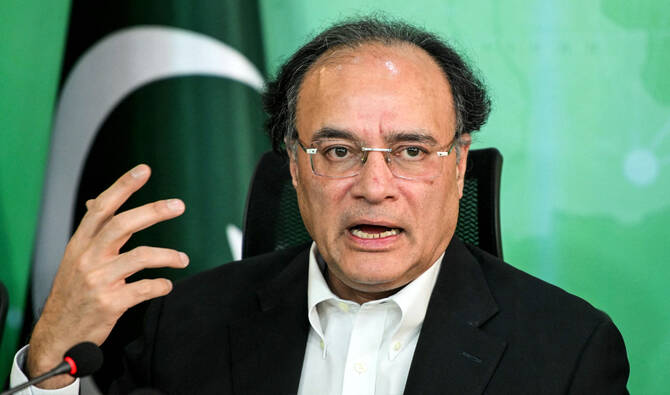
Federal Minister of Finance and Revenue, Muhammad Aurangzeb, addresses a press conference in Islamabad, Pakistan, on April 5, 2025. (AFP)
Short Url
Updated 12 April 2025
Follow

Minerals to be ‘real game changer’ for Pakistan’s economy — finance minister

  • Pakistan hosted minerals investment forum on Apr.8-9 to attract international investment in the sector 
  • Muhammad Aurangzeb urges all economic sectors to export to earn Pakistan valuable foreign exchange

ISLAMABAD: Pakistan’s Finance Minister Muhammad Aurangzeb said on Saturday that the country’s minerals sector would prove to be the “real game changer” for the national economy in the years to come, reiterating the government’s ambitions to ensure export-led growth.

His comments came following the Pakistan Minerals Investment Forum 2025 hosted by the government in Islamabad in collaboration with its partners from Apr. 8-9. The summit was aimed at attracting foreign investment in the country’s mining sector and saw participation from major international companies including Canada-based Barrick Gold and government officials from the United States, Saudi Arabia, China, Turkiye, the United Kingdom, Azerbaijan and others.

Pakistan is home to one of the world’s largest porphyry copper-gold mineral zones, while the Reko Diq mine in southwestern Balochistan province has an estimated 5.9 billion tons of ore. Barrick Gold, which owns a 50 percent stake in the Reko Diq mines, considers them one of the world’s largest underdeveloped copper-gold areas, and their development is expected to have a significant impact on Pakistan’s struggling economy.

But despite rich reserves of salt, copper, gold and coal, Pakistan’s mineral sector contributes only 3.2 percent to GDP and 0.1 percent to global exports. The country is now aiming to tap into this underutilized potential.

“So, 2028 onwards when we talk about whether we have an exportable surplus or not, from traditional sectors textile is going to remain absolutely critical for us as we go forward,” Aurangzeb said while speaking to members of the Lahore Chamber of Commerce. 

“IT services [also] as we go forward and minerals, as we go forward,” he added. “This [minerals sector] is going to be the game changer, the real game changer.”

Aurangzeb said the minerals summit hosted by Pakistan was reflective of the country’s economy heading in the right direction. 

He said around 300-400 delegates from several countries attended the conference with a keen interest in investing in Pakistan’s minerals. 

“These are all manifestations that we have to take this forward,” the minister said. 

Reiterating the government’s resolve to ensure export-led growth in the economy, Aurangzeb called upon all economic sectors to export their products to earn Pakistan valuable foreign exchange. 

“Every single sector has to export,” he said. “No one has taken the responsibility that only textile has to export or any other has to.”

The finance minister noted that Pakistan’s auto manufacturers have started exporting their products, saying there were markets for Pakistani exporters in the Gulf Cooperation Council (GCC) and African countries.


Pakistan, UK discuss regional security, cross-border attacks as senior official visits Islamabad

Updated 20 January 2026
Follow

Pakistan, UK discuss regional security, cross-border attacks as senior official visits Islamabad

  • British envoy for Afghanistan Richard Lindsay’s visit comes at a time of a surge in militancy in Pakistan’s border regions
  • Pakistani diplomat says both sides reviewed broader security challenges, emphasized coordination to address ‘shared concerns’

ISLAMABAD: Pakistani and British officials have discussed regional security challenges and cross-border attacks during talks in Islamabad, a Pakistani diplomat said on Tuesday, during a visit of the United Kingdom’s Afghanistan envoy, Richard Lindsay, to the Pakistani capital.

Pakistan and the UK regularly cooperate on counterterrorism and security, with a focus on intelligence-sharing to combat militant activity. Lindsay’s visit comes at a time of a rise in militancy in Pakistan’s western provinces, which border Afghanistan.

Mohammad Sadiq, Pakistan’s special representative for Afghanistan, said the discussions in Islamabad focused on the regional security situation, particularly the urgent challenge posed by cross-border attacks.

“We also exchanged views on the latest regional security developments and broader security challenges,” he said on X. “We emphasized the importance of continued cooperation and coordination to address shared concerns and promote regional stability.”

Islamabad frequently accuses Afghanistan of allowing its soil and India of backing militant groups, such as the Tehreek-e-Taliban Pakistan (TTP) and the Balochistan Liberation Army (BLA), for attacks against Pakistan. Kabul and New Delhi deny this.

In recent years, Pakistan and the UK have engaged with each other on counterterrorism and cross-border crimes as part of bilateral cooperation.

Both sides held the second round of the Pakistan-UK Counter Terrorism Dialogue in London in February last year, reviewing global and regional threats and exchanging best practices. Over the years, armed forces of both countries have also maintained close cooperation, particularly in counterterrorism efforts and professional military training.