

Pakistan Navy stresses importance of combat readiness to counter regional maritime threats

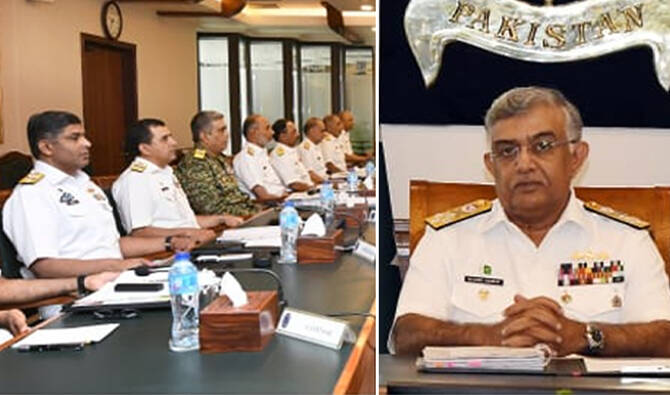
The handout photograph released by the Pakistan NAVY on April 10, 2025, shows Chief of Naval Staff Admiral Naveed Ashraf (right) chairs the Command and Staff Conference at the Naval Headquarters in Islamabad, Pakistan. (Photo Courtesy: DG PR Pakistan NAVVY)
Short Url
Updated 12 April 2025
Follow

Pakistan Navy stresses importance of combat readiness to counter regional maritime threats

  • Pakistan navy chief chairs meeting of apex decision-making forum to discuss plans, review policies
  • Appreciates navy’s efforts in acquiring advanced platforms and technologies to counter threats

ISLAMABAD: Pakistan’s navy chief this week stressed the importance of maintaining combat readiness to counter conventional and non-conventional regional maritime threats, the navy said in a statement, appreciating the force’s efforts in acquiring the latest technologies and advanced platforms. 

Pakistan’s Chief of Naval Staff Admiral Naveed Ashraf chaired the Command & Staff Conference at the Naval Headquarters in Islamabad on Friday. 

The Command & Staff Conference is the apex decision-making forum of the Pakistan Navy, where Ashraf, along with all principal staff officers and field commanders, review policies and strategic plans. 

“The Naval Chief emphasized the importance of maintaining perpetual combat readiness to effectively counter both traditional and non-traditional threats in the maritime domain,” a statement by the navy said on Friday.

“He appreciated the navy’s efforts in acquiring advanced platforms and technologies, expressing confidence in its operational preparedness to safeguard Pakistan’s maritime frontiers.”

The navy said that participants of the conference assessed the evolving maritime situation in the region with a focus on national security, geostrategic affairs and combat readiness.

Ashraf commended the navy for successfully hosting the multinational AMAN-25 naval exercise and the AMAN Dialogue, underscoring their significance in fostering maritime collaboration among regional and extra-regional naval forces. 

“He noted that these initiatives reflect Pakistan’s commitment to cooperative maritime security, in line with the navy’s vision for a secure and stable maritime environment,” the navy said. 

Pakistan Navy regularly collaborates with allies and friendly nations, conducting joint military exercises and other activities to enhance synergy, promote regional peace and stability, deter piracy, drug trafficking and other illicit maritime activities.


Captain Agha reiterates Pakistan’s refusal to play India at the T20 World Cup

Updated 7 sec ago
Follow

Captain Agha reiterates Pakistan’s refusal to play India at the T20 World Cup

  • India vs. Pakistan is usually the showpiece match in world tournaments, with the eyeballs on it rising into the hundreds of millions
  • The boycott has caused an uproar and the International Cricket Council is trying to resolve the issue with the Pakistan Cricket Board

COLOMBO: Pakistan captain Salman Ali Agha has reiterated that his team will abide by his government’s ruling not to play India in the much-anticipated Twenty20 World Cup fixture next week.

India vs. Pakistan is usually the showpiece match in world tournaments — the eyeballs on it rise into the hundreds of millions. The boycott has caused an uproar and the International Cricket Council is trying to resolve the problem with the Pakistan Cricket Board.

At a captains’ media conference on Thursday, Agha repeated the team will follow its government’s advice.

“The India game is not in our control,” Agha said. “The government has decided and we respect that. Whatever they are saying we’ll do.

“We are playing three other (group) games and we are excited about that.”

Pakistan’s World Cup opener is against the Netherlands on Saturday in Colombo. It will play all of its games in co-host Sri Lanka. Namibia and the United States are also in the group. The India game is scheduled for Feb. 15 in Colombo.

In Mumbai, India captain Suryakumar Yadav said they were going to Colombo whether the match was on or not.

“(Our) mindset is pretty clear,” Yadav said. “We did not refuse to play them. The refusal came from them. ICC organized the fixture. BCCI and (Indian) government decided to play in neutral venue in coordination with ICC. Our flight to Colombo is booked. So we are going. We’ll see what happens later.”

The Pakistan government decision came after Bangladesh was kicked out of the World Cup by the ICC. Bangladesh refused to play in India for security reasons and wanted its games moved to Sri Lanka but the ICC dismissed those concerns.

Agha said he was saddened that Bangladesh wasn’t playing in the World Cup for the first time and asked Bangladeshi fans to back his team.

Pakistan has accused the ICC of double standards and not accommodating security concerns. India and Pakistan do not play in each other’s territory and meet in ICC tournaments only at neutral venues.

Their countries are embroiled in military and diplomatic tensions which have spilled into sports for more than a decade. Last year at the men’s Asian Cup and Women’s World Cup, the teams did not shake hands when they met.