

Herd of animal puppets treks from Africa to arctic Circle in climate action

1 / 2
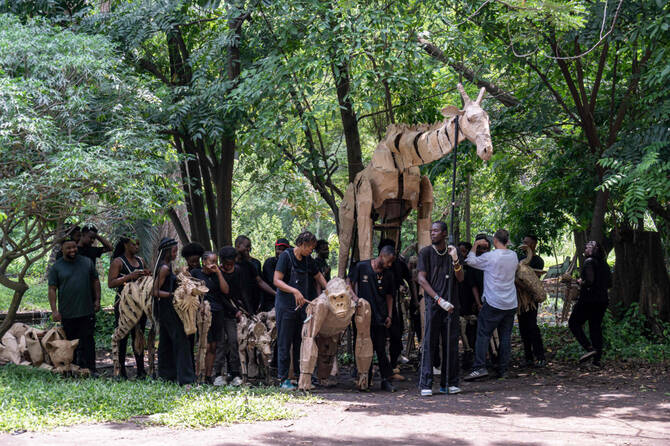
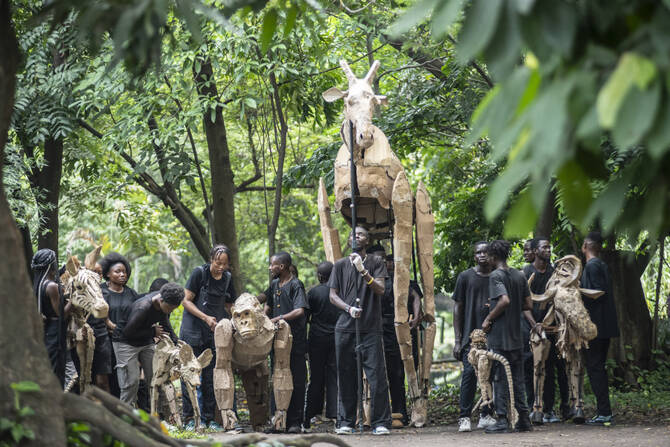
Puppeteers walk next to life size animal puppets, part of the Herds public art and climate action project are displayed in Kinshasa on April 9, 2025. (AFP)
2 / 2
Puppeteers move cardboard animals through Kinshasa's botanical gardens on April 10, 2025, the first steps of "The Herds" as it travels from Africa to the Arctic Circle in a bid to bring attention to the climate crisis. (AP Photo)
Short Url
Updated 12 April 2025
Follow

Herd of animal puppets treks from Africa to arctic Circle in climate action

  • A wildebeest, a gorilla and a giraffe were among the life-size puppets to begin the 20,000-kilometer trek that will cross about 10 countries between central Africa and the Arctic by August

KINSHASA, Congo: In the Kinshasa Botanical Garden, a troupe of cardboard animals stand at attention in a clearing. Their handlers, puppeteers dressed in black, begin to move slowly through the woods, eventually picking up speed and breaking out into a run.
These were the first steps of “The Herds,” a moving theater performance made up of cardboard puppet animals that flee from the Democratic Republic of Congo to the Arctic Circle in a bid to bring attention to the climate crisis.
This week, the puppet animals started their journey in Kinshasa, the capital of the DRC in central Africa. The story goes that the animals will be forced out of their natural habitats due to global warming and displaced north, stopping in cities along the way and being joined by more animals.
Just meters away a real-life example of climate change: Part of the botanical garden lay under floodwaters left over from massive flooding earlier this week that left half the city inaccessible and killed dozens. The sight brought “The Herds” story to life in a bleak way. The main event planned in the center of Kinshasa on Friday was canceled because of the heavy rain.

A wildebeest, a gorilla and a giraffe were among the life-size puppets to begin the 20,000-kilometer (12,400-mile) trek that will cross about 10 countries between central Africa and the Arctic by August.


Puppeteers walk next to life size animal puppets, part of the Herds public art and climate action project are displayed in Kinshasa on April 9, 2025. (AFP)

Their journey will take them through Nigeria, Senegal, Morocco, France and Norway, among other countries.
“This project tries to give the public a powerful emotional sense of what’s happening to the planet,” project producer David Lan said.
The trek includes “now 20, later 40, later 70 animals from all over west Africa, Morocco, Europe who are traveling to escape from the damage done to their ecosystem,” he added.
It is financed by several European countries as well as private foundations.
The puppets are made of mostly recycled materials: cardboard for the skin and rubber for the joints, according to Siphokazi Mpofu, of the South African collective, Ukwanda Puppets, which created the first puppets.
“Some animals will die on the way,” due to high humidity for instance, “just like in real life,” Mpofu said.
As it travels, the herd will be joined by new puppets representing local species, such as vervet monkeys in Nigeria, wolves and red deer in Europe, and reindeer in Norway.
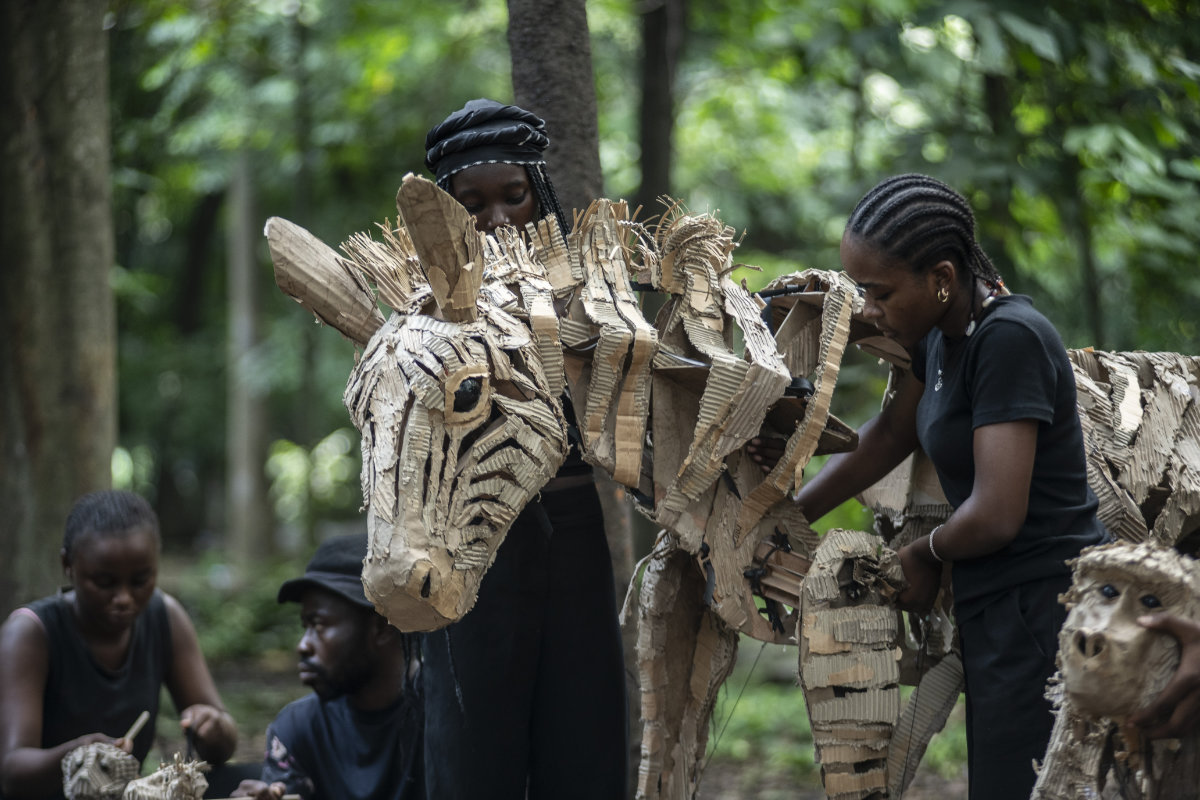


Puppeteers move cardboard animals through Kinshasa's botanical gardens on April 10, 2025, the first steps of "The Herds" as it travels from Africa to the Arctic Circle in a bid to bring attention to the climate crisis. (AP Photo)

“The Herds” comes from the team that was behind “The Walk” in 2021, in which a 12-foot tall puppet of a refugee girl called Little Amal drew attention to the refugee crisis by traveling to 15 countries — from Turkiye to the UK, Ukraine, Mexico and the US.
Tshoper Kabambi, a Congolese filmmaker and producer, is working on “The Herds” as its DRC producer. He said “The Herds” main goal is to raise awareness.
“Nature is very important to us. But humans have a tendency to neglect nature,” he said. “We want to raise awareness among people about everything that is happening. You have seen the floods all over the world, global warming, deforestation.”
“The Herds” will stay in Kinshasa until Saturday before moving onto Lagos, Nigeria, and Dakar, Senegal.
“The Herds” organizers say the significance of starting in Congo lies in the fact that the country is home to the second biggest rainforest in the world. The Congo Basin serves as one of the planet’s “lungs,” the other being the Amazon Rainforest.
They say much less attention has been focused on Congo’s rainforest, but it is still in dire need of protection.
Congolese artists were an integral part of “The Herds” opening act, just as artists from other countries will be as the project moves north.
Amir Nizar Zuabi was on that team and is now the artistic director of “The Herds.” He was also a part of “The Walk.”
“I think one of the big impacts of this project is the fact that this project is happening in 20 different cities,” he said. “It will travel through different cultures, different places, and it accumulates. And it will tell the story of the Congo also in Norway, because we have partners everywhere.”


In the ‘Paris of the Middle East,’ Brigitte Bardot is mourned alongside memories of a golden era

Updated 29 December 2025
Follow

In the ‘Paris of the Middle East,’ Brigitte Bardot is mourned alongside memories of a golden era

  • Bardot’s visit in 1967 coincided with Lebanon’s cultural zenith
  • Nation highlighted as center of global style and sophistication

DUBAI, BEIRUT: The death of French film legend Brigitte Bardot at 91 has focused attention on one of the 20th century’s most captivating cultural icons — and a remarkable, if brief, moment when her star power intersected with Lebanon’s own golden age.

In March 1967, Bardot arrived in Beirut for a four-day visit that would briefly place the French screen legend at the heart of a Middle Eastern hotspot of glamor and modernity.

Brigitte Bardot in Baalbek, Lebanon. (Instagram)

At the time, Beirut was celebrated as the “Paris of the Middle East,” known for its luxuriant hotels, lively nightlife and cosmopolitan mix of cultures.

Mimi Raad, a noted Lebanese image consultant who is the Head of Image Department at MBC1, said to Arab News, “The 60s were considered the Golden Age of Beirut. Lebanese women, known at that time as the most ‘avant-garde’ and stylish women in the Middle East, were fascinated by Brigitte Bardot’s iconic style as well as by her carefree attitude and freedom. The Lebanese high society would look up to the European glamour and Brigitte Bardot was this breath of novelty in style and attitude.”

“Her visits to Lebanon cemented Lebanon's image as a glamorous Mediterranean destination, often compared to Saint-Tropez, reinforcing Beirut's reputation as a cosmopolitan hub and a trendy holiday destination that mirrored the chicest parts of Europe during that era.”

Meanwhile, Lebanese style consultant Hadia Sinno spoke to Arab News about her lifelong admiration of Bardot. “Since I was young, Brigitte Bardot was an icon I deeply admired, not just for her beauty, but for her effortless style, her natural simplicity and that unmistakable French art de vivre. I was always captivated by her look, especially the headbands she wore in her hair and those signature off-the-shoulder tops,” she said.

“For us as Lebanese, there was always a special connection. We have a deep love for French style, and her visit to Lebanon remains a legendary milestone that bridged our two cultures. Beyond the silver screen, she became a force of nature, leading the anti-fur movement that shocked the world and the fashion industry.

“With her flowing skirts, messy hair and playful confidence, she didn’t just wear clothes, she defined an era. A true icon.

“And even though we hadn’t heard much about her in recent years, it was deeply sad to hear of her passing.”

Brigitte Bardot and husband Gunter Sachs returning from Beirut. (Getty Images)

Novelist Hassan Daoud told Arab News, “Beirut at that time was teeming with artistic and cultural life, and some of the city's oldest restaurants still display photographs of famous French and American artists who frequented them.”

Daoud recounted a story from a friend who worked in the General Security Directorate at the time. He said that when Bardot arrived in Beirut by ship and needed to be transferred to a small boat to reach the shore, he helped her by holding her hand. He didn't wash his hands all day so he could retain the feeling of her hand against his own. 

Bardot stayed in the famed, five-star Phoenicia Hotel where international celebrities lounged by the pool and rubbed shoulders with jet-set elites. Paparazzi captured her in relaxed celebrity mode by the poolside, emblematic of both her global appeal and Beirut’s vibrant scene.

During her short stay the actress wandered through the old Beirut souk, the bustling marketplace that was then a fusion of merchants selling jewelry, watches, and luxury goods.

She visited Assaad Georges Daou, a jeweler celebrated for designing pieces for royalty and film stars — a testament to Beirut’s reputation as a fashion and style hub in the region.

Bardot also ventured beyond the capital to Byblos, an ancient Phoenician port city with sparkling sea views and historic ruins.

There she strolled the scenic harbor and old souk, sampled local seafood and soaked up seaside leisure that mirrored the relaxed Mediterranean allure she embodied onscreen.

Her departure from Lebanon was part of a Mediterranean cruise. According to some accounts, the voyage was interrupted by mechanical trouble that stranded the vessel briefly at sea.


A post shared by BETA (@betalebanon)

Researcher and writer Walid Nuwayhid, specializing in philosophy and history, spoke about that era when Beirut was a magnet for actors, artists and intellectuals of various nationalities.  

“They came to relax on its famous beaches, including the Saint George pool and the pools in the Ramlet Al-Bayda area, which disappeared with the outbreak of the civil war in the 1970s. 

Nuwayhid said, “Famous artists, including Johnny Hallyday, frequented the Phoenicia and Vendome hotels, as well as Zaytouna Street, which was bustling with bars and lively nightlife venues. They also frequented Casino du Liban, the only casino in the Middle East at that time.” 

“Lebanon was a location for filming foreign movies and hosted the Beirut International Film Festival. Despite Lebanon's limited resources, the festival held a significant position on the global art scene,” he added.

He further noted, “Beirut Airport was the only major gateway from Europe to Asia at that time. There was no Dubai airport, and Egypt was undergoing socialist nationalization, which prompted the exodus of foreign communities there to leave either to Lebanon or back to Europe. Lebanon was the only refuge because of its openness and the freedom it enjoyed. The generations before us knew the importance of this country, so they built an economy based on providing services that meet needs, it is an economy based on the airport, the port, the printing press, the hospital, the school, and the cafe, all of which provided services to the region and its surroundings, so they left Alexandria and came to Beirut.”

Bardot became a global star after appearing in “And God created Woman” in 1956, and went on to appear in about 50 more movies before retiring in 1973.

Bardot then dedicated over four decades to protecting animals, a mission that resonated with animal welfare groups globally, including in Lebanon.

Beirut for the Ethical Treatment of Animals took to social media to post a heartfelt tribute, greeting her death with “immense sadness” and highlighting her “unwavering commitment” to their mission.

“Today, we say goodbye to Brigitte Bardot — a legendary soul whose love for animals reshaped countless lives. From the silver screen to the front lines of animal welfare, she devoted more than four decades to protecting those who cannot speak for themselves,” the post read.

“Through the Brigitte Bardot Foundation, she turned compassion into action and inspired the world to care more deeply, love more fiercely, and stand up for the voiceless.

“At BETA, we extend our deepest gratitude to Brigitte Bardot and the Brigitte Bardot Foundation for their generous support and unwavering commitment.

“Your kindness strengthened our mission, brought hope where there was despair, and helped save so many precious lives.”

Bardot’s visit left a lasting image of Lebanon as a center of international style and sophistication.