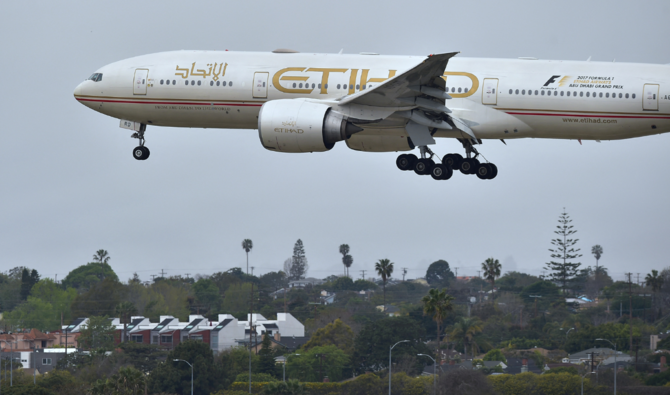
ISLAMABAD: Etihad Airways said this week it would launch a new route to Pakistan’s northwestern Peshawar city in September as part of a broader expansion of its global network.
The route will link Abu Dhabi’s Zayed International Airport with Bacha Khan International Airport in Peshawar starting September 29.
Etihad, the national carrier of the United Arab Emirates, already operates flights to Karachi, Lahore and Islamabad, making Peshawar its fourth nonstop destination in Pakistan.
“We are thrilled to further expand our presence in Pakistan with the launch of our daily service between Abu Dhabi and Peshawar,” Antonoaldo Neves, the airline’s chief executive officer, said.
“This new route reflects our commitment to providing vital connectivity for travelers between Pakistan and the Gulf, Africa, Europe and North America,” he added.
Etihad will initially operate the route five times a week using Airbus A320 family aircraft, with daily service beginning November 22. The aircraft will feature eight Business Class and 150 Economy Class seats.
The announcement comes amid a busy year for the airline, which has added 16 new destinations in 2025, including Prague, Warsaw, Algiers, Tunis, Atlanta and Addis Ababa.
Etihad is also boosting frequency to Karachi to 17 flights a week starting October 1 and expanding service to major European cities such as Paris, Milan and Frankfurt.
Passengers traveling through Abu Dhabi will also have access to the airline’s Stopover program, offering up to two complimentary nights at premium hotels in the UAE capital.


Etihad Airways announces new Peshawar route, expanding Pakistan network
https://arab.news/2unn4
Etihad Airways announces new Peshawar route, expanding Pakistan network

- Five weekly flights to Peshawar will launch in September, increasing to daily service from November
- Peshawar will become Etihad’s fourth gateway to Pakistan and its sixteenth new destination in 2025

Pakistan’s first non-life Shariah-compliant takaful operator plans share sale in January
- Pak-Qatar General Takaful Limited plans to raise up to $1.5 million through initial public offering
- Institutional investors will get 75% of shares, while the remaining 25% will go to retail investors
KARACHI: Pakistan’s first dedicated non-life Shariah-compliant takaful operator said on Monday it will launch an initial public offering this month, seeking to raise up to Rs 420 million ($1.5 million) as Islamic finance gains traction in the country’s capital markets.
The company, Pak-Qatar General Takaful Limited, said it would issue 30 million shares, with a floor price of Rs 10 and a ceiling price of Rs 14 per share. Institutional investors will receive 75% of the shares on offer, while the remaining 25% will be allocated to retail investors.
“Arif Habib Limited has been mandated by Pak-Qatar General Takaful Limited to act as the consultant and book runner for raising funds through the initial public offering,” it announced in a statement.
The book-building process for the offering will take place on Jan. 21-22, it added, with investor registration opening on Jan. 16, while public subscriptions are scheduled for Jan. 28-29.
The offering follows the recent listing of Pak-Qatar Family Takaful Limited, which raised Rs 901 million ($3.23 million) last month in Pakistan’s first Islamic insurance sector IPO, an issue that was oversubscribed several times.
Proceeds from the IPO will be used to strengthen the company’s capital base and support investments in technology, infrastructure and branch expansion, said the statement.
Pak-Qatar General Takaful Limited is part of Pakistan’s pioneer Islamic financial services group and is backed by Qatar-based financial institutions.


