


Wael Shawky

‘The Gulf Project Camp’
This work is part of the award-winning Egyptian artist’s ongoing titular series. Its full title is “The Gulf Project Camp (after ‘Hajj (Panoramic Overview of Makkah)’ by Andreas Magnus Hunglinger, 1803)” — a nod to its inspiration from the Austrian orientalist’s rare early-19th-century drawing of Islam’s holiest city. The project as a whole “investigates the Arabian Peninsula and its modern history through the lenses of migration, trade, petropolitics, religion and tribal alliances” and “sheds light on specific regional and historical moments: the Utub migration; the establishment of the Emirate of Diriyah, the first Saudi state; and the rise of Wahhabism,” according to a guidebook for the 2019 Sharjah Biennale. “Historical treaties, conferences, speeches and experiences of war are rendered in the artwork through imagery and the use of various industrial materials, such as tarmac, graphite and metal dust.”
Anahita Razmi

‘No National Flag Uses a Gradient #1’
Razmi is a German-born artist of Iranian and German descent whose practice, she has written, draws on her background to explore “contextual, geographical, and ideological shifts — with a focus on shifts between an ‘East’ and a ‘West.’” She added that she is interested in “a fluid, transcultural approach to contemporary art and its histories and references,” as well as “in work that is producing testing grounds for possibilities of import/export, hybrid identities, and the constructions and ambiguities of cultural representation.” This work was created in 2022 and is a perfect representation of those interests, seemingly representing the lack of room for nuance in nationalist symbols and rhetoric.
Safwan Dahoul

‘Dream 42’
This work forms part of the Syrian artist’s ongoing “Dream” series, which Dahoul began back in the 1980s. According to Ayyam Gallery, the series explores “the physical and psychological effects of alienation, solitude, and longing that punctuate the human experience at various stages in life.” “Dream 42,” however, is a notable departure from the earlier works in the series, which always featured a female protagonist, who often “takes on the form of a despairing woman in isolated interiors.” Her disappearance from this particular work “could be understood as her final transcendence of a stifling world,” the gallery wrote, noting that in later paintings she is depicted as “a sort of angel.”
Neïl Beloufa

‘Double Standard — canyon’
The French-Algerian artist and filmmaker’s works, according to Francois Ghebaly Gallery, address “themes of geopolitics, technology, urbanism, and ideology through layered projects that combine video, sculpture, social participation, and often dynamic processes like sensor activation or algorithmic control.” This particular piece, as the title suggests, is illustrative of Beloufa’s interest in dichotomies, such as reality and fiction, or presence and absence. “Combining dichotomies allows him to deconstruct our belief systems and presconceived ideas,” We Art Partners have written of Beloufa’s work. “He tries to confront his audience with his own stereotypes to demonstrate their unbelief.” The work is part of the artist’s “Double Standard” series, which forms, according to a catalogue from his solo exhibition in Basel’s Kunsthalle, “an aesthetic world expressed through gaming-inspired forms and the language of digital imagery.”
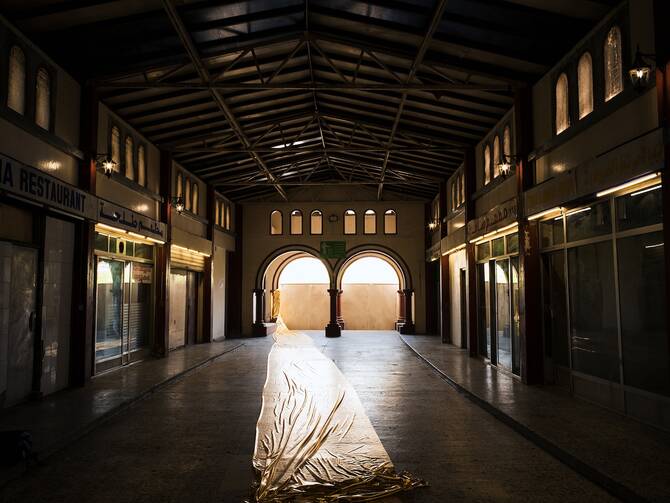
Lamya Gargash

‘Arches Light, Old Jubail Market, Sharjah, UAE’
The Emirati artist has long been inspired by inhabited and/or abandoned spaces, “as well as cultural heritage in a time of rapid change,” according to Dubai gallery The Third Line. In her photo series “Kun” (which translates as ‘To Be’), from which this work is taken, Gargash “connects the cities of Sharjah, Dubai, London and Bath through carefully curated gold draping gestures captured within each frame to create a unique bond,” Maraya Art Center’s catalogue for her solo exhibition there stated. “This draping, golden fabric is placed into various spaces, guided by the Qibla, a modified compass indicating the direction of prayer. Gargash uses the Qibla to symbolize direction, spirituality and unity. The gold fabric covers and conceals elements in its path; this inclusion breaks the silence of the still frame, drawing attention to focal points and bridging the gap between what is considered sacred and secular.


