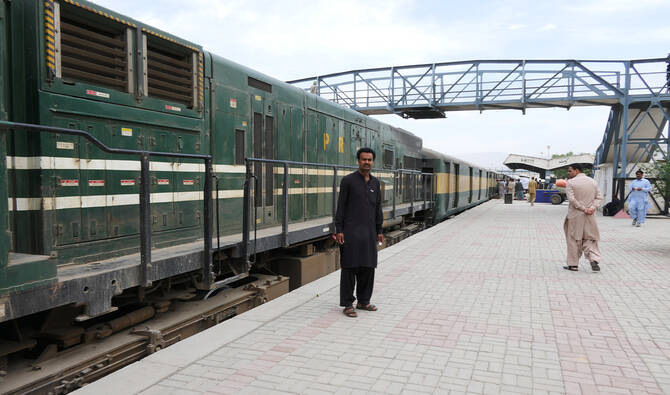

QUETTA: On Mar. 11, as the dawn light began to cast a soft golden glow over the sky, railways employee Assad Ali finished his suhoor morning meal and left for work as his family slept at their home in Quetta, the provincial capital of Pakistan’s remote southwestern province of Balochistan.
An examiner in the Railway Train Lighting (RTL) department for the last 18 years, Ali, 40, arrived at the washing line, an area designated at the Quetta Railway Station for the maintenance and cleaning of passenger trains. He checked and okayed the electricity supply and fan and air conditioners of the Quetta-Peshawar bound Jaffar Express and then returned home to check on his ailing parents before leaving once more for the station to board a train as it departed at 9am.
It was meant to be just another day in Ali’s life, who regularly undertook the 1,600km journey on the Jaffar Express from Quetta to Peshawar in the northwestern Khyber Pakhtunkhwa province. But fate had other plans. Four hours into the trip, separatist militants took over the train as it crossed a remote mountain pass, blowing up the tracks and then holding passengers hostage in an over day-long standoff. There were 425 people on board, including personnel from the Pakistani army and other security forces who were traveling on leave.
“First we heard a powerful blast that hit the engine and intense gun firing started at 12:55 in the afternoon,” Ali told Arab News, identifying the location as being five kilometers from the Paneer Railway Station in an area covered with rugged mountains with no road infrastructure or mobile telephone communication.
“The explosion happened inches away from me,” Ali, who was traveling with other railway employees in the last compartment of the Jaffar Express’s 10 carriages, recalled. “I saw one of my colleagues bleeding and dying in front of my eyes.”
Ali said around two hours after the siege began, attackers locked him and others inside a train compartment where he spent the next 28 hours “with the fear of certain death every second.”
The third among his five siblings and the father of three children, Ali spent those hours in prayer and remembrance of his family.
“We heard horrific sounds of blasts and firing sporadically during those hours,” he said. “I was reciting prayers and thinking, ‘the bullet will hit me now, the bullet will hit me now’.”
It was the 10th day of the holy month of Ramadan, Ali recalled, and he broke his fast in the train, while locked in the compartment, with some candies that he found in his pocket. The siege continued into the night and the time for the next suhoor meal arrived. He began his fast without eating anything.
“WE HAD SURVIVED“
The hijacking was immediately claimed by the Baloch Liberation Army (BLA)’s Majeed Brigade, one of the most prominent ethnic Baloch separatist groups fighting for independence for Balochistan, which borders Iran and Afghanistan and has been the site of a low-level insurgency for decades.
Baloch separatist groups accuse Islamabad of exploiting the province’s natural resources including gas, copper and gold, benefitting the country’s eastern Punjab and southern Sindh provinces.
Pakistani governments have variously denied the allegations, saying they are injecting funds into the infrastructure and economic development of the impoverished province.
Nearly two days after the siege began, the Pakistan Army said the Special Service Group (SSG) Commandos had completed a clearance operation, killing 33 militants. The death toll was 31 soldiers, staff and civilians, the military said.
Ali was among the last group in the train rescued by Pakistani security forces on the evening of Mar. 12 and moved back to Quetta.
“It was around 4 p.m. the next day when I heard passengers’ voices, I saw through the train window that passengers were running outside,” Ali said. “That moment gave me the sense that we had survived.”
Far away in Quetta, his family had gone through their own hell as they waited for news about the rescue operation and prayed for their son to return home alive.
“When I saw Assad at the Quetta Railway Station, we didn’t express our feelings with our tongues but with our eyes,” Muhammad Amir Refique, Ali’s cousin, told Arab News.
“Our minds and hearts were stuck on the assumption that Assad had been killed, but when you see that person alive, you can’t describe those feelings in words.”
One month after the siege, Ali has not been able to board a running train again though he has resumed his duties at the Quetta Railway Station.
“I am still in that mental trauma and not able to carry out my duties in a running train,” he said.
“People were martyred right in front of us, before our eyes, so, of course, there is fear in my heart. Now even when someone knocks on the door or someone comes from outside, in the mind it feels like the sound of a bullet.”