

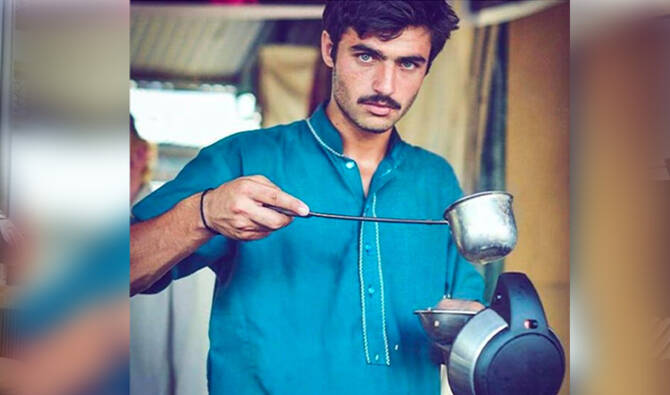

KARACHI: Pakistani Internet sensation Arshad Khan, popularly known as “Chaiwala” (tea seller), has filed a petition in the high court this week to unblock his passport and national ID card over deportation fears amid an ongoing repatriation drive against illegal foreigners, his lawyer said on Thursday.
Pakistan has expelled thousands of Afghan nationals in the past week in a fresh repatriation drive after a March 31 deadline to leave expired. Afghans holding Afghan Citizen Cards (ACC), issued by Pakistani authorities and held by some 800,000 people, according to the United Nations, were told to leave or face deportation to Afghanistan after the deadline. On Tuesday, the UNHCR, the UN’s Refugee Agency, reported that at least 8,906 Afghan nationals have been deported since April 1.
Pakistan started the mass deportation of Afghan refugees in 2023, saying the campaign was aimed at clamping down on migrants who were in the country illegally. Over 800,000 Afghans have left Pakistan over the past 18 months, figures from the government show, while three million Afghans remain.
The deportation drive is also threatening to hit Khan, whose passport was blocked seven years ago following a rumor broadcast by a news channel in 2017 that he was an Afghan national, according to his lawyer Umer Ijaz Gilani’s statement submitted in the Lahore High Court. Pakistani authorities say Khan’s national identity card was also impounded over a failure to comply with government requirements.
Khan rose to overnight fame in 2016 when his chiseled features and scintillating blue eyes captured global attention on social media after a picture of him pouring tea at a roadside stall went viral. He received numerous offers in the entertainment industry including modeling gigs, TV appearances and music videos and eventually leveraged this fame to launch a cafe chain known as “Cafe Chai Wala” in Pakistan and the United Kingdom.
Now, the recent deportation drive against Afghan refugees has pushed Khan to move the court against his canceled identity and travel documents this Tuesday.
“His fears regarding harassment at the hands of police and other state authorities have been heightened in the wake of the recent deportation spree,” Khan’s lawyer Gilani told Arab News.
“Also, for years, he has tried to get his issue resolved at the administrative level and amicably. But his pleas have unfortunately fallen on deaf ears. Finally, he has mustered the courage to go to court for his civil rights.”
According to Gilani, the National Database and Registration Authority (NADRA) was asking Khan to provide proof of his family’s origins before the 1978 Afghan War, following which millions of Afghans sought refuge in Pakistan.
“I told the court that when National Database and Registration Authority asks someone to show pre-1978 records, it is because they suspect the person may be descended from Afghan refugees,” the lawyer explained.
But Khan was not the son of a refugee, and his father received his national identity card in 1984, he said, arguing that it would have been impossible for a refugee to obtain an official ID due to the strict regulations for refugees at that time.
A NADRA spokesperson told Arab News a review of Khan’s documents had raised suspicions that he and his family obtained ID cards by providing incomplete information, implying they were “foreign nationals.”
He said Khan repeatedly did not appear before a verification board for several years despite being served legal notices and given multiple opportunities to comply with the ministry of interior’s requirements.
“Upon his eventual appearance in 2024, the applicant failed to provide mandatory documents outlined in the interior ministry’s notification — such as land ownership, domicile or educational records issued prior to 1979,” the spokesman said.
“Furthermore, discrepancies were found in his personal records including changes in name and inconsistencies in family registration.”
However, Khan’s counsel said his client did not receive any show-cause notice before his passport was blocked and only became aware of the issue when he visited the passport office. He said the requirements listed by NADRA had no basis in the Pakistan Citizenship Act or the NADRA ordinance.
Khan currently resides in Islamabad.
“The Petitioner, who is globally known as “Arshad Khan Chaiwala,” represents the quintessential Pakistani dream,” according to a high court order this Tuesday after the first hearing on Khan’s petition.
“[But] based on a fake rumor telecasted by a news channel, his entire future career/business is now at stake.”


