

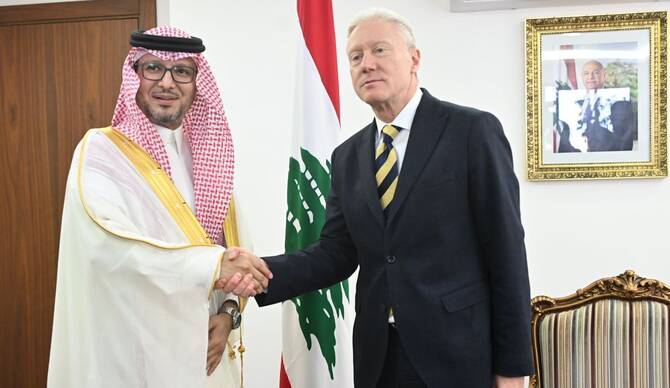
Lebanese foreign minister discusses reforms, weapons control with Saudi ambassador to Beirut

The Lebanese minister of foreign affairs, Youssef Rajji, and the Saudi Ambassador, Waleed Al-Bukhari, in Beirut. (NNA)
Short Url
Updated 14 April 2025
Follow

Lebanese foreign minister discusses reforms, weapons control with Saudi ambassador to Beirut

  • Youssef Rajji and Waleed Al-Bukhari consider latest developments in Lebanon and the Middle East
  • Al-Bukhari confirms the Kingdom’s full support for the reform process in Lebanon

BEIRUT: The Lebanese minister of foreign affairs reassured Saudi Ambassador Waleed Al-Bukhari that Beirut is committed to financial reforms and restricting the possession of weapons outside the state’s control. 

Youssef Rajji met with Al-Bukhari in Beirut on Thursday to discuss the latest developments in Lebanon and the Middle East

Rajji said that Lebanon is committed to implementing the necessary economic, financial, and administrative reforms and ensure that weapons are held exclusively by the state. He said this policy will “put Lebanon on the trail of recovery and advancement,” the National News Agency reported.

He expressed gratitude to the Saudi leadership for supporting Lebanon and its people and said that relations between Riyadh and Beirut have reinstated Lebanon to its rightful place among its Arab neighbors.

Al-Bukhari reaffirmed the Kingdom’s full support for Lebanon’s reform process, which is led by President Joseph Aoun, Prime Minister Nawaf Salam, and the government formed in February.


Echos Of Civil War
50 years on, Lebanon remains hostage to sectarian rivalries

Enter


keywords

Turkish border region feels economic fallout from Iran

Updated 58 min 44 sec ago
Follow

Turkish border region feels economic fallout from Iran

  • Turkiye shares a 550-kilometer border with Iran, 300km of which flank Van province
  • The city of Van has traditionally offered escape and relaxation for Iranian tourists

VAN, Turkiye: As vice president of the chamber of commerce in the eastern Turkish city of Van, Fevzi Celiktas’s job is to boost the local economy. But he has one major problem: his neighbors.
“We have some of the most feared countries in the world right on our doorstep: Iraq, Syria, and Iran,” he said.
“This greatly complicates our development.”
Celiktas is not indifferent to the fate of Iranians who cross to the Turkish side of the border after the ruthless repression of protests in January.
But the collapse of their economy and currency, which sparked the popular uprising, is being felt acutely in the province.
Turkiye shares a 550-kilometer border with Iran, 300km of which flank Van province, with the main pedestrian border crossing of Kapikoy just a 90-minute drive from the provincial capital, also called Van.
The latest crisis is another blow to the struggling economy in this region of 1.1 million people which lies at the eastern end of Anatolia.
Perched on the eastern shores of Lake Van and surrounded by snow-capped mountains, the city of Van has traditionally offered escape and relaxation for Iranian tourists.
Visitors come to shop, enjoy the local bars or take out boats on Turkiye’s largest lake, which is also the second-largest in the Middle East.
“Iranian tourists are our main clientele,” said Emre Deger, head of Van’s tourism professionals association, whose own hotel has seen occupancy rates decline year after year.
Even though winter is the low season, a third of its rooms are usually occupied, he explained.
“But currently, all the hotels are empty or at 10 percent of capacity at best,” he added.
‘For the Internet’
For eight to 10 days after the crackdown on Iranian protesters when there was an Internet blackout, the flow of visitors “completely dried up,” Deger said.
“Those who came were just here for the Internet,” he added.
Every morning when the Kapikoy crossing opens, a few dozen travelers arrive in the cold, wearily boarding buses or taxis headed for Van.
Apart from a handful of students and the odd few with long-term plans outside of Iran, not many are prepared to speak, quickly scurrying off to discreet hotels where they keep to themselves.
“Most even hesitate to go out to get food,” said Deger, who is waiting for March 21 when Iranians mark Nowruz, Persian New Year, to see if the tourists will return.
One Iranian woman in her 30s from the northwestern city of Tabriz said she understood the decline in visitors.
“There’s no middle class left in Iran. We’re all at the bottom, the very bottom,” she said, without giving her name.
“Everyone is poor.”
Back in Iran, she used to work in insurance, but now has a job at an elegant café in downtown Van.
“In the whole of January, I saw maybe two Iranians here,” she said.
‘Our money is worthless’
“Two years ago, when you came to Turkiye with 5 or 10 million rials ($4-$8), you were fine. Now you need at least 40 or 50 million rials. Hotels, food, everything has become more expensive for us.
“Our money is worthless now.”
The monthly salary she earned in Iran would barely last three days in Van today, she added.
“Our customers used to fill entire suitcases with clothes (to take home). But it’s very quiet now,” said Emre Teker in his clothing store.
Celiktas also blamed US and European sanctions for crippling Iran’s economy — and Van’s.
“The Van bypass still isn’t finished after 18 years of construction,” he said. “It’s become a joke, sometimes written on the back of trucks: ‘May our love be like the Van bypass and never end’.”
If a country faces trade restrictions for decades, it inevitably has consequences, he said.
“In a neighborhood, if your neighbor bothers you, you can move. But you can’t do that with countries: you can’t replace Iran with Germany, Italy, France, or Russia,” he said.
“So you have to reach some sort of agreement.”