

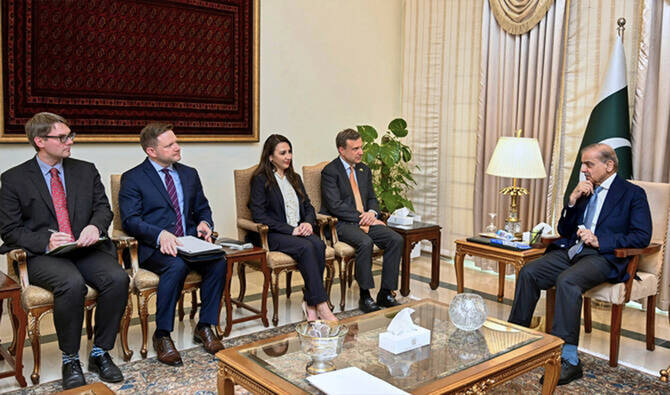

ISLAMABAD: A senior US official has expressed interest in enhancing cooperation with Pakistan in the minerals sector, citing President Donald Trump’s vision of securing rare materials as a “strategic priority” that could benefit both countries, the US Embassy said on Wednesday.
The mission released the statement after Eric Meyer, a senior official from the US Department of State’s Bureau of South and Central Asian Affairs, attended an international minerals summit in Islamabad aimed at attracting foreign investment in the country’s mining sector. Apart from gold and copper, Pakistan is also rich in lithium used to make batteries, as well as other minerals.
The summit has drawn participation from major international companies, including Canada-based Barrick Gold, as well as government officials from the United States, Saudi Arabia, China, Turkiye, the United Kingdom, Turkiye, Azerbaijan, and other nations.
“President Trump has made it clear that securing diverse and reliable sources of these materials is a strategic priority,” the US Embassy quoted Meyer as saying. “Pakistan’s vast mineral potential — if responsibly and transparently developed — can benefit both our countries.”
Despite rich reserves of salt, copper, gold and coal, Pakistan’s mineral sector contributes only 3.2 percent to GDP and 0.1 percent to global exports. The country is now aiming to tap into this underutilized potential.
Pakistan is home to one of the world’s largest porphyry copper-gold mineral zones, while the Reko Diq mine in southwestern Balochistan has an estimated 5.9 billion tons of ore.
Barrick Gold, which owns a 50 percent stake in the Reko Diq mines, considers them one of the world’s largest underdeveloped copper-gold areas, and their development is expected to have a significant impact on Pakistan’s struggling economy.
However, Balochistan is plagued by a decades-long insurgency, with ethnic Baloch separatists opposing any foreign investment which they say is an attempt by Islamabad to solidify its hold through external players on their regional resources.
They have been fighting for decades for a greater share of local resources, but some of their armed groups now say they will not settle for anything less than a separate homeland.
One of the largest insurgent groups, the Baloch Liberation Army, claimed responsibility for the train hijacking, which resulted in the deaths of 23 soldiers, three railway employees and five passengers. At least 33 insurgents were also killed.
Addressing the minerals summit on Tuesday, Pakistan Army Chief Asim Munir said the military would “ensure a robust security framework, proactive measures to protect the interests and trust of partners and investors.”
“You can count on Pakistan as a reliable partner.”


