

Pakistan, Saudi Arabia agree to partner on geological surveying amid push to tap $6 trillion minerals sector

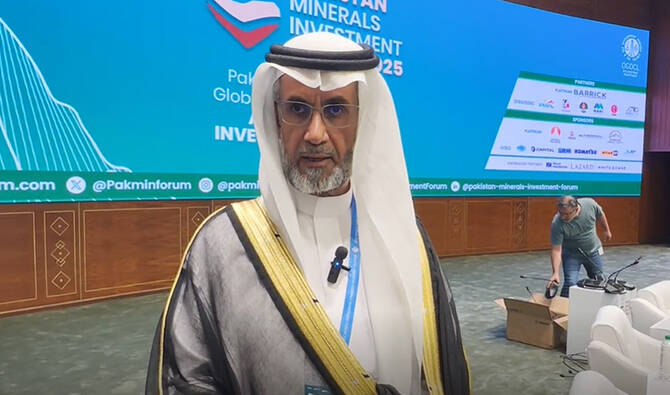
Eng. Abdullah Mefter Al-Shamrani, Chief Executive Officer of the Saudi Geological Survey, speaks to Arab News Pakistan on the sidelines of Pakistan Minerals Investment Forum in Islamabad on April 8, 2025. (AN Photo)
Short Url
Updated 09 April 2025
Follow

Pakistan, Saudi Arabia agree to partner on geological surveying amid push to tap $6 trillion minerals sector

  • Geological surveys significantly impact mining by helping to locate, assess, and sustainably exploit mineral resources
  • Government officials, heads of private companies from various countries attend two-day mineral summit in Pakistani capital

ISLAMABAD: Pakistan and Saudi Arabia have agreed to collaborate in the field of geological surveys through experience sharing and knowledge transfer, the chief of the Saudi Geological Survey said on Tuesday, as Islamabad seeks to tap the potential of the country’s vast natural reserves estimated to be worth $6 trillion. 

Geological surveys, scientific studies that map and analyze the Earth’s geological features, will be a key part of Pakistan’s efforts to tap the underutilized promise of Pakistan’s mineral sector, which despite rich reserves including salt, copper, gold, and coal contributes only 3.2 percent to the GDP and 0.1 percent to global mineral exports. Geographical surveys help to identify mineral deposits, and significantly impact mining by helping to locate, assess, and sustainably exploit mineral resources.

“For the Saudi Geological Survey and Pakistan Geological Survey, yesterday we had a meeting, and we agreed that we will work together to share the experience, transfer the knowledge, the learning, understanding the best practices, which are going to really help both countries in moving forward,” Eng. Abdullah Mefter Al-Shamrani, Chief Executive Officer of the Saudi Geological Survey, told Arab News on the sidelines of the two-day Pakistan Minerals Investment Forum being held in Islamabad. 

“There is good cooperation between the two organizations, [and] it is going to bring great value for both countries.” 

Al-Shamrani said Saudi Arabia had sent a large delegation comprising government officials and private investors to the mineral summit, who had held productive discussions with Pakistani companies.

“We had a great discussion between companies from Pakistan and Saudi Arabia, where they agreed together that they will continue working, exploring and looking for opportunities here in Pakistan and also at the same time for Saudi Arabia,” Al-Shamrani said. 

“Today [Tuesday] we have seen some of the investors in Saudi Arabia, they are asking for permission to go and explore some areas in Pakistan,” he added.

Pakistan is home to one of the world’s largest porphyry copper-gold mineral zones, while the Reko Diq mine in southwestern Balochistan has an estimated 5.9 billion tons of ore. Barrick Gold, which owns a 50 percent stake in the Reko Diq mines, considers them one of the world’s largest underdeveloped copper-gold areas, and their development is expected to have a significant impact on Pakistan’s struggling economy.


IMF hails Pakistan privatization drive, calls PIA sale a ‘milestone’

Updated 10 January 2026
Follow

IMF hails Pakistan privatization drive, calls PIA sale a ‘milestone’

  • Fund backs sale of national airline as key step in divesting loss-making state firms
  • IMF has long urged Islamabad to reduce fiscal burden posed by state-owned entities

KARACHI: The International Monetary Fund (IMF) on Saturday welcomed Pakistan’s privatization efforts, describing the sale of the country’s national airline to a private consortium last month as a milestone that could help advance the divestment of loss-making state-owned enterprises (SOEs).

The comments follow the government’s sale of a 75 percent stake in Pakistan International Airlines (PIA) to a consortium led by the Arif Habib Group for Rs 135 billion ($486 million) after several rounds of bidding in a competitive process, marking Islamabad’s second attempt to privatize the carrier after a failed effort a year earlier.

Between the two privatization attempts, PIA resumed flight operations to several international destinations after aviation authorities in the European Union and Britain lifted restrictions nearly five years after the airline was grounded following a deadly Airbus A320 crash in Karachi in 2020 that killed 97 people.

“We welcome the authorities’ privatization efforts and the completion of the PIA privatization process, which was a commitment under the EFF,” Mahir Binici, the IMF’s resident representative in Pakistan, said in response to an Arab News query, referring to the $7 billion Extended Fund Facility.

“This privatization represents a milestone within the authorities’ reform agenda, aimed at decreasing governmental involvement in commercial sectors and attracting investments to promote economic growth in Pakistan,” he added.

The IMF has long urged Islamabad to reduce the fiscal burden posed by loss-making state firms, which have weighed public finances for years and required repeated government bailouts. Beyond PIA, the government has signaled plans to restructure or sell stakes in additional SOEs as part of broader reforms under the IMF program.

Privatization also remains politically sensitive in Pakistan, with critics warning of job losses and concerns over national assets, while supporters argue private sector management could improve efficiency and service delivery in chronically underperforming entities.

Pakistan’s Cabinet Committee on State-Owned Enterprises said on Friday that SOEs recorded a net loss of Rs 122.9 billion ($442 million) in the 2024–25 fiscal year, compared with a net loss of Rs 30.6 billion ($110 million) in the previous year.