

Israel fulfilling ‘none’ of its legal duties as an occupying power, UN chief warns

Palestinians receive food aid from an UNRWA distribution center at the Nuseirat refugee camp in the central Gaza Strip, Mar. 3, 2025. (AFP)
Short Url
Updated 08 April 2025
Follow

Israel fulfilling ‘none’ of its legal duties as an occupying power, UN chief warns

  • Gaza is ‘killing field’ and civilians caught in ‘endless death loop,’ says Secretary-General Antonio Guterres
  • West Bank could spiral into a similar crisis unless urgent steps are taken to protect civilians, end dehumanization and restore peace, he adds

NEW YORK CITY: The UN secretary-general evoked several provisions of the Fourth Geneva Convention on Tuesday to remind Israeli authorities of an occupying power’s “unequivocal” obligations under international law.

The obligations Antonio Guterres highlighted included ensuring the welfare of the civilian population, the supply of food and medicine, and the maintenance of public health services.

“None of that is happening today,” he said. “No humanitarian supplies can enter Gaza. At the crossing points, food, medicine and shelter supplies are piling up and vital equipment is stuck.”

Speaking in New York to reporters, the UN chief described Gaza’s current path as a dead end that is “totally intolerable” in the eyes of international law and history.

He also warned that the situation in the West Bank could spiral into a similar crisis unless urgent steps are taken to protect civilians, end dehumanization and restore peace.

Guterres called for an immediate, unconditional ceasefire in Gaza and full humanitarian access to be restored. It has been more than a month since aid entered the territory, he added, exacerbating an already devastating humanitarian crisis.

“More than an entire month has passed without a drop of aid into Gaza,” he said. “No food. No fuel. No medicine. No commercial supplies. As aid has dried up, the floodgates of horror have reopened.”
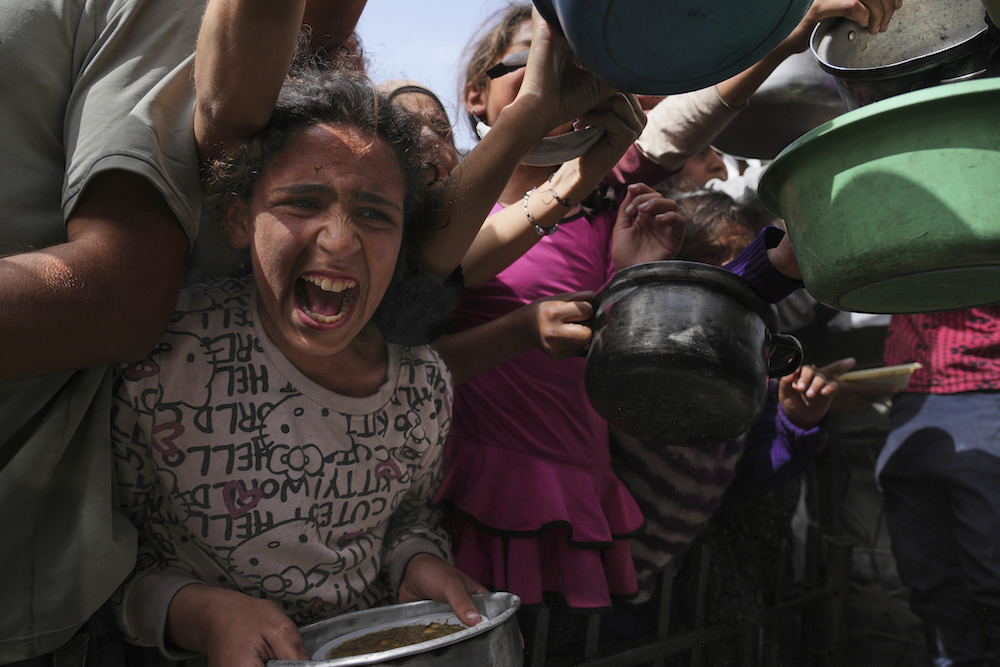


A Palestinian girl struggles as she and others try to get donated food at a distribution center in Beit Lahiya in the northern Gaza Strip. (AP)

Guterres condemned proposals by Israeli authorities to introduce “authorization mechanisms” for the delivery of aid that risk further controlling and “callously limiting aid, down to the last calorie and grain of flour.”

He said the UN “will not participate in any arrangement that does not fully respect the humanitarian principles: humanity, impartiality, independence and neutrality.”

He warned that “the situation in Gaza has become a killing field” and civilians are trapped in an “endless death loop” as a result of the blockade on food, medicine, fuel and other essential supplies.

“Ceasefires work,” Guterres said. “During that ceasefire (between January and March this year), humanitarian organizations successfully delivered critical aid, including food and medical supplies, to Gaza. Guns fell silent, obstacles were removed, looting ended and we were able to deliver lifesaving supplies to virtually every part of the Gaza Strip.

“That all ended with the shattering of the ceasefire. Hope sank for Palestinian families in Gaza and families of hostages in Israel.”

Guterres expressed deep concern about the continuing detention of hostages by Hamas and other militant groups in Gaza. He met the families of the hostages on Monday and reiterated his call for their immediate release.

“With crossing points into Gaza shut and aid blockaded, security is in shambles and our capacity to deliver has been strangled,” he continued.

He reiterated the declaration made by UN humanitarian organizations on Monday, who said in a joint statement that “assertions that there is now enough food to feed all Palestinians in Gaza are far from the reality on the ground, and commodities are running extremely low.”

Guterres said: “We must stick to our core principles. It is time to end the dehumanization, protect civilians, release the hostages, ensure lifesaving aid and renew the ceasefire.

“The world may be running out of words to describe the situation in Gaza but we will never run away from the truth.”


Arab Coalition announces ‘limited’ airstrike targeting two ships that smuggled weapons to Yemen

Updated 30 December 2025
Follow

Arab Coalition announces ‘limited’ airstrike targeting two ships that smuggled weapons to Yemen

  • Coalition urges evacuation of the Port of Mukalla, signaling that a major military operation to force an STC withdrawal could be imminent
  • Spokesman says the two ships transported weapons from the UAE port of Fujairah to Mukalla without getting permission from Coalition command

RIYADH: The Coalition to Support Legitimacy in Yemen on Tuesday said it conducted a “limited” airstrike targeting two ships that smuggled weapons and other military hardware into Mukalla in southern Yemen.

In a statement carried by the Saudi Press Agency (SPA), the Coalition Forces spokesman, Major General Turki Al-Maliki, said that two ships coming from the port of Fujairah in the United Arab Emirates entered the Port of Mukalla in Hadramaut without obtaining official permits from the Joint Forces Command of the Coalition. 

“The crews of the two ships disabled the tracking systems of the two ships and unloaded a large quantity of weapons and combat vehicles to support the Southern Transitional Council forces in the eastern governorates of Yemen (Hadramawt, Al-Mahra) with the aim of fueling the conflict. This is a clear violation of imposing a truce and reaching a peaceful solution, as well as a violation of UN Security Council Resolution No. (2216) of 2015 AD,” said the spokesman.

The coalition urged civilians and fishermen to evacuate the Port of Mukalla, signaling that a major military operation to force an STC withdrawal could be imminent.

Google map showing the location of Mukalla in southern Yemen

Al-Maliki said the Coalition Forces acted on a request by Rashad Al-Alimi, the president of the Yemeni Presidential Leadership Council, “to take all necessary military measures to protect civilians in the governorates of Hadramawt and Al-Mahra.”

Al-Alimi, the president of the Yemeni Presidential Leadership Council, warned last week that unilateral actions by the STC were pushing the country toward a dangerous tipping point.

“Given the danger and escalation posed by these weapons, which threaten security and stability, the Coalition Air Forces conducted a limited military operation this morning targeting weapons and combat vehicles unloaded from the two ships at the port of Al-Mukalla. This was done after documenting the unloading, and the military operation was carried out in accordance with international humanitarian law and its customary rules, ensuring no collateral damage occurred,”  spokesman Al-Maliki said on Tuesday.


READ MORE: Analysis: The risks of carving up Yemen


He affirmed the Coalition’s "continued commitment to de-escalation and enforcing calm in the governorates of Hadramawt and Al-Mahra, and to prevent any military support from any country to any Yemeni faction without coordination with the legitimate Yemeni government and the Coalition. This is aimed at ensuring the success of the Kingdom and the Coalition’s efforts to achieve security and stability and prevent the conflict from spreading.”

Disregarding previous agreements with the Coalition, the group calling itself Southern Transitional Council, or STC, launched a sweeping military campaign early in December, seizing the governorates of Hadramaut along the Saudi border and the eastern governorate of Al-Mahra in Yemen’s border with Oman.

The UAE-backed STC forces captured the city of Seiyun, including its international airport and the presidential palace. They also took control of the strategic PetroMasila oilfields, which account for a massive portion of Yemen’s remaining oil wealth.

CaptioYemenis members of the Sabahiha tribes of Lahj, who live along the strip between the south and north of the country, gather during a rally in the coastal port city of Aden on December 14, 2025, to show their support for the UAE-backed Southern Transitional Council (STC), which wants to revive an independent South Yemen. (AFP)

This prompted Saudi Arabia to issue a firm demand for the STC to withdraw and hand over the seized areas to the National Shield Forces, a Saudi-backed unit.

The coalition warned that any military movements undermining de-escalation efforts would be dealt with immediately to protect civilians, according to the Saudi Press Agency.

On Dec. 26, the UAE issued a statement welcoming Saudi Arabia’s efforts to support security and stability in Yemen.

The statement carried by state news agency WAM praised Saudi Arabia’s constructive role in advancing the interests of the Yemeni people and supporting their legitimate aspirations for stability and prosperity.