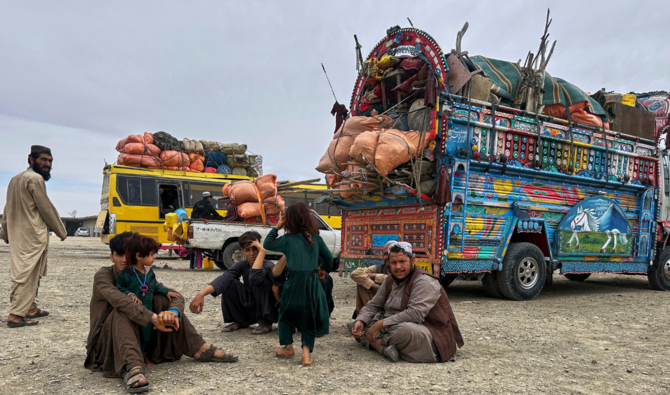
KABUL: The Taliban government condemned on Tuesday the “violence” used by Pakistan in its new campaign to expel Afghans from the country, accusing Islamabad of using the migrants for “political goals.”
Islamabad canceled the residence permits of hundreds of thousands of Afghans in Pakistan, including many who were born or living for decades there, as part of a deportation program.
“The mistreatment of them (Afghans) by neighboring countries is unacceptable and intolerable,” the Taliban Ministry of Refugees and Repatriation said on X, calling for a joint agreement to facilitate repatriations.
An average of 4,000 Afghans crossed the border from Pakistan on Sunday and Monday, “far higher than the March daily average of just 77,” the International Organization for Migration (IOM) told AFP.
The new phase in Pakistan’s campaign to repatriate Afghans “could affect up to 1.6 million undocumented Afghan migrants and Afghan Citizen Card (ACC) holders during 2025,” the agency said.
The UN says nearly three million Afghans live in Pakistan: 800,000 had their Pakistani ACC residency cards canceled in April and 1.3 million still have residence permits until June 30 because they are registered with the UN refugees agency UNHCR. Others have no papers.
“It is with great regret that Afghan refugees are being subjected to violence,” the Taliban refugees ministry said.
“All refugees should be allowed to take their ho was born in northern Afghanistan, told AFP on Monday after crossing the Torkham border point.
“I had papers and they ripped them up.”
In September 2023, hundreds of thousands of undocumented Afghans poured across the border into Afghanistan in the days leading up to a deadline to leave, after weeks of police raids.
More than 800,000 Afghans by the end of 2024, according UN figures.wealth, belongings, and household goods with them to their own country,” it added.
Afghans crossing the border have told AFP in recent days that they left without being able to take all their belongings or money, while others are rounded up and taken directly to the border.
Human rights activists have for months been reporting harassment and extortion by Pakistani security forces against Afghans.
Moniza Kakar, a lawyer in Pakistan’s largest city Karachi, said, “(Officials) are picking and arresting people randomly, from different places. There is no proper mechanism to shift the whole family,” she told AFP.
Relations between Kabul and Islamabad have soured since the Taliban takeover, fueled by a sharp rise in violence in Pakistan along the Afghan border.
“No one should use refugees as tools for their political goals,” the Afghan refugees ministry added.
Pakistan authorities did not provide immediate comment when contacted by AFP.
“My only crime is that I’m Afghan,” Shah Mahmood, who was born in northern Afghanistan, told AFP on Monday after crossing the Torkham border point.
“I had papers and they ripped them up.”
In September 2023, hundreds of thousands of undocumented Afghans poured across the border into Afghanistan in the days leading up to a deadline to leave, after weeks of police raids.
More than 800,000 Afghans by the end of 2024, according UN figures.


Kabul slams Pakistan’s ‘violence’ against Afghans pressured to leave
https://arab.news/yhenn
Kabul slams Pakistan’s ‘violence’ against Afghans pressured to leave

- Islamabad canceled the residence permits of hundreds of thousands of Afghans in Pakistan as part of a deportation program
- Afghan refugees should be allowed to take their wealth, belongings and household goods with them, Afghan refugees ministry says

Imran Khan's sons fear for his health, seek visas to visit him in Pakistan
- Pakistani authorities say medical procedures are under way and reject opposition claims of neglect
- Khan's sons say he should be moved to a proper medical facility and have access to private doctors
LONDON: Imran Khan's sons say they fear for their father's deteriorating health in a Pakistani jail and are seeking permission to visit the former prime minister, urging authorities to grant access after more than two years apart.
Khan's lawyer told Pakistan's Supreme Court last week that the ex-cricketer had lost significant vision in his right eye while in custody. A medical board said on Monday the swelling had reduced after treatment and his vision had improved.
Speaking to Reuters in London, where they are based, Khan's sons, Kasim and Sulaiman, 26 and 29, said they were uncertain about the medical report. They spoke to their father on Thursday for the first time since September.
They said their father usually avoids discussing his health, but during the call he expressed frustration, saying he had been denied treatment for his eye for a few months.
"It's hard not to feel low at times because we've been away from him so long," Kasim said of his father, whom he and his brother call 'Abba', adding that he should be moved to a proper medical facility and have access to his private doctors.
Authorities say medical procedures are under way and reject opposition claims of neglect. The Supreme Court has sought details of his treatment.
JAILED SINCE AUGUST 2023
Khan, 73, has been jailed since August 2023 after convictions he and his Pakistan Tehreek-e-Insaf party call politically motivated.
Since his 2022 ouster in a no-confidence vote, he has faced multiple cases, including over state gifts and an unlawful marriage. Some convictions have been suspended or overturned, with appeals pending. He denies wrongdoing.
Kasim and Sulaiman were raised in Britain after Khan's divorce from their mother, British socialite and filmmaker Jemima Goldsmith. They have not seen their father since November 2022 after he survived an assassination attempt. They said they applied for visas last month but have yet to receive a response.
"Maybe the establishment is worried that if we go and see him it would create more noise, and just more attention to his situation," Sulaiman said, when asked why there could be a delay.
The Pakistani embassy in London and Pakistan's foreign ministry did not immediately respond to requests for comment.
Kasim said their immediate concern was his health, but there were other pressing issues, including "his freedom, abiding by correct human rights processes and also the rule of law and just ensuring that he's allowed a proper, fair trial".
Broadcast outlets have been restricted from airing Khan's name and speeches or even showing his image. Only a single court photograph has been publicly available since his imprisonment.
PTI swept to power in 2018 and retains a large support base across key provinces.
For four days, PTI supporters have blocked major highways linking Khyber Pakhtunkhwa to Punjab, stranding thousands of vehicles and affecting fuel and food supplies in some areas.
Asked if they had a message for Khan's supporters, Kasim asked them to "keep faith and keep fighting", adding: "It's the same kind of message we're trying to hold on to."


