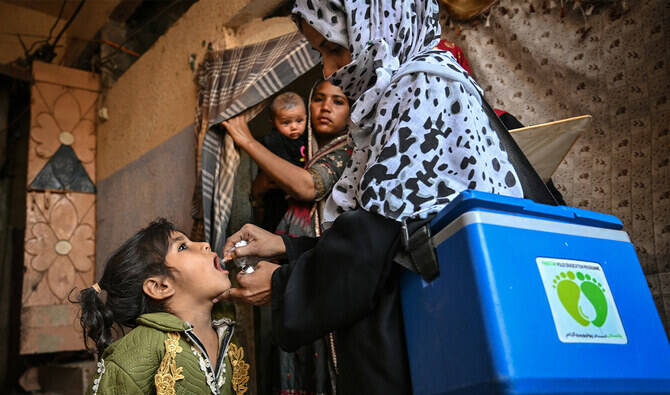
ISLAMABAD: A five-day polio eradication campaign will begin in Pakistan’s northwestern Khyber Pakhtunkhwa (KP) province from Apr. 21, Pakistani state media reported on Tuesday, with the drive aimed at vaccinating over 6 million children in the region.
Polio is a paralyzing disease with no cure and multiple doses of the oral polio vaccine, along with completing the routine vaccination schedule for children under five, are essential to provide immunity against the virus.
Pakistan, which has reported six polio cases so far in 2025, planned three major polio campaigns in the first half of 2025, with rounds scheduled for April and May, the Associated Press of Pakistan news agency reported, citing authorities.
“A five-day polio eradication campaign is set to be launched in Khyber Pakhtunkhwa from Apr. 21,” the report read. “According to the provincial health department, more than 800,000 children in the capital city of Peshawar will receive the polio vaccine.”
Over 30,000 teams were formed to participate in the campaign whereas 50,000 police personnel will also be deployed for security purposes, the state news agency reported.
Pakistan’s polio program, launched in 1994, has faced significant challenges, including vaccine misinformation and opposition from some religious hard-liners who claim immunization is a foreign plot to sterilize Muslim children or a cover for Western espionage. Militant groups also frequently attack and kill members of polio vaccination teams.
Last year, Pakistan reported 74 polio cases. Pakistan and Afghanistan are the last two countries where polio remains endemic.

Pakistan to hold five-day anti-polio drive in its northwest starting Apr. 21
https://arab.news/jjfxy
Pakistan to hold five-day anti-polio drive in its northwest starting Apr. 21
- Pakistan has reported six polio cases in the first three months of 2025
- The latest drive aims to vaccinate over 6 million children in the region
Pakistan engages Saudi Arabia, China in bid to ease surging Middle East tensions
- Pakistan’s foreign minister stresses need for de-escalation in conversations with Chinese, Saudi counterparts
- Tensions in the Middle East continue to remain high as conflict between US, Israel and Iran intensifies
ISLAMABAD: Pakistan’s Deputy Prime Minister Ishaq Dar spoke to the foreign ministers of Saudi Arabia and China on Tuesday, stressing the importance of diplomatic engagement to de-escalate tensions in the Middle East as the Iran war intensifies.
Pakistan has constantly engaged regional countries in efforts to broker a ceasefire in the Middle East, after the US and Isreal launched coordinated strikes against Iran on Feb. 28.
Iran launched fresh attacks on Gulf countries on Tuesday morning, where it has targeted US military bases in recent weeks. In addition to firing missiles and drones at Israel and American bases in the region, Iran has also been targeting energy infrastructure which, combined with its stranglehold on the Strait of Hormuz, has sent oil prices soaring worldwide.
Dar spoke to Saudi Foreign Minister Prince Faisal bin Farhan to discuss developments in the Middle East and ongoing deliberations at the UN Security Council, Pakistan’s foreign office said in a statement.
“DPM/FM shared Pakistan’s perspective, underscoring the importance of continued coordination and diplomatic engagement to support de-escalation and promote peace and stability across the region and beyond,” the statement said.
Dar, who also serves as Pakistan’s foreign minister, spoke to Chinese foreign minister Wang Yi over the telephone separately. The two discussed the evolving regional situation and broader global developments.
Dar underscored the need to ease tensions in the Middle East and the wider region during the conversation, the foreign office said.
Yi appreciated Pakistan’s constructive efforts aimed at promoting de-escalation and stability in the region, it added.
“The two leaders stressed the importance of de-escalation and emphasized the need to pursue dialogue and diplomacy in accordance with the principles of the UN Charter,” the foreign office’s statement said.
The conflict in the Middle East has hit Pakistan hard as well, forcing Islamabad to hike petrol and diesel prices by Rs55 per liter last Friday.
Pakistan’s government has also announced a set of austerity measures, which include closing schools and cutting down on government expenditures, as it evaluates petrol stocks and looks for alternative supply routes.