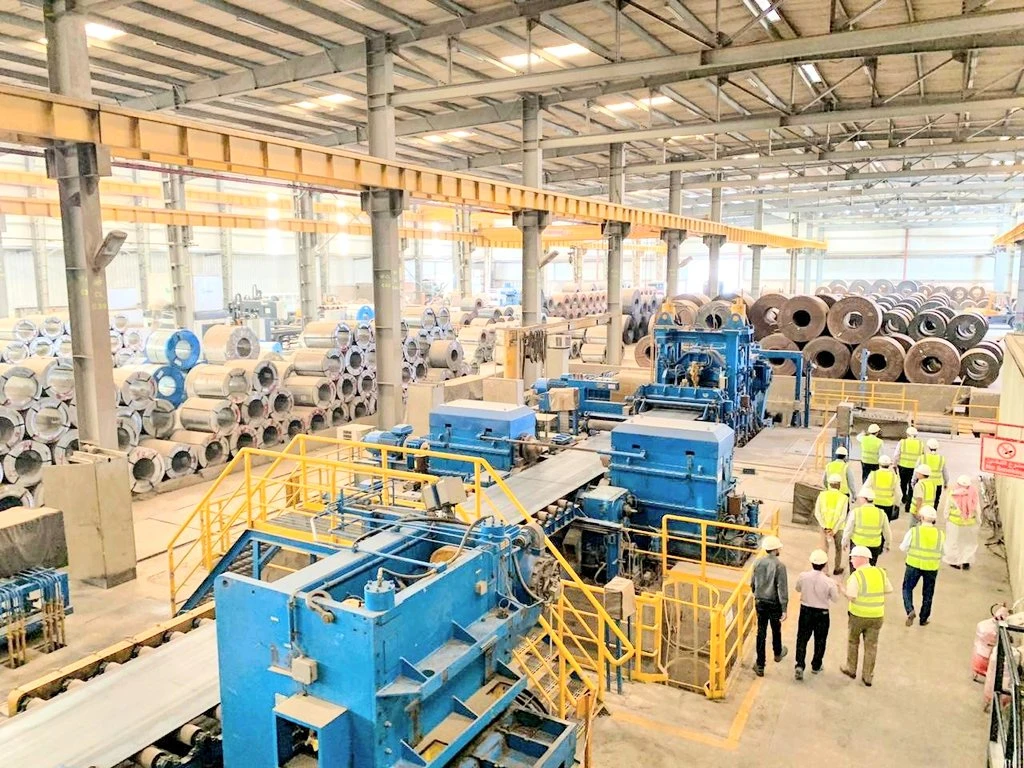
Saudi Arabia boosts industrial output with 103 new factories

In January, the ministry also issued 63 new industrial licenses, according to the National Industrial and Mining Information Center, which operates under the ministry. File
Short Url
Updated 08 April 2025
Follow

Saudi Arabia boosts industrial output with 103 new factories

JEDDAH: Saudi Arabia’s Ministry of Industry and Mineral Resources has announced the launch of 103 new factories in January, marking a significant milestone for the Kingdom’s industrial sector.

These factories attracted a total investment of SR900 million ($240 million), generating approximately 1,504 new jobs and underscoring the continued growth of the country’s industrial landscape.

The announcement, made on April 8, highlights the increasing number of establishments reaching full operational capacity.

In January, the ministry also issued 63 new industrial licenses, according to the National Industrial and Mining Information Center, which operates under the ministry.

As part of its Vision 2030 initiative, Saudi Arabia is accelerating efforts to diversify its economy, with the industrial and manufacturing sectors playing a key role in reducing the country’s reliance on oil. Programs like the National Industrial Development and Logistics Program are central to the Kingdom’s strategy, aiming to establish Saudi Arabia as a leading regional hub for advanced manufacturing, with a focus on petrochemicals, mining, and renewable energy.

Saudi Arabia is set to transform its industrial landscape with plans to increase the number of factories to 36,000 by 2035, including 4,000 fully automated facilities.

This ambitious goal is part of the Kingdom’s strategy to foster a dynamic, innovation-driven industrial sector.

In January, the country’s industrial production index saw a 1.3 percent year-on-year increase, driven by continued growth in manufacturing and waste management, according to the General Authority for Statistics. The index remained stable month-on-month at 103.9, maintaining the same level as in December 2024.

The manufacturing sub-index rose by 4 percent annually, supported by a 4.3 percent increase in the production of coke and refined petroleum products, along with a 4.2 percent rise in chemicals and chemical products.

The report, which tracks key industrial indicators, showed that investments related to new industrial licenses amounted to SR1.197 billion, with these projects expected to generate over 2,500 new job opportunities across the Kingdom.

In 2023, the number of industrial units in Saudi Arabia surged by 10 percent year-on-year, reaching 11,549, according to the Ministry of Industry and Mineral Resources. Jarrah Al-Jarrah, a spokesman for the ministry, also revealed that the new industrial organizations were established with an investment totaling SR1.54 trillion.


Saudi POS spending jumps 28% in final week of Jan: SAMA

Updated 06 February 2026
Follow

Saudi POS spending jumps 28% in final week of Jan: SAMA

RIYADH: Saudi Arabia’s point-of-sale spending climbed sharply in the final week of January, rising nearly 28 percent from the previous week as consumer outlays increased across almost all sectors. 

POS transactions reached SR16 billion ($4.27 billion) in the week ending Jan. 31, up 27.8 percent week on week, according to the Saudi Central Bank. Transaction volumes rose 16.5 percent to 248.8 million, reflecting stronger retail and service activity. 

Spending on jewelry saw the biggest uptick at 55.5 percent to SR613.69 million, followed by laundry services which saw a 44.4 percent increase to SR62.83 million. 

Expenditure on personal care rose 29.1 percent, while outlays on books and stationery increased 5.1 percent. Hotel spending climbed 7.4 percent to SR377.1 million. 

Further gains were recorded across other categories. Spending in pharmacies and medical supplies rose 33.4 percent to SR259.19 million, while medical services increased 13.7 percent to SR515.44 million. 

Food and beverage spending surged 38.6 percent to SR2.6 billion, accounting for the largest share of total POS value. Restaurants and cafes followed with a 20.4 percent increase to SR1.81 billion. Apparel and clothing spending rose 35.4 percent to SR1.33 billion, representing the third-largest share during the week. 

The Kingdom’s key urban centers mirrored the national surge. Riyadh, which accounted for the largest share of total POS spending, saw a 22 percent rise to SR5.44 billion from SR4.46 billion the previous week. The number of transactions in the capital reached 78.6 million, up 13.8 percent week on week. 

In Jeddah, transaction values increased 23.7 percent to SR2.16 billion, while Dammam reported a 22.2 percent rise to SR783.06 million. 

POS data, tracked weekly by SAMA, provides an indicator of consumer spending trends and the ongoing growth of digital payments in Saudi Arabia.  

The data also highlights the expanding reach of POS infrastructure, extending beyond major retail hubs to smaller cities and service sectors, supporting broader digital inclusion initiatives.  

The growth of digital payment technologies aligns with Saudi Arabia’s Vision 2030 objectives, promoting electronic transactions and contributing to the Kingdom’s broader digital economy.