Egypt, France enter $7.6bn green hydrogen agreement 

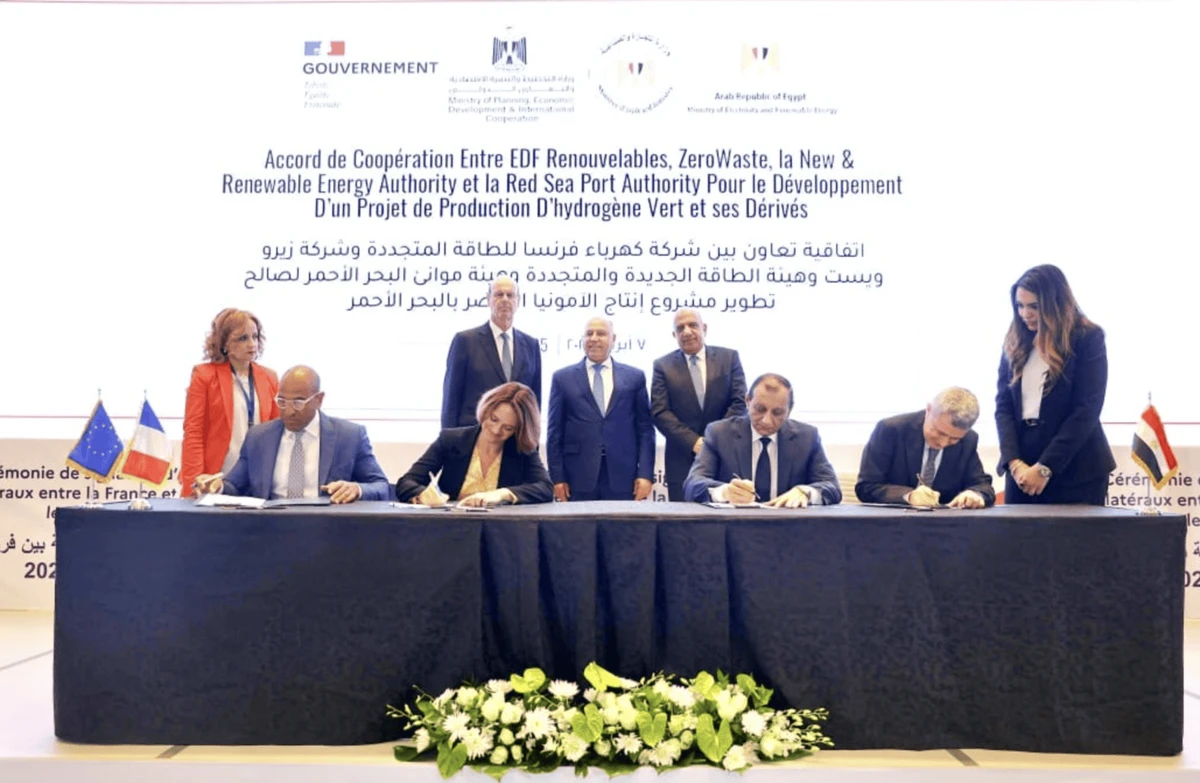
EDF Renewables Chairwoman Beatrice Buffon and Zero Waste Chairman Amr El-Sawaf signed the agreement alongside Egyptian energy officials. Facebook/Egyptian Prime Minister's Office
Short Url
Updated 08 April 2025
Follow

Egypt, France enter $7.6bn green hydrogen agreement 

RIYADH: Egypt and France have signed a €7 billion ($7.6 billion) agreement to develop a large-scale green hydrogen and ammonia production complex near Ras Shokeir on the Red Sea coast. 

The deal, which comes amid heightened economic relations between the two nations, includes the development, financing, construction, and operation of a private-sector-led facility.

EDF Renewables and Zero Waste will lead the project in partnership with the General Authority for the Red Sea Ports and the New and Renewable Energy Authority.

According to a joint statement by the Egyptian Ministries of Industry and Transport, the undertaking will be fully financed and implemented by the private sector consortium, with no financial commitments or infrastructure obligations from the government. 

The initiative will be developed over three phases and is expected to produce up to 1 million tonnes of green ammonia annually, starting in 2029.

Earlier in April, Egypt received French President Emmanuel Macron in an official visit focused on addressing the humanitarian crisis in Gaza and strengthening bilateral economic cooperation.

Macron participated in the Franco-Egyptian Business Forum, where discussions emphasized increasing French investment in Egypt and expanding collaboration in renewable energy, infrastructure, and industry. 

The hydrogen agreement signed during the visit was among the most significant outcomes, aligning with Egypt’s strategy to become a regional hub for clean energy and green fuel exports.

Egypt’s Deputy Prime Minister for Industrial Development and Minister of Industry and Transport Kamel El-Wazir emphasized that the project aligns with national directives to localize the green hydrogen industry and position Egypt as a regional and global leader for progressive environmental practices. 

He stated that this initiative reflects the distinguished relationship between the political leaderships and peoples of both countries and highlights their shared commitment to strategic cooperation for mutual benefit and development.

The first phase of the project will require €2 billion in direct investment and aims to produce 300,000 tonnes of green ammonia per year. 

EDF Renewables Chairwoman Beatrice Buffon and Zero Waste Chairman Amr El-Sawaf signed the agreement alongside Egyptian energy officials. The combined investment across all three phases is projected to reach €7 billion, entirely financed by the project company.

The minister noted that 368 sq. km of land in Ras Shokeir have been allocated for solar and wind energy generation to power the facility, while 1.2 million sq. meters will be used to construct the integrated industrial plant. 

The project also includes the construction of a 400-meter export jetty with a 17-meter draft, as well as a 7-km transmission corridor. A dedicated seawater desalination unit will supply the project’s water needs.

El-Wazir said that this is one of the few long-term projects in Egypt being implemented entirely by the private sector, without any reliance on public infrastructure or electricity grid services, highlighting that the investment is structured to recover costs over a 50-year period. 

The state will benefit from licensing fees, land-use charges, export duties, and taxes— all to be paid in US dollars.

Beyond direct revenues, the undertaking is expected to generate thousands of jobs during the construction and operational phases. 

The consortium has committed to training and employing local labor, with a goal of reaching 95 percent Egyptian participation in the project’s workforce.

El-Wazir added that the initiative will also support the localization of green energy components, including electrolyzers, solar panels, and wind turbines.

This undertaking strengthens Egypt’s position in the global renewable energy landscape and contributes to the country’s transition toward a green economy, El-Wazir explained. 

He also noted its alignment with Egypt’s climate commitments under the Paris Agreement and COP27, as well as its potential to reduce greenhouse gas emissions and preserve natural gas reserves by providing sustainable alternatives for the energy and industrial sectors.

The minister also underscored the strategic importance of providing green fuel for ships transiting the Suez Canal and developing a new Red Sea port under the Red Sea Ports Authority without any fiscal burden on the government.

Saudi Arabia brings the Asian houbara back from the brink

Updated 8 sec ago
Follow

Saudi Arabia brings the Asian houbara back from the brink

  • A science-led reintroduction is giving the iconic desert bird a chance to recover

JEDDAH: The Asian houbara (Chlamydotis macqueenii) is classified as critically endangered across the Arabian Peninsula by the International Union for Conservation of Nature, with populations continuing to decline despite decades of conservation initiatives and captive breeding programs.

Wild resident populations no longer exist in Saudi Arabia, and migratory birds are now only occasionally recorded along the Kingdom’s northern and eastern borders.

It was formally recognized as a distinct species only in 2003. For many years, it was considered a subspecies of the African houbara, until scientific research confirmed clear differences in morphology, plumage, vocalizations and genetic makeup. One of its most distinctive behavioral traits is the male’s courtship display, during which it raises its white breast feathers and performs a striking running display across open terrain.

FASTFACT

DID YOU KNOW?

  • The Asian houbara was only recognized as a distinct species in 2003.
  • Migratory Asian houbara can travel more than 5,000 km.
  • Captive houbara require strict genetic management to maintain wild traits.
  • Individual houbara can disperse up to 500 km after release in search of suitable habitat.

Physically, the Asian houbara is larger and paler than its African relative. Adult females typically weigh between 1.2-1.5 kg, while males range from 1.8 to 2.5 kg. Well adapted to arid and semi-arid environments, the species is a strong flier, with migratory individuals capable of traveling more than 5,000 km between breeding and wintering grounds.

Historically, Saudi Arabia supported large numbers of both resident houbara in the north of the Kingdom and migratory Asian houbara across its deserts. Birds arrived from Central Asia in autumn, spent the winter months in Saudi Arabia, and departed in early spring to return to their breeding grounds.

The species’ historical range extends from eastern Egypt to Mongolia, encompassing the entire Arabian Peninsula, Palestine, Syria, Iraq, Iran, Pakistan, western India, Turkmenistan, Uzbekistan, Afghanistan, Kyrgyzstan, Tajikistan, Kazakhstan, China — including Xinjiang and Gansu provinces — and Mongolia as far as the Gobi Desert.

During the second half of the 20th century, wild populations of both resident and migratory Asian houbara declined sharply, driven primarily by overhunting and widespread habitat degradation.

Today, the creation of large protected landscapes — aligned with Vision 2030 and the Saudi Green Initiative’s commitment to enhance biodiversity, restore desert ecosystems and protect 30 percent of the Kingdom’s land and sea by 2030 — is creating renewed opportunities for recovery. 

In particular, the royal reserves in northern Saudi Arabia are providing extensive suitable habitat, active restoration programs and strengthened wildlife protection systems, enabling houbara to return and complete their natural annual cycles in the wild.

The Reserve’s habitat is suitable to support resident populations of Asian houbara. (Prince Mohammed bin Salman Royal)

As part of its ReWild Arabia mission, the Prince Mohammed bin Salman Royal Reserve has reintroduced the Asian houbara bustard after more than 35 years of absence. The release of 20 birds marks a science-led effort, conducted in collaboration with the National Center for Wildlife and the Prince Mohammed bin Salman Houbara Conservation Foundation, to restore sustainable wild populations in Saudi Arabia.

Falconry, centered on the houbara bustard, has shaped life on the Arabian Peninsula for thousands of years and was recognized by UNESCO in 2021 as Intangible Cultural Heritage. While traditional practices once ensured sustainability, habitat loss, overhunting and poaching led to sharp population declines from the mid-20th century onwards.

In response, the late Prince Saud Al-Faisal established a pioneering houbara breeding centre in Taif in 1985. Although captive breeding programs across the Gulf have achieved technical success, restoring self-sustaining wild populations has remained a challenge — one now led by the Prince Mohammed bin Salman Houbara Conservation Foundation.

The Asian houbara is the 13th species to be reintroduced to the Prince Mohammed bin Salman Royal Reserve as part of its rewilding program, which aims to return 23 native species to their historical range.

Andrew Zaloumis, CEO of the Prince Mohammed bin Salman Royal Reserve, told Arab News that the present moment offers the best opportunity to reintroduce the species. “We have established the ecological, operational, and community foundations required to support large-scale rewilding, including the return of the Asian houbara.

“Habitat restoration across the reserve is re-establishing suitable conditions for the species to survive and disperse. At the same time, our advanced ranger program and community engagement initiatives provide the capacity needed to monitor wildlife effectively and counter the risk of illegal hunting.”

A science-led conservation approach has underpinned every stage of the reintroduction program. Zaloumis said: “Every stage of this program, from breeding to release to long-term monitoring, is guided by research, data, and specialist expertise.”

Prince Mohammed bin Salman Houbara Conservation Foundation CEO Olivier Combreau and Reserve CEO Andrew Zaloumis attach a satellite tag to an Asian houbara to be released into Prince Mohammed bin Salman Royal Reserve. (Prince Mohammed bin Salman Royal)

He added: “Captive breeding of the Asian houbara is technically complex. The species does not breed naturally in managed conditions, so artificial insemination is required, with limited breeding windows each year.

“Genetic management is equally critical. Captive populations must retain sufficient genetic diversity and wild-type traits to support survival after reintroduction. This requires controlled breeding programs, continuous genetic monitoring and meticulous records to prevent inbreeding and loss of genetic variability. In parallel, rearing techniques must be designed to ensure birds retain natural behaviors and do not become imprinted to maximize their chances of survival once released.”

Ten of the released birds have been fitted with satellite tracking devices to collect critical data on survival, movement, habitat use and threats encountered in the wild.

“The satellite transmitter weighs about 30g, in line with best practice that tags should weigh 3 to 5 percent of an animal’s body weight and is attached to the bird with a Teflon ribbon arranged in a harness configuration, the process takes less than 10 minutes. The harness is designed to minimize impact on the bird’s natural behavior, allowing normal movement, feeding, breeding, and migration,” Zaloumis said. “The devices are set to transmit data 4 times per day.”

The information gathered will help guide future releases and support the long-term recovery of houbara populations in Saudi Arabia and across the region.

Release sites were selected to maximize survival and long-term population stability through detailed ecological assessments. Zaloumis explained that these evaluations ensure the sites provide the conditions reintroduced houbara need to survive and establish in the wild.

“The three key criteria are: adequate natural food such as fresh green leaves, flowers and buds, insects and reptiles, an absence of disturbance (no vehicles, no or little grazing animals), an absence of poaching and a limited number of predators (foxes being the most common threat to reintroduced houbara).”

He added: “Houbara needs space, a lot of space to thrive.”

Individual houbara released into the Prince Mohammed bin Salman Royal Reserve are expected to disperse into neighboring reserves and beyond. “We have observed resident houbara traveling up to 500 km in search of suitable habitat. This underscores the importance of protected areas and the Kingdom’s royal reserve initiative.”

The ultimate indicator of success is natural population growth in the wild, assessed through regular, standardized field surveys conducted across large and representative areas. Repeating these surveys annually provides a clear picture of population trends over time.

Additional scientific indicators are also monitored, including evidence of breeding activity, breeding success, mortality rates and movement patterns, observed through field surveys and satellite tracking data.

“For a long-lived bird with a low reproductive rate, such as the Asian houbara, success cannot be measured over short timeframes. A period of at least 10 to 15 years of consistent monitoring is typically required to confirm with confidence that a reintroduced population is self-sustaining,” Zaloumis concluded.