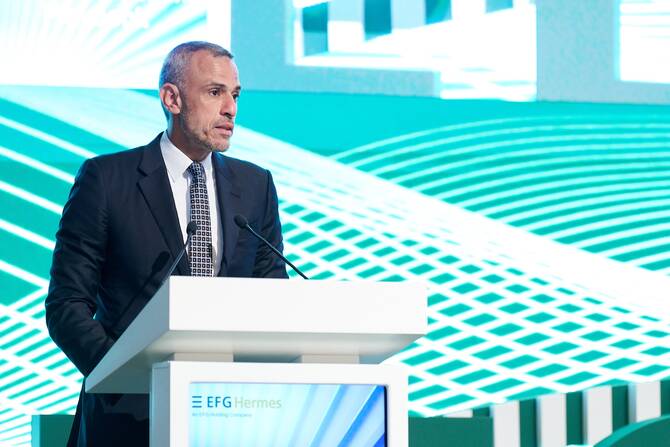

DUBAI: Amid the ongoing global economic turbulence, the Gulf Cooperation Council region has demonstrated resilience, emerging as a dynamic hub. Its capital markets have weathered challenges, from US tariff shocks to fluctuations in oil prices, according to the group chief executive of EFG Holding.
In an interview with Arab News at the 19th Annual EFG Hermes One-on-One Investor Conference in Dubai, Karim Awad highlighted the region’s solid fundamentals, emphasizing that concerns over external shocks often overshadow its long-term growth potential.
“You’re seeing more IPOs coming to the region, and more sectors that are being represented on different exchanges, and this is all a reflection of the dynamism of the region as a whole,” Awad said.
Dismissing concerns over the effects of new US tariffs, Awad told Arab News that that the 10 percent tariff “is not a massive game-changer,” especially compared to the situation with China, but the panic tends to spread.
This optimism persists despite the global uncertainty, which includes rising US-China trade tensions, volatile oil prices, and ongoing geopolitical conflicts. However, Awad stressed that the GCC’s young, tech-savvy population and ongoing efforts toward economic diversification are unlocking unprecedented opportunities for growth.
“Investors are interested in a multitude of sectors. You have a young region, very dynamic technologies coming through today, a lot of tech companies. They like to see the different sectors that are coming from the region,” he said.
Away said the investors value the increasing economic diversification, as it’s not just about oil and gas, which is often the misconception. There is much more to offer, the top executive added.
Saudi Arabia’s diversification plans
Ahmed Shams, the head of research at EFG Hermes, an EFG Holding company, shared Awad’s optimistic views, particularly regarding Saudi Arabia.
Shams explained to Arab News that the Saudi market is driven by two key factors. The first is the transformation and economic diversification plans, and the second is the depth of the financial market, along with the crucial role of capital markets in funding these transformation efforts.
He acknowledged that oil price volatility could cause potential delays in Vision 2030 projects but emphasized that the long-term direction remains unchanged.
“There is no turning back, meaning that this will not derail the economic reform and the economic diversification program in Saudi Arabia. It could lead to some delays and reprioritization and recalibration,” he said.
Shams was particularly optimistic about the Saudi real estate sector. “The demand is huge. But there is an imbalance in the supply and demand, and this is a golden opportunity,” he said, adding that “90 percent of the announced projects, whether they’re PIF-owned or even the private sector players, will not be impacted.”
Shams also expressed a positive outlook on utilities companies in the Kingdom and shared similar optimism about the banking sector.
“I would say even before the crisis, the valuation was very reasonable to see a bank in Saudi trading almost at book value. This is very interesting.”
Egypt’s reform story
Awad highlighted Egypt’s progress in fintech. “In Egypt, we have one of the best fintech companies, which is Valu, a company that offers buy now, pay later services. It is a company that we started from scratch and pretty much revolutionized the buy now, pay later market in Egypt,” he said.
Mohamed Ebeid, Co-CEO of EFG Hermes, highlighted the firm’s growth in the equity capital markets, noting that EFG Hermes executed deals worth $20 billion last year.
“This is 14 deals in terms of ECM (equity capital market), be it IPOs or accelerated book builds or FMOs (financial market operations),” he told Arab News.
However, the top official noted Saudi Arabia’s challenges in allocating shares to foreign investors due to oversubscription. “International investors are not getting the allocations that they ask for. It’s because there’s oversubscription, that’s No.1. No.2 , the banks, we do the recommendation for the issuer, but the issuer decides and has the final say,” Ebeid explained.
Egypt’s economic resilience was a key focus, with the country’s deputy governor of the central bank, Rami Aboulnaga, outlining the nation’s proactive approach to managing global shocks.
“We’ve been building these buffers throughout the past years to ensure we can immune ourselves and minimize damage from these types of crises,” he stated in a panel discussion during the conference, highlighting Egypt’s transition from a $29 billion net foreign asset deficit to a $10 billion surplus since January 2024.
Aboulnaga emphasized that although global trade slowdowns may affect Suez Canal traffic, Egypt’s diversified strategy — where only 7 percent of total trade volume is tied to the US — provides a level of insulation.
He described the foreign exchange market as functioning as a “shock absorber,” enabling real-time adjustments that help prevent structural imbalances.
The deputy governor particularly stressed the importance of policy sustainability, highlighting that February’s inflation drop to 12.8 percent validated Egypt’s orthodox policy mix. He also noted that upcoming reviews by the International Monetary Fund would further solidify the country’s reforms.
“What we’re seeing is very healthy and sustaining it is quite possible because you avoid these one-off hits,” Aboulnaga said.
Dubai’s accessibility boom
The conference’s panel discussions reinforced these themes, with Dubai’s leaders highlighting the emirate’s booming real estate sector and investor-friendly policies.
The CEO of Dubai Economic Development Corp., Hadi Badri, said: “The real estate investment market continues to be very strong. Last year, it grew in terms of value by 27 percent. Coincidentally, that’s the same rate of growth that the Dubai Financial Market index also grew.”
He added that demand continues to outstrip supply. “Our biggest constraint today in Dubai, to be able to attract as many businesses as we are able to attract, is office space,” Badri said.
The CEO of Dubai Financial Market and Nasdaq Dubai, Hamed Ali, emphasized the efforts to attract foreign investors. He reported that last year, the market gained 437,000 new investors, with about 85 percent of them coming from outside the UAE. He shared this during a panel discussion at the event.
Global headwinds
Despite the regional optimism, speakers acknowledged global challenges, such as US tariffs and the potential for stagflation. However, they argued that the MENA region remains relatively insulated from these issues.
Shams told Arab News that the impact had been evident on global trade and the inflation the world experienced post-COVID. He explained that part of this was due to the injection of money supply, while another part was attributed to supply chain disruptions and the reconfiguration of the global grid.
As the conference concluded, EFG Hermes leaders emphasized a unifying message: the MENA region’s story remains intact. While volatility may persist, they argued that strategic positioning — whether in Saudi megaprojects, Egyptian fintech, or Dubai’s property market — provides a hedge against global chaos.
“You should start deploying the market,” Ebeid urged investors, capturing the event’s defiant optimism.