KYIV, Ukraine: Ukraine’s President Volodymyr Zelensky on Sunday lamented the lack of a US response to Russia’s refusal to agree “a full, unconditional ceasefire” as two people were killed in Moscow’s latest aerial bombardment.
Russia mounted a “massive” missile and drone attack on Ukraine that also wounded seven people, Zelensky said, warning that Moscow was stepping up its aerial attacks.
Ukraine has agreed to an unconditional truce in the more than three-year-long war proposed by the United States but Russian President Vladimir Putin has refused to do so.
“We are waiting for the United States to respond — so far there has been no response,” said Zelensky.
Russia claimed the capture of a village in Ukraine’s Sumy region in a rare cross-border advance, but Ukraine branded that as “disinformation.”
Earlier, Russia “launched a massive nationwide attack on Ukraine using ballistic missiles, cruise missiles and drones,” said Ukraine’s first deputy prime minister Yulia Svyrydenko.
Zelensky said “the number of Russian air attacks is increasing,” which he said proved that “the pressure on Russia is still insufficient.”
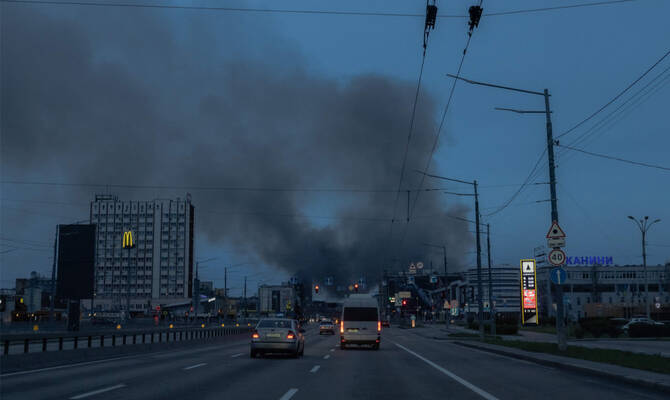
In Kyiv, explosions were heard in the night and a smoke rose up from the city on Sunday morning.
One person was killed and three people were wounded, the head of the city’s military administration, Tymur Tkachenko, wrote on social media.
Kyiv mayor Vitali Klitschko said that “the body of a man killed in an enemy attack was discovered in Darnytsia district.”
A missile strike partially destroyed a building housing state foreign-language broadcasters, the Russian-language Freedom television channel reported, saying that its newsroom had been destroyed.
Emergency services said that fires broke out in non-residential buildings in Kyiv. In a nearby region, a man was burned when an attack sparked a house fire, the head of the military administration said.
Russia attacked Ukraine with 23 cruise and ballistic missiles and 109 drones during the night, the Ukrainian air force said.
The air force said it shot down 13 of the missiles and 40 drones while 54 others caused no damage.
In the southern Kherson region, a drone killed a 59-year-old man, while in the northeastern Kharkiv region, near the border with Russia, two people were wounded in an aerial bomb attack, regional officials said.
In the western region of Khmelnytsky, authorities said air defenses destroyed a missile but falling fragments damaged a house and wounded a woman.
Over the past week, Russia has launched more than 1,460 guided aerial bombs, nearly 670 attack drones, and over 30 missiles of various types on Ukraine, Zelensky said.
Russia’s defense ministry said troops “liberated” the village of Basivka, close to the border with Russia’s Kursk region. Ukraine quickly rejected the report.
“The enemy continues its disinformation campaign regarding the seizure of settlements in Sumy region or the breakthrough of the border,” Andriy Demchenko, spokesman for the State Border Guard Service of Ukraine, told AFP.
French President Emmanuel Macron echoed Zelensky’s calls for a stronger response to Russia.
“A ceasefire is needed as soon as possible. And strong action if Russia continues to try to buy time and refuse peace,” Macron said on X on Sunday.
Russia continues “to murder children and civilians,” he added.
The latest attacks came two days after a missile attack on the central Ukrainian city of Kryvyi Rig killed 18 people including nine children.
The United Nations High Commissioner for Human Rights, Volker Turk, denounced Russia’s “reckless disregard” for human life in using “an explosive weapon with wide area effects.”
Russia on Sunday said it had struck a central artillery base and enterprises involved in producing drones.
It accused Ukraine of striking its energy infrastructure including a gas distribution facility in the Voronezh region.
US President Donald Trump is pushing the two sides to agree a partial ceasefire, but has so far failed to broker an accord acceptable to both sides.
The United States is also seeking better ties with Russia and Kremlin envoy Kirill Dmitriev in an interview with state television said that the next US-Russian contacts could be “next week,” Russian news agencies reported.
Dmitriev last week became the most senior Russian official to visit Washington since Moscow’s invasion of Ukraine.


![]()

Zelensky slams US lack of response to Putin truce rejection
Short Url
https://arab.news/gthwa
Zelensky slams US lack of response to Putin truce rejection
- Zelensky said “the number of Russian air attacks is increasing,” which he said proved that “the pressure on Russia is still insufficient”


Latest updates




© 2026 SAUDI RESEARCH & PUBLISHING COMPANY, All Rights Reserved And subject to Terms of Use Agreement.