

US starts collecting Trump’s new 10 percent tariff, smashing global trade norms

1 / 3
2 / 3
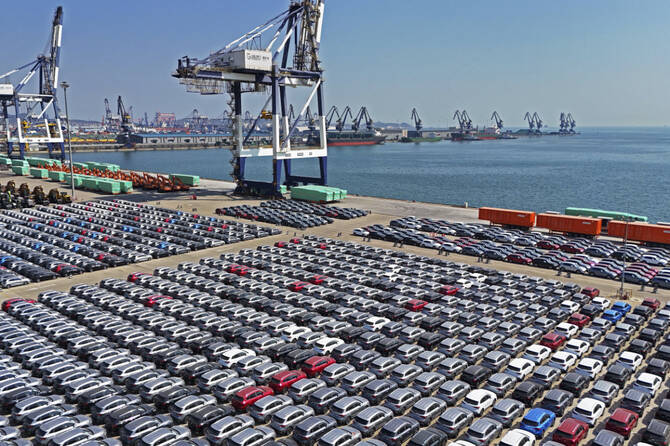
An aerial view of new cars waiting for shipment at a pier for ro-ro ships in Yantai city in eastern China's Shandong province on March 30, 2025. (Chinatopix Via AP)
3 / 3
A general view shows ships docked at the Deendayal Port Authority (DPA) in Kandla in India's Gujarat state on April 5, 2025. (AFP)
Short Url
Updated 06 April 2025
Follow

US starts collecting Trump’s new 10 percent tariff, smashing global trade norms

  • Trump’s tariffs impact global markets, causing $5 trillion loss in S&P 500 value
  • Exemptions include crude oil, pharmaceuticals and semiconductors

WASHINGTON/JUPITER, Florida: US customs agents began collecting President Donald Trump’s unilateral 10 percent tariff on all imports from many countries on Saturday, with higher levies on goods from 57 larger trading partners due to start next week.
The initial 10 percent “baseline” tariff paid by US importers took effect at US seaports, airports and customs warehouses at 12:01 a.m. ET (0401 GMT), ushering in Trump’s full rejection of the post-World War Two system of mutually agreed tariff rates.
“This is the single biggest trade action of our lifetime,” said Kelly Ann Shaw, a trade lawyer at Hogan Lovells and former White House trade adviser during Trump’s first term.
Shaw told a Brookings Institution event on Thursday that she expected the tariffs to evolve over time as countries seek to negotiate lower rates. “This is a pretty seismic and significant shift in the way that we trade with every country on earth,” she added.


Caption


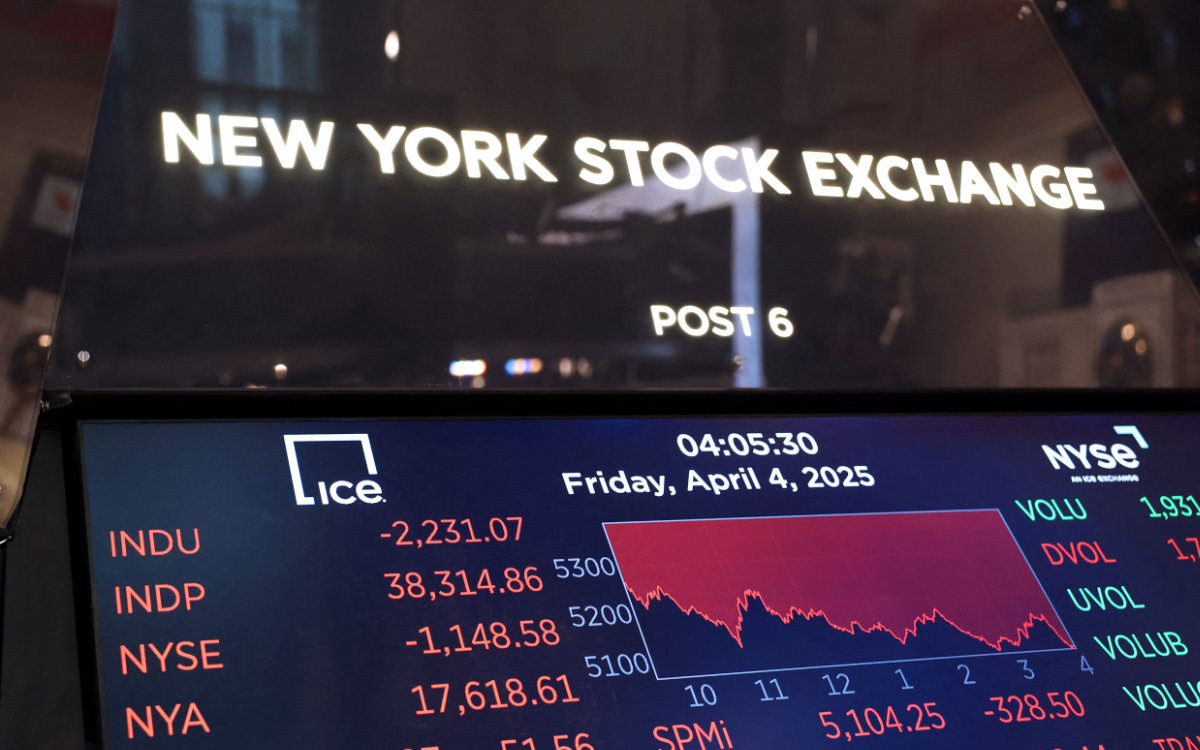
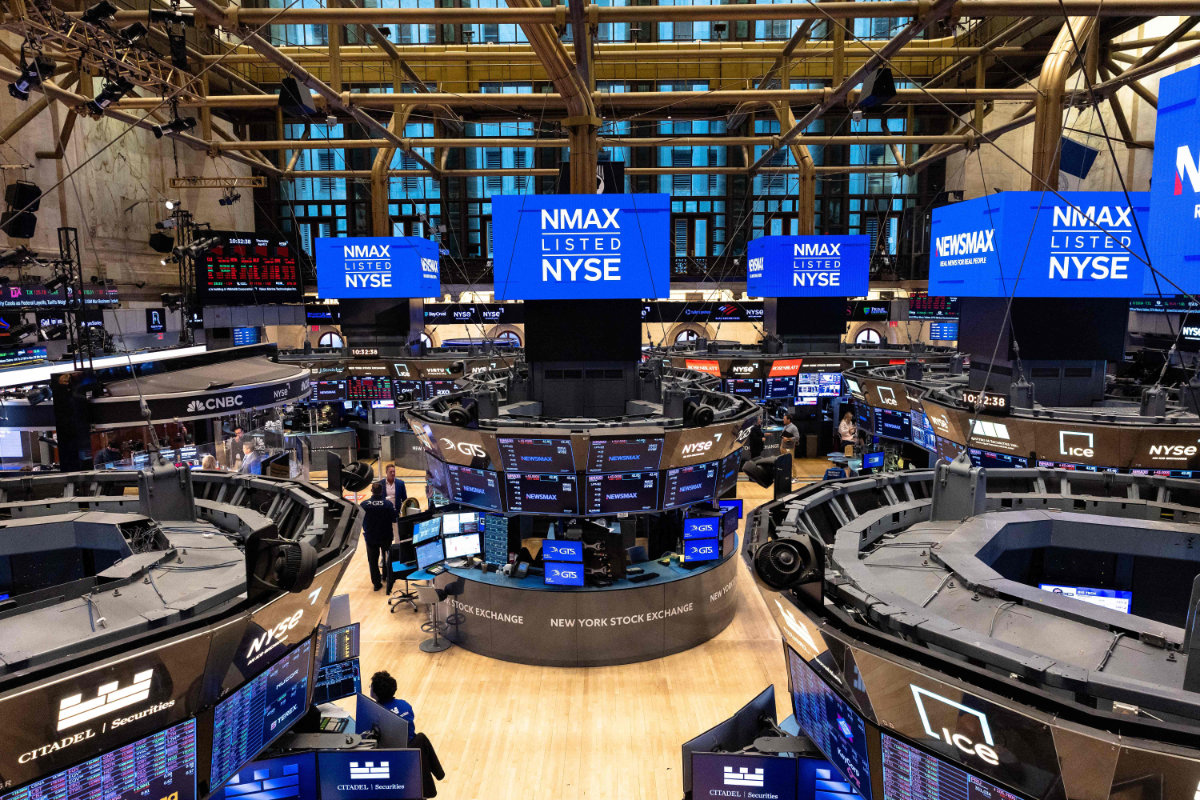
Trump’s Wednesday tariff announcement shook global stock markets, wiping out $5 trillion in value for S&P 500 index companies by Friday’s close, a record two-day decline. Driven by recession fears, prices for oil and commodities plunged, while investors fled to the safety of government bonds.
Among the countries first hit with the 10 percent tariff were Australia, Britain, Brazil, Colombia, Argentina and Saudi Arabia despite their having goods trade deficits with the US last year. White House officials have said many countries would run larger deficits with the US if their policies were fairer.
A US Customs and Border Protection bulletin provided a 51-day grace period for cargoes loaded or in transit to the US before 12:01 a.m. ET Saturday. These cargoes need to arrive by May 27 to avoid the 10 percent duty.
Trump’s higher “reciprocal” tariff rates of 11 percent to 50 percent are due to take effect on Wednesday at 12:01 a.m. ET. European Union imports will face a 20 percent tariff, while Chinese goods will be hit with a 34 percent tariff, bringing Trump’s total new levies on China to 54 percent.
Beijing on Saturday said, “The market has spoken” in rejecting Trump’s tariffs. China applied a slew of countermeasures, including extra levies of 34 percent on all US goods and export curbs on some rare earth minerals.
“China has been hit much harder than the USA, not even close,” Trump said on Saturday on social media. “THIS IS AN ECONOMIC REVOLUTION, AND WE WILL WIN. HANG TOUGH, it won’t be easy, but the end result will be historic.”
Shortly after posting the comment, Trump was spotted arriving at his Trump National Golf Club in Jupiter, Florida, reading a New York Post article covering China’s retaliation to US tariffs and the stock market fall.

Israel, Taiwan, Vietnam
“A trade war is in no one’s interest. We must stand united and resolute to protect our citizens and our businesses,” French President Emmanuel Macron said in post on X.
Some world leaders hoped to strike a deal with Trump and avert economic fallout while others weighed countermeasures.
Prime Minister Benjamin Netanyahu was expected to visit the White House on Monday, sources said, to discuss the new 17 percent tariff on Israel. Media reported Prime Minister Shigeru Ishiba of Japan, which faces a 24 percent levy, was seeking a telephone conversation with Trump.
Vietnam, which benefited from the shift of US supply chains away from China after Trump’s first-term trade war with Beijing, agreed on Friday to discuss a deal with the US after Trump announced a 46 percent tariff on Vietnamese imports.
The head of Taiwan’s National Security Council was in Washington for talks that were expected to include the tariffs, a source said. Taiwan President Lai Ching-te huddled with tech executives on Saturday to discuss how to respond to the 32 percent duty imposed on its products.
Italian Economy Minister Giancarlo Giorgetti warned on Saturday against imposing retaliatory tariffs on the United States, saying at a business forum near Milan that doing so could cause damage.
US billionaire Elon Musk, a close Trump adviser, told a political event in Italy by video on Saturday that he hoped to see complete freedom of trade between the United States and Europe, which he described as “a zero tariff situation.”
Canada and Mexico were exempt from Trump’s latest duties but still face a 25 percent tariff imposed recently on goods that do not comply with rules of origin under a North America trade accord.
While Trump’s order exempted 1,000 product categories from the new tariffs such pharmaceuticals, uranium and semiconductors, the administration is considering new duties on some of them.


Thai villagers stay behind to guard empty homes as border clashes force mass evacuations

Updated 2 sec ago
Follow

Thai villagers stay behind to guard empty homes as border clashes force mass evacuations

SURIN: Fighting that has flared along the Thai-Cambodian border has sent hundreds of thousands of Thai villagers fleeing from their homes close to the frontier since Monday. Their once-bustling communities have fallen largely silent except for the distant rumble of firing across the fields.
Yet in several of these villages, where normally a few hundred people live, a few dozen residents have chosen to stay behind despite the constant sounds of danger.
In a village in Buriram province, about 6 miles (10 kilometers) from the border, Somjai Kraiprakon and roughly 20 of her neighbors gathered around a roadside house, keeping watch over nearby homes. Appointed by the local administration as Village Security Volunteers, they guarded the empty homes after many residents were forced to flee and with fewer security officials stationed nearby than usual.
The latest large-scale fighting derailed a ceasefire pushed by US President Donald Trump, which halted five days of clashes in July triggered by longstanding territorial disputes. As of Saturday, around two dozen people had been reported killed in the renewed violence.
At a house on the village’s main intersection, now a meeting point, kitchen and sleeping area, explosions were a regular backdrop, with the constant risk of stray ammunition landing nearby. Somjai rarely flinched, but when the blasts came too close, she would sprint to a makeshift bunker beside the house, built on an empty plot from large precast concrete drainage pipes reinforced with dirt, sandbags and car tires.
She volunteered shortly after the July fighting. The 52-year-old completed a three-day training course with the district administration that included gun training and patrol techniques before she was appointed in November. The volunteer village guards are permitted to carry firearms provided by relevant authorities.
The army has emphasized the importance of volunteers like Somjai in this new phase of fighting, saying they help “provide the highest possible confidence and safety for the public.”
According to the army, volunteers “conduct patrols, establish checkpoints, stand guard inside villages, protect the property of local people, and monitor suspicious individuals who may attempt to infiltrate the area to gather intelligence.”
Somjai said the volunteer team performs all these duties, keeping close watch on strangers and patrolling at night to discourage thieves from entering abandoned homes. Her main responsibility, however, is not monitoring threats but caring for about 70 dogs left behind in the community.
“This is my priority. The other things I let the men take care of them. I’m not good at going out patrolling at night. Fortunately I’m good with dogs,” she said, adding that she first fed a few using her own money, but as donations began coming in, she was able to expand her feeding efforts.
In a nearby village, chief Praden Prajuabsook sat with about a dozen members of his village security team along a roadside in front of a local school. Around there, most shops were already closed and few cars could be seen passing once in a while.
Wearing navy blue uniforms and striped purple and blue scarves, the men and women chatted casually while keeping shotguns close and watching strangers carefully. Praden said the team stationed at different spots during the day, then started patrolling when night fell.
He noted that their guard duty is around the clock, and it comes with no compensation and relies entirely on volunteers. “We do it with our own will, for the brothers and sisters in our village,” he said.
Beyond guarding empty homes, Praden’s team, like Somjai, also ensures pets, cattle and other animals are fed. During the day, some members ride motorbikes from house to house to feed pigs, chickens and dogs left behind by their owners.
Although his village is close to the battlegrounds, Praden said he is not afraid of the sounds of fighting.
“We want our people to be safe… we are willing to safeguard the village for the people who have evacuated,” he said.