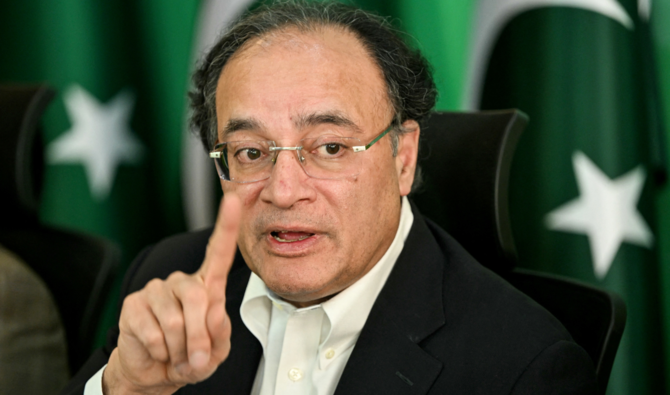
ISLAMABAD: Pakistan’s finance chief Muhammad Aurangzeb said on Saturday the government plans to send a high-level delegation to Washington to discuss the United States’ recent decision to impose a 29 percent tariff on Pakistani goods, describing the move as both a challenge and an opportunity to reset trade ties.
The finance minister’s remarks at a news conference came days after US President Donald Trump announced “reciprocal tariffs” on multiple countries, a measure widely viewed as a setback for a global economy still recovering from the pandemic. Trump defended the tariffs as necessary to address trade imbalances and what he termed unfair treatment of American goods abroad.
Pakistan’s inclusion in the tariff list has raised concern in Islamabad as the country pushes for export-driven growth. The US is Pakistan’s largest export destination, and the newly imposed duties threaten to undermine its fragile economic recovery.
Reacting to the development, Prime Minister Shehbaz Sharif this week formed a steering committee led by Aurangzeb to assess the impact of the tariffs and develop a policy response.
“You should never let a good crisis go to waste,” Aurangzeb told reporters. “So, we are looking at it both as a challenge and as an opportunity. On the opportunity side, it’s a relative value discussion in terms of what is happening at other locations and jurisdictions. And on the challenge side, what we can do in terms of the negotiations with the US administration.”
“In the next couple of days, we are going to finalize our recommendations to the prime minister and ... with [his] approval ... send a high-level delegation to Washington to get our views across and to ensure that we want to be ... a long term strategic partner [with the US],” he added.
Aurangzeb said a policy package was under development to guide future discussions with American officials.
“We want to make sure that we, in terms of our representations, put forward how we see [the tariff issue] in the medium to long term as a win-win situation for both Pakistan and the US,” he said.
According to the country’s central bank, Pakistan exported $5.44 billion worth of goods to the US in 2024. In the first eight months of the current fiscal year (July–February), exports to the US totaled $4 billion, up 10 percent from the same period last year.
Nearly 90 percent of those exports are textiles, which analysts expect to be hardest hit by the new tariffs.
Officials warn the increased cost burden could reduce Pakistan’s competitiveness, particularly if countries like China, Bangladesh and Vietnam — facing higher US tariffs — divert more of their exports to Europe, increasing competition in alternative markets.
The US tariff announcement could also disrupt Pakistan’s economic stabilization efforts, which rely on support from International Monetary Fund programs.
Global financial markets dropped sharply on Friday after China pledged retaliatory tariffs of 34 percent on US goods, heightening fears of a deepening trade war and possible global recession.


Pakistan to send high-level delegation to US over 29 percent tariff on exports
https://arab.news/5dvgu
Pakistan to send high-level delegation to US over 29 percent tariff on exports

- Muhammad Aurangzeb says Pakistan is looking at the situation as both an opportunity and a challenge
- He informs the government is finalizing recommendations for a ‘win-win’ outcome for both countries

Pakistan president meets UAE counterpart, explores trade, investment opportunities
- Asif Ali Zardari is in UAE on four-day visit to strengthen bilateral ties, review bilateral cooperation
- Both sides discuss regional, international developments, reaffirm commitment to promote peace
ISLAMABAD: President Asif Ali Zardari met his UAE counterpart Sheikh Mohammed bin Zayed Al-Nahyan in Abu Dhabi on Tuesday during which both sides explored new opportunities in trade, investment, energy and other sectors, Zardari's office said.
Zardari arrived in Abu Dhabi on Monday evening with a high-level delegation on a four-day official visit to the UAE to review trade, economic and security cooperation.
"The leaders discussed ways to further deepen the longstanding and brotherly relations between Pakistan and the UAE," a statement from Zardari's office said about his meeting with the UAE president.
"They reviewed the full spectrum of bilateral cooperation and explored new opportunities in trade, investment, energy, infrastructure, technology, and people-to-people exchanges, highlighting the significant potential for expanding economic and strategic partnership.
Zardari highlighted the significance of Al-Nayhan's visit to Pakistan last month, the statement said, expressing appreciation for the UAE's continued support for strengthening bilateral ties.
It said both sides also exchanged views on a range of regional and international developments, reaffirming their commitment to promoting peace, stability and sustainable development.
The meeting was also attended by Pakistan's First Lady Aseefa Bhutto-Zardari, the Pakistani president's son Bilawal Bhutto-Zardari, who is also the chairman of the Pakistan Peoples Party, Interior Minister Mohsin Naqvi and Pakistan's ambassador to the UAE.
ZARDARI MEETS AD PORTS CEO
Zardari earlier met AD Ports Group CEO Captain Mohamed Juma Al-Shamisi to discuss the group's investment initiatives in Karachi.
"Both sides agreed that the expansion and modernization of port infrastructure would strengthen trade flows and support Pakistan’s broader economic development and country’s seaborne trade," the President's Secretariat said in a statement.
It added that Zardari described the AD Ports Group's long-term investment and expanding role in Pakistan's maritime and logistics sector as a key pillar of Pakistan–UAE economic cooperation.
Pakistan and the UAE maintain close political and economic relations, with Abu Dhabi playing a pivotal role in supporting Islamabad during periods of financial stress through deposits, oil facilities and investment commitments.
The UAE is Pakistan's third-largest trading partner, after China and the United States, and a key destination for Pakistani exports, particularly food, textiles and construction services.
The Gulf state is also home to more than 1.5 million Pakistani expatriates, one of the largest overseas Pakistani communities in the world, who contribute billions of dollars annually in remittances, a crucial source of foreign exchange for Pakistan’s economy.
Beyond trade and labor ties, Pakistan and the UAE have steadily expanded defense and security cooperation over the years, including military training, joint exercises and collaboration in counter-terrorism and regional security matters.


