ISLAMABAD: Prime Minister Shehbaz Sharif on Friday lauded the successful implementation of Pakistan’s Ramadan Relief Package 2025, praising the transparent use of digital wallets for fund distribution and instructing officials to adopt the model for future government programs, state media reported.
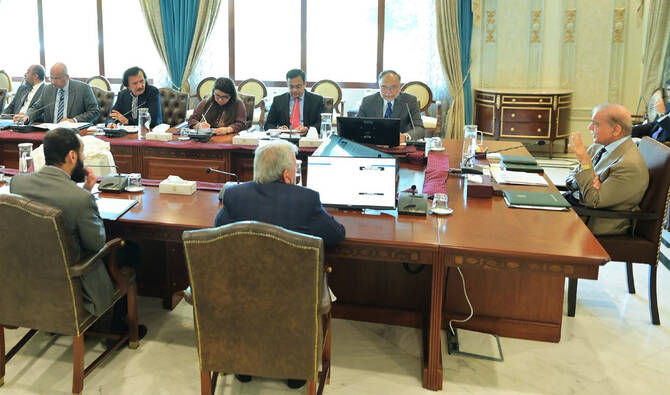
The premier made the comments during a meeting in Islamabad to review the execution of the nationwide relief scheme, which aimed to provide financial support during the Muslim fasting month of Ramadan.
The package, rolled out across the country including Gilgit-Baltistan and Azad Kashmir, utilized digital tools to deliver assistance to beneficiaries and was promoted as a step toward the country’s broader digital transformation agenda.
Under the initiative, aid was transferred directly into recipients’ digital wallets — secure mobile accounts linked to national ID numbers — allowing beneficiaries to access funds via mobile apps, ATMs or designated agents without needing a traditional bank account.
“Appreciating the effective and transparent implementation of the Ramazan Relief Package 2025, [the prime minister] directed the authorities concerned to emulate this model in future government schemes,” the Associated Press of Pakistan (APP) news agency reported the PM Office as saying.
It said 1.9 million digital payments were made and over 951,000 digital wallets used, marking what officials described as a significant move toward realizing the “Digital Nation Pakistan” vision.
More than 823,000 women and over 2,500 persons with disabilities accessed the funds through digital platforms, APP added.
Authorities said 79 percent of the allocated funds had been disbursed, with a team of 2,224 employees resolving over 1,200 complaints during the scheme’s implementation.
Millions of robocalls, SMS alerts and outbound calls were also made to raise awareness, the report added.

PM Sharif hails Ramadan relief success, orders digital wallet model for future welfare programs
https://arab.news/rc9r4
PM Sharif hails Ramadan relief success, orders digital wallet model for future welfare programs
- Government transferred cash directly into digital wallets to provide Ramadan relief to deserving citizens
- Over 951,000 digital wallets were used and 1.9 million payments made, according to official statistics
Pakistan eyes ‘heavy’ Chinese investments in 10 key sectors at Islamabad agriculture summit
- More than 300 Chinese and Pakistani firms attended the event focusing on fertilizers, seeds, smart farming and irrigation techniques
- Islamabad expects the conference to lead to investments in agriculture, food processing, livestock, farm machinery and renewable energy
KARACHI: Pakistan is expecting “heavy” Chinese investments across 10 key sectors, including agriculture, renewable energy and technology, the Pakistani food security minister said on Monday, as officials and business leaders from both countries gathered for a major agriculture investment summit in Islamabad.
The Pakistan-China Agriculture Investment Conference was billed by Pakistan as a platform for deepening bilateral agricultural ties and supporting broader economic engagement between the two countries.
Around 120 Chinese companies and over 190 Pakistani firms participated in the event that focused on fertilizers, seed varieties, machinery, precision farming and smart irrigation systems, according to the organizers.
Speaking at the event, National Food Security Minister Rana Tanveer Hussain said the conference’s objective was to project Pakistan as a place where Chinese enterprises could grow, innovate and succeed alongside Pakistani partners.
“Heavy investments worth millions of dollars are expected, with multiple MoUs [memorandums of understanding] likely to be finalized by the end of the day across 10 key sectors, including agriculture, food processing, livestock, fisheries, agri-inputs, farm machinery, renewable energy, logistics, technology and value-added exports,” Hussain said on Monday evening.
Pakistan’s exports to China reached approximately $2.38 billion in Fiscal Year 2024–25 that ended in June, while imports stood at $16.3 billion, reflecting growing demand on both sides despite global economic headwinds, according to the minister.
This performance demonstrated resilience and expanding opportunities under the China–Pakistan Free Trade Agreement (CPFTA) framework.
Hussain said Islamabad was committed to supporting Chinese investors from regulatory processes to seamless coordination with all government departments and institutions.
“Together, Pakistan and China can push the boundaries of innovation, transform agri-technology, strengthen food security and reshape the economic landscape of the region,” he said.
The completion of the China-Pakistan Economic Corridor (CPEC) Phase I and the launch of CPEC Phase II marked a decisive shift toward industrialization, technology transfer, renewable energy and people-centric development, according to Hussain.
Both sides had signed over 40 MoUs in Sept. 2025, covering modern farming, livestock, fisheries, farm mechanization and advanced technology transfer.
“These initiatives are not just projects; they are lifelines of growth, confidence and mutual trust,” he said, adding that they aim to enhance productivity, expand exports, strengthen food security and ensure sustainable and inclusive economic growth.
Pakistan and China have been expanding cooperation in agriculture under the CPEC framework. Officials say stronger agricultural ties could help Pakistan boost exports, ensure food security and create jobs, while offering Chinese companies access to a large farming market and new investment opportunities.
Addressing the conference, Prime Minister Shehbaz Sharif urged Pakistani and Chinese agriculturists and experts to strengthen their existing partnership, saying that their sustained hard work and productivity gains could turn Pakistan into a surplus agricultural economy.
“Chinese experts are there to assist us and support us all the way to achieve this wonderful target [of becoming a surplus agricultural economy],” he said. “Now it’s up to us to generate this trade surplus through higher yields, comparative cost and, of course, highest quality.”
The prime minister noted that Pakistan’s policy rate was down to 10.5 percent down from 22 percent two years ago, exports were gradually increasing and macroeconomic indicators were stable.
“Now we have to move toward growth,” he said. “But then it requires solid, hard work, untiring efforts, blood and sweat. Without that, you will not be able to achieve your targets.”


