

Italy plans $22 million for migrant repatriations

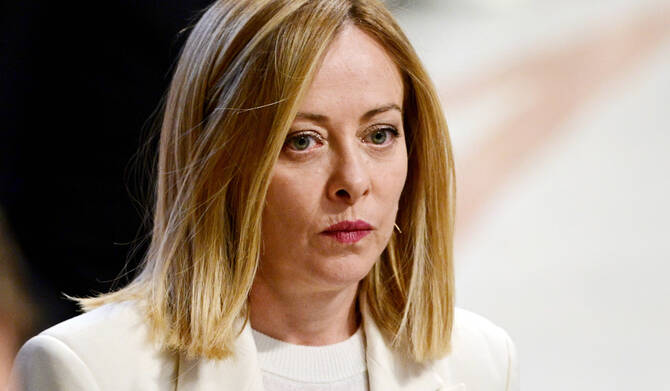
Italy's Prime Minister Giorgia Meloni (C) attends a mass for the 20th Anniversary of the death of John Paul II at Saint Peter Basilica in Vatican city on April 2, 2025. (AFP)
Short Url
Updated 03 April 2025
Follow

Italy plans $22 million for migrant repatriations

  • The ministry said the plan would benefit “around 3,300 of the most vulnerable migrants, carrying out their repatriation to their countries of origin sustainably and effectively”

ROME: Italy plans to invest 20 million euros ($22 million) in a new project to help Algeria, Libya, and Tunisia send irregular migrants from their territories back to the migrants’ countries of origin.
The government of Prime Minister Giorgia Meloni has vowed to cut irregular migration to Italy’s shores from North Africa — the majority of whom depart from Libya and Tunisia.
However, many migrants who depart hail from other countries, especially sub-Saharan African countries.
Italy’s new plan “focuses on strengthening the institutional and administrative-managerial capacities of the partner countries,” with the involvement of 400 officials, Italy’s Foreign Ministry said in a statement.
Irregular migration would be better addressed “through the improvement and development of assisted voluntary repatriations from Algeria, Libya and Tunisia to the countries of origin,” it said.
It said the project would collaborate with the International Organization for Migration to ensure migrants’ rights.
The ministry said the plan would benefit “around 3,300 of the most vulnerable migrants, carrying out their repatriation to their countries of origin sustainably and effectively.”
It said Italy’s Agency for Development Cooperation, which helps carry out development activities, would provide technical support.
The agency has also been charged with another plan targeted at the “socio-economic reintegration of returning migrants,” tapping Italian companies and civil society groups, it said.
Most migrants arriving in Italy via the Mediterranean depart from Libya and Tunisia.
Italy has agreements with both countries to provide funding in exchange for help stemming departures.
On Wednesday, Libyan authorities said they would suspend the work of 10 international humanitarian groups, including Doctors Without Borders, accusing them of a plan to “settle migrants” from other parts of Africa in the country.


UK eyes Russia sanctions after Navalny poisoning findings

Updated 3 sec ago
Follow

UK eyes Russia sanctions after Navalny poisoning findings

  • ‘We continue to look at coordinated action, including increasing sanctions on the Russian regime’
  • Opposition leader Alexei Navalny was killed by dart-frog toxin in a Russian prison
LONDON: Britain will consider “increasing sanctions” against Russia following findings from five European states that opposition leader Alexei Navalny was killed by dart-frog toxin in a Russian prison, UK foreign minister Yvette Cooper said Sunday.
“We continue to look at coordinated action, including increasing sanctions on the Russian regime,” Cooper told the BBC from the Munich Security Conference, where the UK, France, Germany, the Netherlands and Sweden announced findings that the Russian state was a prime suspect for poisoning Navalny two years ago.
Navalny, a staunch critic of President Vladimir Putin, died in a Russian prison in mysterious conditions on February 16, 2024, while serving a 19-year sentence.
The five European countries on Saturday said that a deadly toxin known as epibatidine, found in Ecuadorian dart frogs, was found on laboratory analyzes of samples from his body.
Cooper told Sky News that the toxin can also be produced synthetically.
“We do know that the Russian regime has had possession of this particular chemical,” the British foreign minister said.
“Russia claimed that Navalny died of natural causes. But given the toxicity of epibatidine and reported symptoms, poisoning was highly likely the cause of his death,” the European countries said in a joint statement Saturday.
Britain’s foreign office said separately that “only the Russian state had the means, motive and opportunity to deploy this lethal toxin.” It added: “We hold it (Russia) responsible for his death.”
UK Prime Minister Keir Starmer hailed Navalny’s “courage in the face of tyranny” in a social media post, slamming “Putin’s murderous intent.”
Russia’s foreign ministry spokeswoman and Moscow’s embassy in London dismissed the Western report.
The Kremlin has never given a full explanation for Navalny’s death, only saying he fell ill and died suddenly after taking a walk in his prison colony.
Putin said in 2024 that Navalny had “passed away.” The opposition leader died shortly before a presidential election in Russia.
On Saturday, Navalny’s widow, Yulia Navalnya, said it was now “science-proven” that the Kremlin opponent had been murdered, two years after his death was announced during the same annual conference in Germany.
Navalnaya last September said that laboratory analysis of smuggled biological samples found that her husband was killed by poisoning.
French Foreign Minister Jean-Noel Barrot paid “tribute” to Navalny after the findings.
“We now know that Vladimir Putin is prepared to use biological weapons against his own people to remain in power,” Barrot said in a post on X.
