
BEIRUT: Lebanese leaders have reached a unified position on border demarcation to present to Morgan Ortagus, the US envoy, who is scheduled to arrive in Beirut before the end of the week.
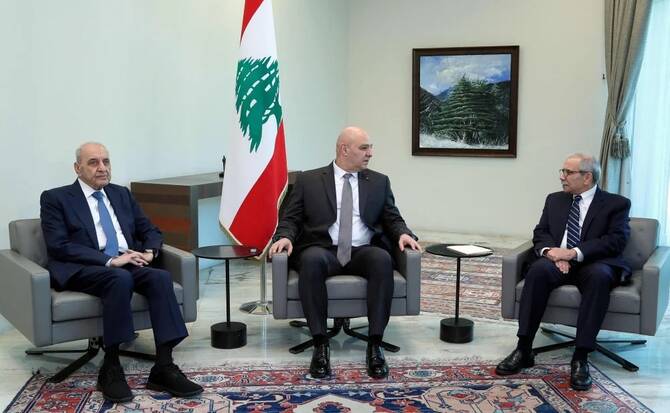
President Joseph Aoun, Parliament Speaker Nabih Berri, and Prime Minister Nawaf Salam, agreed that there “will be no negotiations with the Israeli side regarding (a) prisoner swap or withdrawal from the Lebanese hills still occupied by the Israeli Army,” a source in the government told Arab News on Thursday.
“However, Lebanon is open to discussing disputed land border points,” the source added.
“Regardless of the US envoy’s proposals, the Lebanese stance remains unchanged,” said the source, who clarified that the Lebanese Army “is fulfilling its duties by being deployed south of the Litani River and confiscating weapons in the border area, as acknowledged by the US side overseeing the ceasefire monitoring committee and the UNIFIL forces.”
The source said that the military had made significant progress on the issue, destroying weapons and ammunition seized from Hezbollah sites.
Aoun told top security officials on Thursday that Lebanon’s interests comes above anything else.
He was speaking during a visit to the leadership of the Internal Security Forces and the General Security Directorate.
“We have a great opportunity to seize at all levels, and we must show the people that we are mature enough to build the state and that we will build it,” he said.
The president called on security bodies to “remain unaffiliated with anyone, serve only Lebanon’s interests, and enforce the law,” noting that “the world is ready to help us, but we must first help ourselves.”
Aoun stated: “Lebanon’s interest comes above anything else. It is the state that protects Lebanon, not its sects. Parties and sects prioritize their interests, whereas your duty is to serve Lebanon.
“You must reject any demands or interference that might harm the nation’s interests and prompt people to respect the law, keeping in mind that no request outside the law will be tolerated.”
Also on Thursday, Maronite Patriarch Bechara Al-Rahi, the highest Maronite religious authority in Lebanon, said the time “has come to unify weapons in Lebanon, as stipulated in the Taif Agreement.”
He also told the Lebanese Editors Syndicate that the military “needs strengthening and support from other nations, but the solution now is diplomatic, as we are incapable of engaging in war, and no one can confront Israel.
“What has the resistance achieved with all its weapons against the Israeli war machine,” he asked, adding “now is not the time for normalization with Israel, as there are other issues that must be addressed first, such as border demarcation and disarmament.”
Israeli Defense Minister Israel Katz said Israel would not withdraw from the five positions it controls in Lebanon.
He was speaking during a visit to an Israeli military site in southern Lebanon — one of the five hills still occupied since the ceasefire declaration in November.
At the site, which is near the Israeli settlement of Margaliot, Katz stated Israel’s presence at the five locations will be determined not by time but by the situation on the ground.
“Only if Hezbollah disarms and withdraws from the border can we discuss the withdrawal of the Israeli Army from these positions, and this matter is being coordinated with the Americans,” he said.
Katz anticipated “an increase in activity among Palestinian organizations, including Hamas, in Lebanon and Syria.”
He stated: “We are working to prevent the arming of Hezbollah and Palestinian organizations. The challenge will begin and intensify.”
Katz claimed that Hezbollah “is not a protector of Lebanon.”
He added: “The Iranians now realize that it is no longer capable of defending them.”
Elsewhere, an Israeli drone targeted a vehicle on the main road between Bint Jbeil and Yaroun in the border area.
The drone struck the vehicle from behind, resulting in two injuries, the Lebanese Ministry of Health said.
The Israeli military conducted airstrikes around Naqoura and one strike in the town’s center, targeting pre-fabricated homes as replacements for the destroyed houses and facilities.
These pre-fabricated facilities were being used to meet citizens’ needs, serving as a substitute for the municipal building, destroyed by Israel following the ceasefire, said Naqoura Mayor Abbas Awada.
He highlighted that recent aggression occurring in proximity to UNIFIL headquarters falls “under the jurisdiction of the five-member ceasefire monitoring committee and UNIFIL forces.”
Hezbollah’s Islamic Health Authority reported that Israeli strikes destroyed a “newly established civil defense center and damaged ambulances and firefighting vehicles.”
Meanwhile, the Lebanese Armed Forces have taken proactive measures, with military units removing “engineering obstacles placed by Israeli forces inside Lebanese territory” near Al-Labouna in the Tyre region.
The military also closed an unauthorized dirt road created by Israeli units in the same area.
In an official statement, the Lebanese Army Command affirmed its ongoing commitment to “addressing Israeli violations through close coordination with the ceasefire monitoring mechanism and UNIFIL.”
The Army Command condemned Israel’s “persistent violations of Lebanese sovereignty and targeting of civilians across multiple regions.”
In another development, UNIFIL Western Sector Commander Gen. Nicola Mandolisi conducted his first meeting with Khirbet Selem Mayor Mohammed Rahhal.
Their joint statement highlighted “UNIFIL’s commitment to facilitating the safe return of displaced residents and supporting Lebanese military operations through strategic partnerships with the Fifth Brigade and the Second and Fifth Rapid Intervention Regiments, key components in regional stabilization efforts.”