BERLIN: The German military will be armed with loitering munitions, or exploding drones, for the first time, two defense ministry sources said on Thursday, as Berlin tries to catch up with a technology that has shown its destructive power in Ukraine.
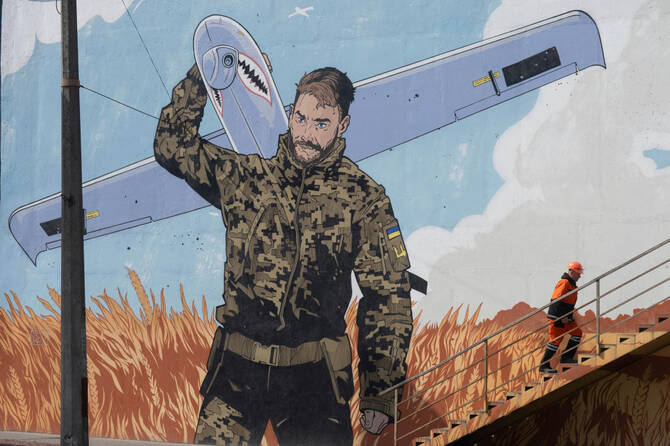
Both Russia and Ukraine have fielded such single-use drones, which cruise toward their target before plummeting at velocity and detonating on impact.
But the procurement of armed drones has been controversial in Germany, with some politicians associating them with targeted extrajudicial killings by US forces in Afghanistan.
It took years of heated debate before parliament agreed in 2022 to enable a large drone such as the Heron TP, which flies at much higher altitudes, to carry arms.
However, military upgrades are more urgent now for Germany, amid the continuing war between Russia and Ukraine and doubts about the future of US military protection.
Last month, parliament approved plans for a defense spending surge worth hundreds of billions of euros.
Contracts with two companies for a first batch of exploding drones will be signed in the coming days, the sources said, declining to name the companies. The army, air force and navy will test them in the following months.
“The use of drones and the defense against drones is crucial for the survival of our troops on the modern battlefield, that’s something we learned in Ukraine,” said one of the sources, who spoke on condition of anonymity.
“Each soldier must be capable of operating drones, just as today, everybody knows how to use binoculars.”
Germany will aim to sign longer-term contracts by the end of the year for a larger number of drones, shortening the period for introducing new weapons which usually takes years.
As drone technology evolves rapidly, the deals will specify that companies supply a limited number initially for training purposes, and that they may be asked later to supply a larger number of the latest models at short notice, if needed.
“There’s no use in purchasing thousands of drones ... only to realize they are outdated by the time we need them,” one of the sources said.

German military to order exploding drones for first time, sources say
https://arab.news/27whj
German military to order exploding drones for first time, sources say
- Russia and Ukraine have fielded such single-use drones
- The procurement of armed drones has been controversial in Germany
More than 100 dead in torrential rain and floods across southern Africa
- South Africa has reported at least 19 deaths in two of its northern provinces following heavy rains
- Tourists and staff members were evacuated this week by helicopter from flooded camps
JOHANNESBURG: Torrential rains and flooding have killed more than 100 people in South Africa, Mozambique and Zimbabwe, and authorities warned Friday that more severe weather was expected across several countries in southern Africa.
South Africa has reported at least 19 deaths in two of its northern provinces following heavy rains that began last month and led to severe flooding.
Tourists and staff members were evacuated this week by helicopter from flooded camps to other areas in the renowned Kruger National Park, which is closed to visitors while parts of it are inaccessible because of washed out roads and bridges, South Africa’s national parks agency said.
In neighboring Mozambique, the Institute for Disaster Management and Risk Reduction said 103 people had died in an unusually severe rainy season since late last year. Those deaths were from various causes including electrocution from lightning strikes, drowning in floods, infrastructure collapse caused by the severe weather and cholera, the institute said.
The worst flooding in Mozambique has been in the central and southern regions, where more than 200,000 people have been affected, thousands of homes have been damaged, while tens of thousands face evacuation, the World Food Program said.
Zimbabwe’s disaster management agency said that 70 people have died and more than 1,000 homes have been destroyed in heavy rains since the beginning of the year, while infrastructure including schools, roads and bridges collapsed.
Flooding has also hit the island nation of Madagascar off the coast of Africa as well as Malawi and Zambia. Authorities in Madagascar said 11 people died in floods since late November.
The United States’ Famine Early Warning System said flooding was reported or expected in at least seven southern African nations, possibly due to the presence of the La Nina weather phenomenon that can bring heavy rains to parts of southeastern Africa.
South African President Cyril Ramaphosa visited flood-stricken areas in the northern Limpopo province on Thursday and said that region had received around 400 millimeters (more than 15 inches) of rain in less than a week. He said that in one district he visited “there are 36 houses that have just been wiped away from the face of the Earth. Everything is gone ... the roofs, the walls, the fences, everything.”
The flooding occurred in the Limpopo and Mpumalanaga provinces in the north, and the South African Weather Service issued a red-level 10 alert for parts of the country for Friday, warning of more heavy rain and flooding that poses a threat to lives and could cause widespread infrastructure damage.
The huge Kruger wildlife park, which covers some 22,000 square kilometers (7,722 square miles) across the Limpopo and Mpumalanga provinces, has been impacted by severe flooding and around 600 tourists and staff members have been evacuated from camps to high-lying areas in the park, Kruger National Park spokesperson Reynold Thakhuli said.
He couldn’t immediately say how many people there were in the park, which has been closed to visitors after several rivers burst their banks and flooded camps, restaurants and other areas. The parks agency said precautions were being taken and no deaths or injuries had been reported at Kruger.
The South African army sent helicopters to rescue other people trapped on the roofs of their houses or in trees in northern parts of the country, it said. An army helicopter also rescued border post officers and police officers stranded at a flooded checkpoint on the South Africa-Zimbabwe border.
Southern Africa has experienced a series of extreme weather events in recent years, including devastating cyclones and a scorching drought that caused a food crisis in parts of a region that often suffers food shortages.
The World Food Program said more than 70,000 hectares (about 173,000 acres) of crops in Mozambique, including staples such as rice and corn, have been waterlogged in the current flooding, worsening food insecurity for thousands of small-scale farmers who rely on their harvests for food.


