



BAHAWALPUR: A young nawab once built a palace for his wife, so goes a local legend, only for her to abandon it after a single visit. As the tale is told, Nawab Sadiq Muhammad Khan IV had Noor Mahal constructed for his spouse, who, after spending one night there, glimpsed a nearby graveyard from the balcony and refused to return, considering it a bad omen.
The story may not hold up to historical scrutiny, but it continues to captivate the many tourists who flock to Noor Mahal, Bahawalpur’s most iconic monument. Towering over manicured gardens, the palace, built in 1875, is famed for its Indo-European architecture and striking symmetry.
Before joining Pakistan in 1956, Bahawalpur was a princely state, one of over 500 semi-autonomous territories in British India ruled by local monarchs. These rulers retained control over internal affairs while pledging allegiance to the British Crown.
The 152-year-old Noor Mahal was a crown jewel of Bahawalpur under its last great ruler, lending some credence to the theory that it may have been built as a gesture of affection for Noor Jahan, his wife. Some historians, however, offer a different reading.
“At the time, the Nawab family had multiple palaces, and Noor Mahal was primarily intended as a guest house for foreign dignitaries and experts,” Dr. Nadeem Omar Tarar, an art historian, told Arab News while challenging the popular story.

The picture taken on February 28, 2022, shows interior view of Noor Mahal in Pakistan's Bahawalpur city. (AN Photo)
Nevertheless, another scholar, Dr. Usman Ali, maintained that the building might originally have been planned as a personal residence before its use shifted.
“The 1904 Gazetteer acknowledges that it was originally designed as a personal residence but later repurposed due to its proximity to the graveyard,” he said.
The story of Nawab Sadiq Muhammad Khan’s ascension to the throne is equally intriguing. When his father died at the age of 29 on March 25, 1866, Khan was just four years old. The young nawab was immediately declared his successor, but his position was challenged by rival factions seeking control of the state.
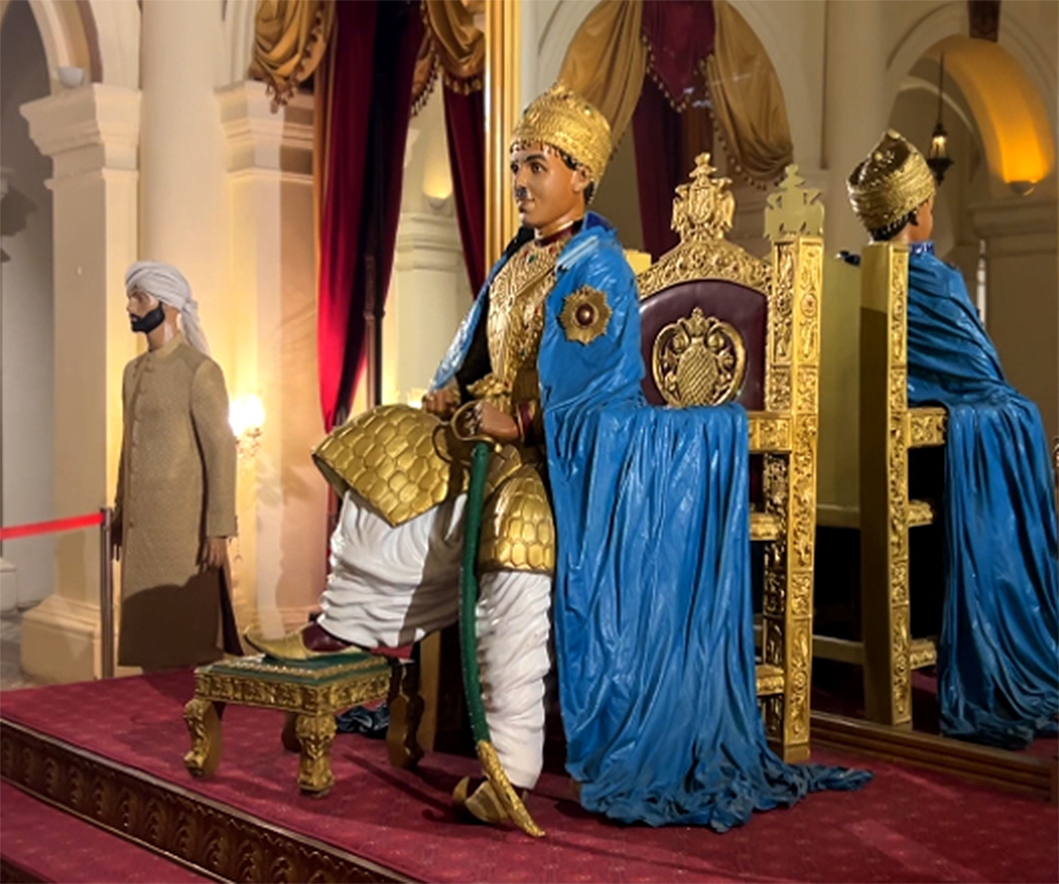
The statue of Nawab Sadiq Muhammad Khan IV is pictured at Noor Mahal in Bahawalpur, Pakistan, on February 19, 2025. (AN photo)
Fearing internal unrest, his family and loyalists turned to the British for support. In return for their intervention, the British assumed guardianship of the child ruler, securing complete political influence over Bahawalpur.
“The British government took the young Nawab under its guardianship, ensuring his personal education, health and training while also focusing on the development of every sector of the state,” Hafizur Rahman Hafiz wrote in his 1924 book, “Tajdaran-e-Riyasat Bahawalpur.”

The picture taken on February 9, 2025, shows first printing press of the former “Bahawalpur State” at the Noor Mahal palace in Bahawalpur, Pakistan. (AN photo
To oversee both state affairs and the young Nawab’s upbringing, Major Charles Cherry Minchin was appointed political agent in November 1866 and served as the de facto authority until Nawab Sadiq IV formally assumed power at the age of 18.
Noor Mahal was constructed over an area of 44,600 square feet, featuring 32 rooms — 14 of them in the basement — along with six verandas and five domes.
Its design was selected from 11 architectural proposals solicited from across India, with the final plan submitted by a building designer named Muhammad Hussain, adopted with minor modifications.

The picture taken on February 9, 2025, shows exterior view of Noor Mahal palace in Bahawalpur, Pakistan. (AN photo)
The palace blends Corinthian and Islamic styles, with columns, balustrades and pediments sitting alongside domes and angled arches, a signature of Indo-Saracenic architecture.
A commemorative inscription and state coins were buried in its foundations during construction as a good omen, according to court historian Azizur Rahman Aziz in his book, “Subh-e-Sadiq.”
After Bahawalpur joined Pakistan in 1956, Noor Mahal came under the Auqaf Department. In 1971, the Pakistan Army leased the property and eventually bought it in 1997 for Rs119 million ($428,400).
Today, the palace is open to the public and remains a major tourist attraction. Each evening, visitors gather for a sound and light show narrating Bahawalpur’s history, from its state rulers to its accession to Pakistan.
“The immersive experience draws large crowds every weekend, running throughout the year,” said local tourism official Waqas Ahmed.


