ISLAMABAD: The United Nations Human Rights Council on Wednesday adopted a resolution presented by Pakistan on behalf of the Organization of Islamic Cooperation (OIC), calling for accountability for Israel and justice for Palestinians in the Occupied Palestinian Territories (OPT), amid the ongoing conflict in Gaza.
The war in Gaza, which began in October 2023, has persisted despite multiple international efforts to broker a ceasefire. The Palestinian death toll, according to latest figures, has exceeded 50,000, with women and children making up a large share of the casualties.
Thousands remain missing under the rubble of buildings destroyed in Israeli airstrikes. In parallel, there have been mounting reports of harassment, arbitrary detentions, and even sexual assaults against Palestinians in the West Bank and East Jerusalem.
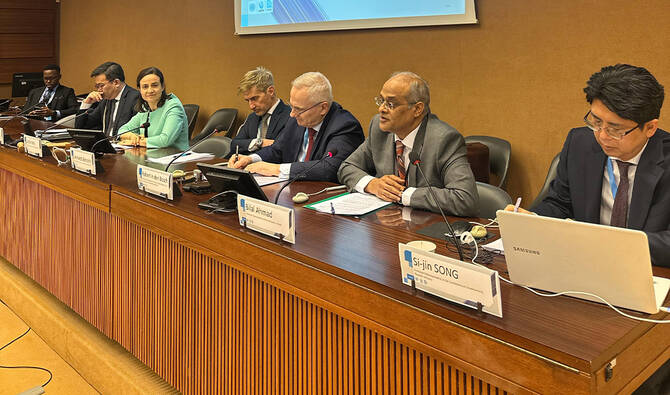
“Over the past eighteen months, the Palestinian people under occupation have faced horror upon horror,” Pakistan’s top diplomat at the UN mission in Geneva, Ambassador Bilal Ahmed, told the Council. “Whether in the desolate Gaza Strip or the West Bank including East Jerusalem, this Council has borne witness to a litany of crimes that demand justice.”
Ahmed said the resolution reflects the International Court of Justice’s advisory opinion from July 2024, which declared Israel’s continued presence in the Palestinian territories illegal.
It also incorporates findings by the UN Independent International Commission of Inquiry on the widespread and systematic use of sexual violence against Palestinians, particularly women and girls.
The resolution emphasizes the need to prevent and punish “incitement to genocide in Gaza,” in line with the ICJ’s provisional measures issued in January 2024.
It further calls for the establishment of an independent mechanism to assist in the investigation and prosecution of those responsible for the most serious crimes under international law.
“We have long known that impunity for human rights violations enables more and worse violations,” Ahmed said. “The adoption of this resolution would signal the strong resolve of this Council to end impunity for serial violators. For the Palestinian people, it would be the light at the end of an unimaginably dark tunnel.”
Pakistan’s Permanent Mission to the United Nations in Geneva confirmed later that the resolution was adopted by an overwhelming majority.


UN rights council adopts Pakistan-led OIC resolution on Palestine seeking Israel’s accountability
https://arab.news/4qccv
UN rights council adopts Pakistan-led OIC resolution on Palestine seeking Israel’s accountability

- Pakistan’s top diplomat at the UN council says impunity for human rights violations enables more and worse violations
- The resolution calls for a mechanism to prosecute those responsible for the most serious crimes against Palestinians

Pakistan footwear sector flags used imports as barrier to export growth
- Industry says production capacity far exceeds domestic consumption, signaling export potential
- Its delegation tells commerce minister up to 40 percent of domestic market met through used shoe imports
KARACHI: Pakistan’s leather and footwear industry has warned that rising imports of used shoes are distorting the domestic market and limiting export growth, according to a commerce ministry statement issued on Thursday after industry representatives met Commerce Minister Jam Kamal Khan.
The meeting focused on export potential, domestic market challenges and regulatory concerns linked to the import of second-hand footwear, which industry leaders say is undermining local manufacturers despite significant production capacity.
“Pakistan’s annual footwear consumption is estimated at around 550 million pairs, while the country has an installed production capacity of nearly 700 million pairs annually, indicating significant potential for both domestic supply and export expansion,” the delegation said, according to the commerce ministry statement.
“A considerable portion of this capacity remains underutilized due to market distortions created by the growing influx of used footwear imports,” it added.
Industry representatives told the minister that around 30-40 percent of Pakistan’s domestic footwear market is currently supplied through imports of used shoes, many of which enter the country under the broader customs category of used clothing and accessories.
They said branded footwear is often imported at very low declared values under this classification, creating what they described as unfair competition for domestic manufacturers.
To address the issue, the delegation proposed introducing a separate Harmonized System (HS) code for used footwear, which would allow regulators to better track imports, improve customs valuation and introduce sector-specific regulatory measures.
The commerce ministry said the proposal has been placed on the agenda of the Tariff Policy Board and could eventually be considered as part of the upcoming federal budget following consultations and approvals.
The commerce minister acknowledged the importance of the leather and footwear sector as a potential export driver and reiterated the government’s support for local manufacturing and export-led growth, the statement said.
He also encouraged industry stakeholders to expand exports while ensuring locally produced footwear remains affordable for domestic consumers.
Both sides agreed to maintain close coordination to help the sector boost employment, increase production and expand Pakistan’s presence in international footwear markets.


