KARACHI: United States President Donald Trump announced on Wednesday the imposition of reciprocal tariffs on several countries, including a 29% tariff on Pakistani products, a move widely seen as a jolt to the global economy still recovering from the COVID-19 pandemic.
The decision came after Trump defended the measures as necessary to address long-standing trade imbalances and what he described as unfair treatment of American goods abroad.
The US leader has called for realigning trade with both allies and competitors since taking office, arguing that high tariffs imposed by partner countries have effectively subsidized their economies at America’s expense.
According to a list of tariffs shared by Reuters, Trump has imposed a 29% tariff on Pakistan.
“Pakistan has been charging us a 58% tariff on our goods,” he was quoted as saying by Geo TV. “Hence, we are imposing a 29% tariff on their products.”
The US remains one of Pakistan’s largest trading partners.
According to the Office of the United States Trade Representative, total goods trade between the US and Pakistan was estimated at $7.3 billion in 2024. US exports to Pakistan reached $2.1 billion, marking a 4.4% increase from the previous year, while imports from Pakistan totaled $5.1 billion, up 4.9% compared to 2023.
Alongside Pakistan, the US has also slapped a 26% reciprocal tariff on India, in a blow to New Delhi’s expectations of tariff relief.
“In many cases, the friend is worse than the foe in terms of trade,” Reuters quoted Trump as saying during the announcement. “We subsidize a lot of countries and keep them going and keep them in business. Why are we doing this? I mean, at what point do we say you got to work for yourselves.”
“We are finally putting America first,” he added, calling trade deficits “a national emergency.”
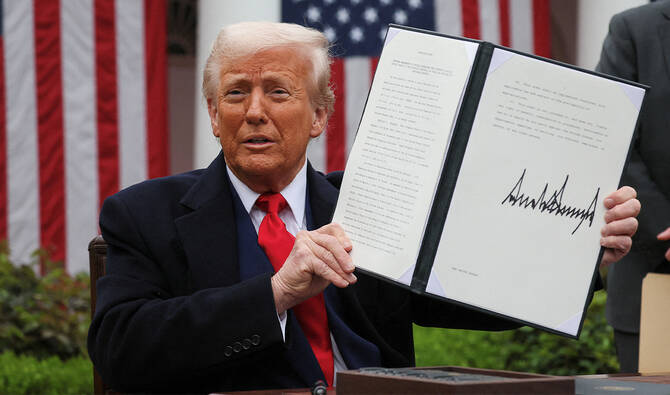
Trump held up boards displaying the new tariff rates, ranging from 10% to 49% for most countries. He said that in most cases, the US was imposing about half the tariff rates that other countries charge, though in some instances the rates were matched exactly.
With input from Reuters


![]()

Trump targets Pakistan with 29 percent tariff as part of new trade policy
Short Url
https://arab.news/vxprf
Trump targets Pakistan with 29 percent tariff as part of new trade policy
- US is a key market for Pakistani exports, with bilateral trade estimated at $7.3 billion in 2024
- US has also slapped a 26% reciprocal tariff on India, dashing New Delhi’s hopes of tariff relief


Latest updates


© 2026 SAUDI RESEARCH & PUBLISHING COMPANY, All Rights Reserved And subject to Terms of Use Agreement.